30 Articles
Sorted by publication date
 AI Tools
how to make a persuasive speech outline Ultimate Guide
Learn exactly how to make a persuasive speech outline with our step-by-step 2026 guide. Includes templates, infographics, examples, and a free AI outline generator tool.
 AI Tools
How to Write an Informative Speech Outline Step-by-Step Guide
Learn how to write an informative speech outline with step-by-step guidance, templates, real examples, structure tips, and a free AI outline generator that builds yours instantly.
How to Start a Critical Analysis Essay Hooks, Structure, Examples & Free AI Tool
Learn exactly how to start a critical analysis essay with powerful openings, thesis writing tips, real examples, step-by-step guidance, and a free AI essay generator.
 AI Tools
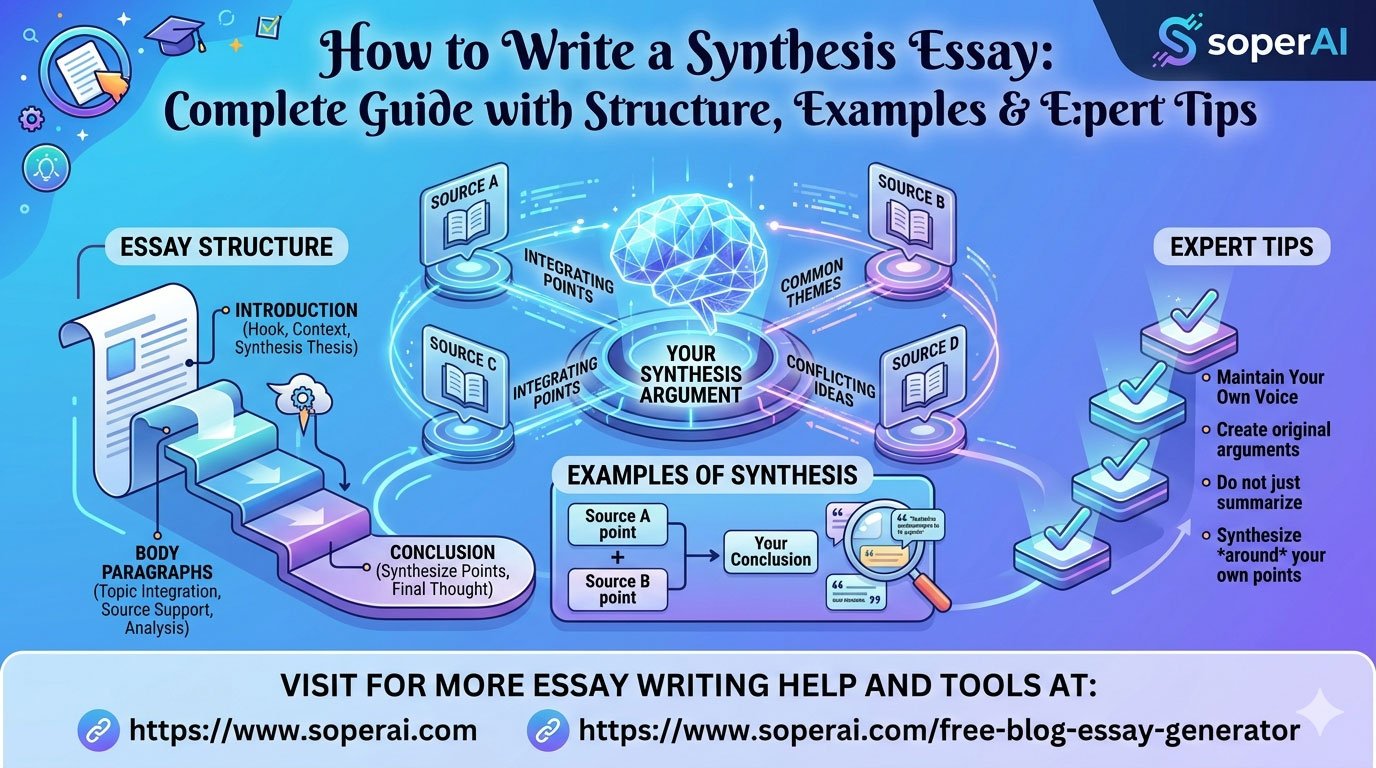
How to Write a Synthesis Essay: Complete Guide with Structure, Examples & Expert Tips
Learn how to write a synthesis essay step by step. Covers synthesis essay structure, thesis writing, source integration, AP Lang tips, examples, and free AI writing tools
 AI Tools
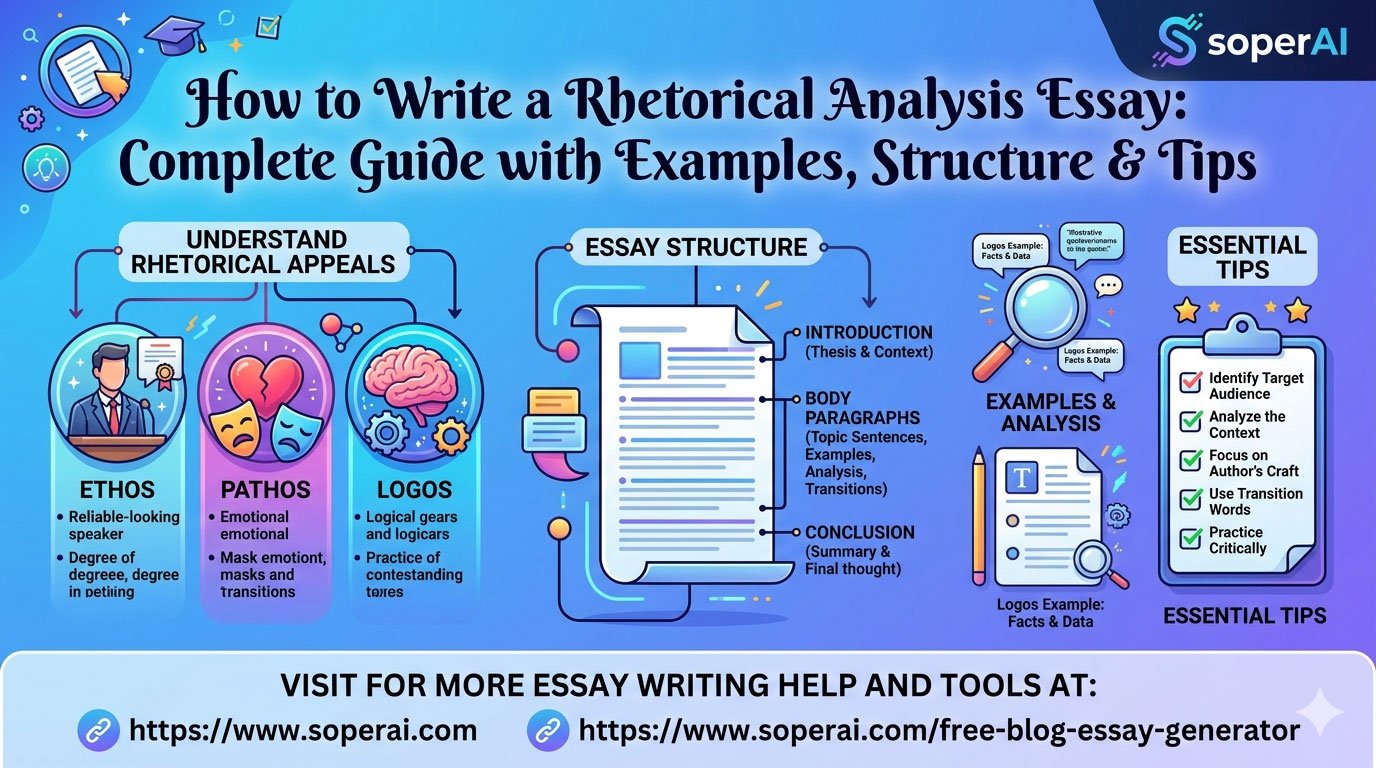
How to Write a Rhetorical Analysis Essay, Complete Guide with Examples, Structure & Tips
Learn how to write a rhetorical analysis essay step by step. Covers ethos, pathos, logos, essay structure, examples, SOAPSTone method, and free AI writing tools.
 AI Tools
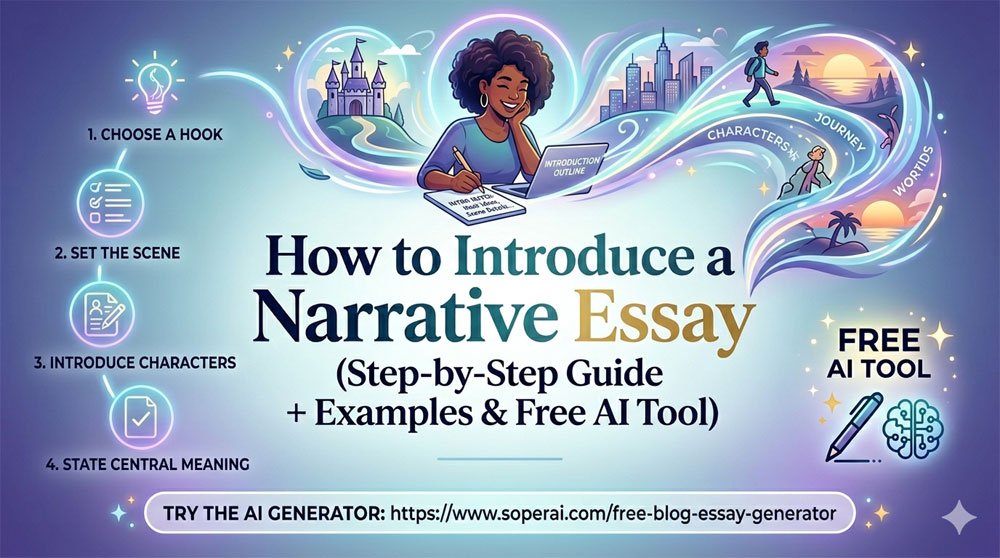
How to Introduce a Narrative Essay
Research in reader psychology consistently shows that people decide within the first few sentences whether a piece of writing is worth their time. For a narrative essay, this pressure is even more acute. Unlike an argumentative essay where readers come for information, narrative essay readers come for an experience — and your introduction is the door through which they enter that experience.
 AI Tools
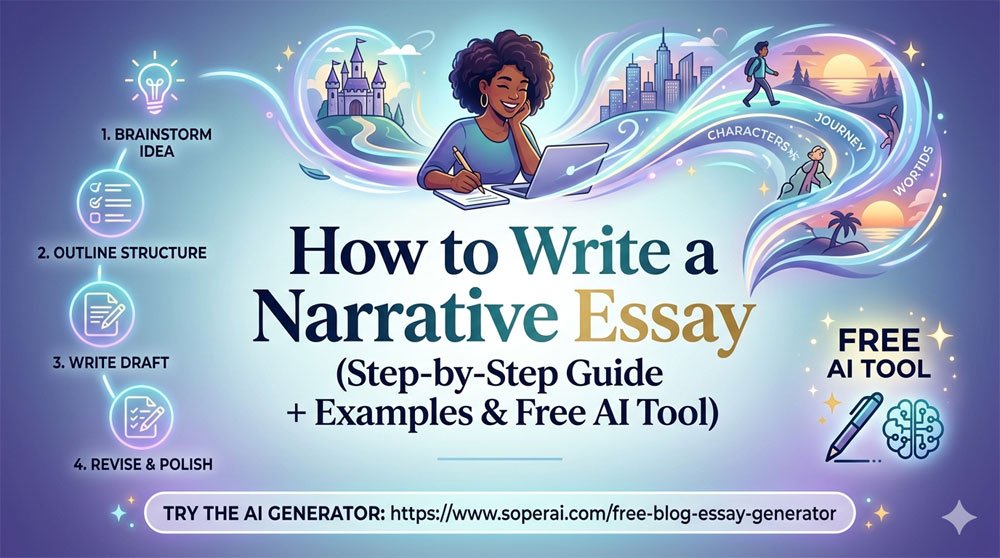
How to Write a Narrative Essay (Step-by-Step Guide + Examples & Free AI Tool)
You have a story inside you. Maybe it's the night you got lost in a foreign city, the moment you stood up for yourself, or a single conversation that changed everything. A narrative essay is your chance to transform that raw experience into a piece of writing that moves, teaches, and resonates with readers.
 AI Tools
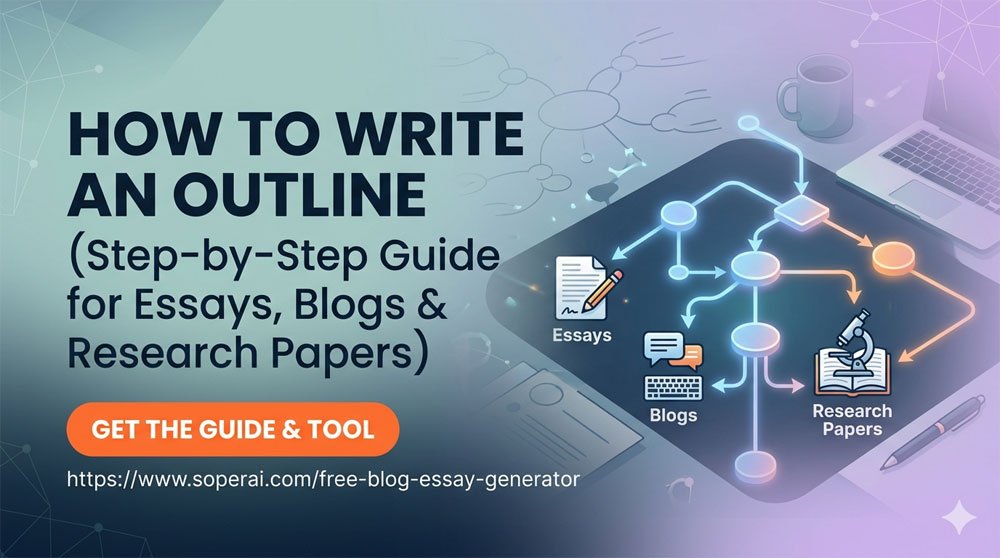
How to Write an Outline Step-by-Step Guide for Essays, Blogs & Research Papers
Have you ever sat down to write an article, essay, or research paper and found yourself staring at a blank screen for 20 minutes, not knowing where to begin? Or maybe you got halfway through a piece, realized it was going in circles, and had to scrap everything and start over? If so, you are not alone — and there is a surprisingly simple solution that most experienced writers never skip
 AI Tools
Clothing Description Generator: The Complete Guide to AI-Powered Fashion Copy
Fashion × AI × 2025 Clothing Description Generator: The Complete Guide to AI-Powered Fashion Copy Stop staring at a blank screen. Learn how AI clothing description generators can write compelling, SEO-ready product copy in seconds — and which free tool works best for fashion sellers in 2025. ⏱ 18 min read 📅 Updated June 2025 👗 Fashion eCommerce 🤖 AI Tools Guide ✨ Try the Free Clothing Description Generator → 📋 Table of Contents 1. What Is a Clothing Description Generator? 2. Why Product Descriptions Matter 3. How AI Clothing Generators Work 4. Key Benefits for Fashion Sellers 5. Types of Clothing Descriptions You Can Generate 6. Tool Comparison Table 7. SEO Optimization for Fashion Copy 8. Pro Tips & Best Practices 9. Before & After Examples 10. FAQ Why Fashion Sellers Can't Ignore AI Copywriting Key statistics every clothing store owner should know 87% of shoppers say product descriptions influence their buying decision 78% of fashion eCommerce stores report higher conversions after improving descriptions 5× faster content production with AI vs. writing manually 40% reduction in product return rates when descriptions are detailed and accurate 👗 What Is a Clothing Description Generator? A clothing description generator is an AI-powered tool that automatically writes product descriptions for fashion items — things like dresses, jackets, jeans, shoes, accessories, and more. You give it a few basic inputs (item name, fabric, color, key features), and it outputs polished, conversion-ready copy in seconds. Think of it like having a professional fashion copywriter on-demand, except it costs nothing and never has writer's block. For online clothing brands — whether you're running a boutique Shopify store, selling on Etsy, listing on Amazon Fashion, or managing a large-scale eCommerce catalog — writing fresh, SEO-optimized descriptions for every single product is one of the most time-consuming tasks. A good AI generator solves that instantly. 💡 Quick Definition A clothing description generator uses Large Language Models (LLMs) trained on fashion data to produce human-quality product copy, headlines, bullet points, and metadata based on your product specs. Tools like SoperAI's Free Product Description Generator let you do this instantly, for free, with no login needed. Modern clothing description generators don't just throw words together. They understand fashion terminology — "relaxed fit," "breathable modal fabric," "off-the-shoulder silhouette" — and craft copy that speaks directly to your target customer. They know the difference between describing a streetwear hoodie and a luxury cashmere blazer. These tools are built on the same foundational AI technology used by global retailers, but they're now accessible to anyone — from solo sellers on Depop to mid-size brands on WooCommerce. 📈 Why Product Descriptions Matter More Than You Think When someone walks into a physical clothing store, they can touch the fabric, try the item on, and ask a sales associate questions. Online, you don't get any of that. Your product description is the sales associate. It's the fitting room. It's the fabric swatch. It's everything. Weak descriptions don't just fail to convert — they actively drive customers away. If someone can't clearly picture wearing your product, they leave. If your copy reads like a generic warehouse listing, they don't trust you. If you're missing key details, they'll go find them on a competitor's page. 🛒 Conversion Detailed descriptions reduce purchase hesitation and move customers from browsing to buying. 🔍 SEO & Discovery Google indexes your descriptions. Rich, keyword-loaded copy helps customers find you organically. ↩️ Fewer Returns When shoppers know exactly what they're buying (fit, material, care), returns drop significantly. According to research by Shopify, product descriptions are among the most critical on-page elements for both SEO rankings and conversion rates in eCommerce. This is doubly true for fashion, where emotional connection to a product is everything. The challenge is scale. If you have 200 products in your catalog, writing a unique, compelling description for each one is a full-time job. If you're adding seasonal collections, it never ends. That's exactly the problem AI writing tools are built to solve. And if you need broader writing help beyond product descriptions, check out SoperAI's full suite of free AI writing tools — covering everything from blog posts to landing page copy. ⚙️ How Does an AI Clothing Description Generator Work? It sounds like magic, but the mechanics are actually pretty straightforward once you break them down. Here's what's happening under the hood when you use a tool like SoperAI's free generator: 1 You Enter Your Product Details You type in your product name, category (dress, jacket, etc.), material, color, key features, and target audience. The more detail you give, the better the output. 2 AI Processes Your Input The LLM analyzes your inputs against patterns learned from millions of fashion product pages, copywriting guides, and conversion data. It understands fashion-specific language naturally. 3 Output Is Generated You get a fully written product description — typically including a headline, body paragraph, and bullet points — in 10–30 seconds. 4 You Refine & Publish Copy the output to your store, tweak a word or two to match your brand voice, and you're done. No more blank-page anxiety. The best tools — like SoperAI's free product description generator — are also trained to naturally incorporate SEO keywords. So your generated copy doesn't just read well; it also helps search engines understand what your product page is about. For fashion brands that also need descriptive names or branding copy, tools like the Clothing Store Name Generator on SoperAI can help you round out your brand identity alongside product copy. 🚀 Key Benefits of Using a Clothing Description Generator Whether you're a one-person boutique or a growing fashion brand, here's exactly how an AI clothing description generator changes the game: ⚡ Speed at Scale Write a full product description in under 30 seconds. If you have 500 SKUs, that's potentially 60+ hours of writing saved every season. Even large catalog updates take an afternoon instead of months. 💰 Cost Savings Freelance fashion copywriters charge $50–$150 per product description. AI tools do it for free. That's not a small saving — for a 200-product catalog, you're looking at $10,000–$30,000 worth of work done instantly. 🎯 Consistent Brand Voice When descriptions are written by multiple people or during busy seasons, quality varies wildly. AI tools produce consistent tone and style across your entire catalog — keeping your brand looking polished and professional. 🔍 Built-In SEO Good AI tools naturally weave in relevant keywords like fabric types, seasonal terms, and style descriptors — all without keyword-stuffing. Your pages rank higher and attract more organic traffic from shoppers actively searching for what you sell. 🌍 Multilingual Ready Many AI generators can produce descriptions in multiple languages — a huge advantage if you sell internationally. No expensive translation agencies needed for your core product copy. 🔄 Easy Iteration Not happy with the first draft? Just regenerate. You can test different styles, tones, and angles in seconds until you find what performs best for your specific audience and product category. 👚 Types of Clothing Descriptions You Can Generate A clothing description generator isn't one-size-fits-all in terms of output. Depending on where you need the copy and what your products are, you'll want different formats. Here's what the best tools can handle: 👗 Dresses & Gowns Evening wear, casual dresses, maxi dresses, mini skirts, formal gowns 🧥 Outerwear Jackets, coats, blazers, parkas, windbreakers, trench coats 👕 Tops & Shirts T-shirts, blouses, hoodies, polos, graphic tees, tank tops 👖 Bottoms Jeans, trousers, shorts, skirts, leggings, joggers 👟 Footwear Sneakers, heels, boots, sandals, loafers, athletic shoes 💍 Accessories Bags, belts, scarves, jewelry, hats, sunglasses 🩱 Activewear Sports bras, compression tights, gym shorts, athletic hoodies 🎽 Underwear & Lingerie Bras, underwear, loungewear, sleepwear, robes Beyond clothing categories, these tools can also produce different formats of descriptions: Short product blurbs — 50–80 words for mobile-first product listings Long-form descriptions — 150–300 words for SEO-heavy product pages Feature bullet points — Scannable lists of key specs and selling points Meta descriptions — 155-character summaries for search engine result pages Social media captions — Punchy copy for Instagram, TikTok, Facebook product posts Email copy — Product highlights for newsletters and promotional emails 📊 AI Clothing Description Tools: Comparison Table There are several AI tools in the market for generating clothing and product descriptions. Here's how they compare across the factors that matter most: Tool Free Plan No Login Fashion-Specific SEO Optimized Output Quality Speed SoperAI ⭐ ✅ ✅ ✅ ✅ ★★★★★ ⚡ Fast Copy.ai ⚠️Limited ❌ ⚠️ ⚠️ ★★★★ Moderate Jasper AI ❌ ❌ ⚠️ ✅ ★★★★★ Fast Writesonic ⚠️25 credits ❌ ⚠️ ✅ ★★★★ Fast ChatGPT (manual) ⚠️ ❌ ❌ ❌ ★★★ Slow (manual) ⭐ Recommendation: For fashion sellers who want a free, no-login, fast solution with fashion-aware output, SoperAI's free generator is the clear choice. It's purpose-built for product descriptions, requires zero account setup, and produces copy that's ready to publish. 🔍 SEO Optimization: Making Your Fashion Copy Rank Getting your clothing description to rank on Google is a science in itself. Here's what separates high-ranking fashion product pages from the ones buried on page 7: Semantic Keywords Instead of stuffing "blue dress" five times, write naturally about "navy blue midi dress," "cocktail attire," "evening wear" — Google's semantic understanding rewards contextual richness. Long-Tail Intent Target phrases like "oversized linen shirt for summer beach" rather than just "linen shirt." Specific queries convert better and are easier to rank for. Fabric & Material Terms Shoppers search for "100% organic cotton," "merino wool," "recycled polyester." Including exact material names drives highly targeted, purchase-ready traffic. Fit & Size Language Terms like "relaxed fit," "plus size," "petite," "slim cut," or "oversized" add search relevance while also helping shoppers self-qualify before purchasing. Occasion & Season Mention where and when something can be worn — "wedding guest dress," "office-appropriate," "summer festival outfit," "winter coat for cold climates." This matches real search intent. Unique Value Propositions Describe what makes your product different — "handcrafted in Italy," "limited edition print," "ethically sourced." These build authority with both Google and customers. What a Well-Optimized Fashion Description Looks Like Example Output Midnight Linen Midi Dress — Relaxed Fit Summer Dress Effortless warm-weather style meets everyday comfort in this breathable 100% linen midi dress. Cut in a relaxed, slightly oversized silhouette, it moves beautifully whether you're at a summer brunch, beach wedding, or farmers' market. The button-front closure adds a touch of casual elegance, while the deep side pockets make it as practical as it is pretty. Material: 100% breathable European linen Fit: Relaxed/oversized — size down for a more fitted look Length: Midi (hits just below the knee) Features: Button-front, deep pockets, slightly A-line hem Best for: Summer weddings, garden parties, casual Fridays ↑ Notice how this naturally includes keywords (linen, midi dress, relaxed fit, summer, oversized) without ever feeling forced. AI generators like SoperAI's free tool are trained to write exactly in this style — semantically rich, naturally keyword-inclusive, and structured for both human readers and search engines. For more SEO content help, also check out the AI Blog Generator and Free Outline Generator on SoperAI. 💎 Pro Tips for Getting the Best Output AI tools are powerful, but like any tool, the quality of what you get depends on how you use them. Here are some tried-and-tested techniques from experienced fashion sellers: 🎯 Tip 1: Be Specific With Materials Instead of just "cotton shirt," write "60% organic cotton / 40% recycled polyester, 180gsm jersey." The more specific your inputs, the more technically accurate and trustworthy your output will sound. 🧑💻 Tip 2: Define Your Audience Tell the tool who this is for. "Athletic women aged 25–35 who prioritize performance and style" produces very different copy than "budget-conscious college students." Audience context transforms generic copy into targeted copy. ✍️ Tip 3: Mention the Occasion or Use Case Add context like "perfect for office wear," "designed for outdoor festivals," or "ideal for postpartum comfort." This helps the AI write emotionally resonant copy that matches real purchase intent. 🔤 Tip 4: Specify Your Brand Tone Add a tone instruction like "write in a luxurious, aspirational tone" or "keep it fun and casual." This ensures your AI copy matches your existing brand voice instead of sounding generic. 🔁 Tip 5: Regenerate & A/B Test Generate 2–3 versions of the same product description and test them. Small wording changes can significantly impact conversion. Track click-through rates and add-to-cart events to find your winners. 🔍 Tip 6: Always Do a Final Human Edit AI output is a first draft, not a final draft. Spend 60 seconds reading through and swapping any word that feels off. Check that size/fit information is accurate. Add any unique selling points the AI missed. This small edit step makes the difference between good and great copy. 📝 Before & After: Real Clothing Description Transformations The difference between a weak description and a great one isn't about fancy words — it's about specificity, emotion, and clarity. Here are three real-world examples: Example 1: Women's Denim Jacket ❌ Before (Weak) "Women's denim jacket. Blue color. Size S, M, L, XL. Machine washable." ✅ After (AI-Generated) "The jacket that goes with everything. This classic medium-wash denim jacket features a relaxed fit, vintage-inspired stitching, and just the right weight for transitional seasons. Layer it over a sundress for a casual summer look or throw it over a cozy sweater when temperatures drop. Machine washable for everyday ease. Available in S–XL." Example 2: Men's Running Shoes ❌ Before (Weak) "Men's running shoes. Lightweight. Good for running. Sizes 7–13." ✅ After (AI-Generated) "Built for the miles ahead. These men's running shoes feature a responsive foam midsole that absorbs impact without sacrificing speed, a breathable knit upper that keeps feet cool on long runs, and a grippy rubber outsole engineered for both road and trail. Weighing in at just 245g per shoe, they feel almost weightless mid-stride. Available in sizes 7–13." Example 3: Luxury Cashmere Scarf ❌ Before (Weak) "Cashmere scarf. Soft and warm. Multiple colors. Great gift idea." ✅ After (AI-Generated) "Pure luxury, woven in. Crafted from Grade A Mongolian cashmere, this oversized scarf wraps you in cloud-like softness that gets better with every wash. The generous 200cm length means you can style it as a wrap, a shawl, or a classic neck scarf. A timeless gift for people who appreciate quality. Available in 12 rich, seasonal colors." 💡 All three "After" examples were generated using an AI clothing description tool in under 30 seconds. The difference is night and day — and the after versions will dramatically outperform the before versions on both SEO and conversion rates. Try generating your own → 🛍️ Platform-Specific Clothing Description Strategies Not all platforms are the same. Here's how to tailor your AI-generated descriptions based on where you're selling: 🛒 Shopify Focus on storytelling in the main description. Use H2/H3 headers for "Key Features" and "Size Guide" sections. Integrate Shopify's SEO fields (meta title, meta description) with keyword-rich AI-generated text. 📦 Amazon Fashion Lead with bullet points. Amazon shoppers scan fast. Use all 5 bullet point slots with features + benefits. The product title matters most for search — pack it with relevant terms. 🧵 Etsy Etsy shoppers love handmade stories. Add context about materials, inspiration, or your making process. Etsy's search algorithm rewards listings that include size, color, occasion, and style terms naturally in the text. 📱 Instagram/TikTok Shop Short-form copy wins. Focus on the hook — the one irresistible thing about the product. Add sizing + care info as bullet points. Match the energy of your audience (playful for Gen Z, polished for millennial professionals). 🧰 More Free Tools for Fashion Sellers Looking beyond product descriptions? SoperAI has a full suite of free AI tools for clothing brands: 👗 Product Description Generator Write compelling descriptions instantly 🏪 Clothing Store Name Generator Find the perfect brand name 💬 Slogan Generator Craft a memorable brand tagline 📄 Landing Page Copy Convert visitors into customers 🔄 Content Rewriter Refresh old descriptions instantly 🤖 All Free AI Tools Explore 100+ free tools { "@context": "https://schema.org", "@type": "FAQPage", "mainEntity": [ { "@type": "Question", "name": "Is a free clothing description generator actually good enough for professional use?", "acceptedAnswer": { "@type": "Answer", "text": "Yes — when you pick the right tool. Free tools like SoperAI's generator use the same underlying AI technology as paid tools, just without the subscription fee. The key is giving the tool good inputs and doing a quick final edit on the output." } }, { "@type": "Question", "name": "Will AI-generated clothing descriptions get penalized by Google?", "acceptedAnswer": { "@type": "Answer", "text": "Not if the content is genuinely helpful. Google's Search Essentials guidelines focus on content quality, not content origin. AI-generated descriptions that are accurate, unique, and helpful to shoppers will rank just fine. The risk only comes when you publish low-quality, repetitive, or misleading AI content at scale without any human review." } }, { "@type": "Question", "name": "How many product descriptions can I generate for free?", "acceptedAnswer": { "@type": "Answer", "text": "SoperAI's free product description tool requires no login and has generous usage limits — enough for most small to mid-size clothing catalog needs." } }, { "@type": "Question", "name": "Can I use AI for luxury or high-end fashion brands?", "acceptedAnswer": { "@type": "Answer", "text": "Absolutely. The key is adjusting your tone input. Specifying 'luxury, aspirational, editorial tone' or providing examples of your existing copy gives the AI a clear direction. Many luxury fashion brands already use AI for first-draft copy." } }, { "@type": "Question", "name": "Does it work for vintage or secondhand clothing?", "acceptedAnswer": { "@type": "Answer", "text": "Yes! For secondhand items, just include details like 'vintage 90s,' 'pre-owned condition,' 'slight fading on collar' — the AI handles these nuances well and can write honest, compelling descriptions for resale platforms like Depop, ThredUp, or Poshmark." } }, { "@type": "Question", "name": "What platforms can I use the generated descriptions on?", "acceptedAnswer": { "@type": "Answer", "text": "Anywhere you sell — Shopify, WooCommerce, BigCommerce, Amazon, Etsy, eBay, ASOS Marketplace, Instagram Shop, TikTok Shop, Depop, your own website, or email newsletters. The output is plain text you can paste anywhere." } }, { "@type": "Question", "name": "How do I make AI clothing descriptions sound more like my brand?", "acceptedAnswer": { "@type": "Answer", "text": "Include your brand tone in the input prompt. Phrases like 'write in a playful, gen-Z tone' or 'use a refined, minimalist luxury voice' steer the output significantly. You can also paste one or two examples of existing copy you love and ask the tool to match that style." } }, { "@type": "Question", "name": "Can a clothing description generator write in multiple languages?", "acceptedAnswer": { "@type": "Answer", "text": "Yes. Most modern AI description tools can generate copy in Spanish, French, German, Arabic, and many other languages. Simply specify the target language in your input or follow up by asking the tool to translate the output." } }, { "@type": "Question", "name": "How long should a clothing product description be?", "acceptedAnswer": { "@type": "Answer", "text": "For SEO purposes, aim for 150–300 words for your main product description. Include 3–5 bullet points for quick scanning. Short descriptions under 75 words tend to rank poorly, while overly long ones (500+ words) can feel like padding unless the product genuinely needs the detail." } }, { "@type": "Question", "name": "Is AI clothing description writing ethical and legal to use commercially?", "acceptedAnswer": { "@type": "Answer", "text": "Yes. AI-generated text is legally yours to use for commercial purposes when produced by tools like SoperAI. There are no copyright restrictions on the output. Always review the specific terms of the tool you use, but for general product copy, AI-generated content is fully cleared for commercial use." } } ] } ❓ Frequently Asked Questions Everything you need to know about AI clothing description generators — answered. 10 Questions Answered Schema Markup Included Google Rich Snippet Ready Q1 Is a free clothing description generator actually good enough for professional use? Yes — when you pick the right tool. Free tools like SoperAI's generator use the same underlying AI technology as paid tools costing $50–$100/month, just without the subscription fee. The key is giving the tool detailed, specific inputs and spending 60 seconds on a final human review. Most professional sellers find free AI output is 80–90% publish-ready straight away. Q2 Will AI-generated clothing descriptions get penalized by Google? No — not if the content is genuinely helpful and accurate. Google's Search Essentials guidelines evaluate content quality and user value, not how it was produced. Thousands of eCommerce stores already use AI-written product descriptions that rank on page one. The risk only arises when you mass-publish thin, repetitive, or inaccurate AI content without any editorial oversight — so always do a quick read-through before hitting publish. Q3 How many product descriptions can I generate for free on SoperAI? SoperAI's free product description tool requires no login, no credit card, and no account creation. You can generate descriptions immediately with generous daily limits — more than enough for small boutique owners, seasonal catalog updates, or testing the tool before scaling. For large-scale catalog work (hundreds of SKUs), visit the tool page to see current usage details. Q4 Can I use AI for luxury or high-end fashion brands? Absolutely. AI generators handle luxury tone extremely well when you guide them. In your input, specify phrases like "write in an aspirational, editorial tone — think Vogue or Net-a-Porter" or paste a sample of your existing brand copy and ask for it to be matched. Many established luxury fashion brands already use AI for first-draft copy, with human editors adding the final brand storytelling layer. The result is faster output with no compromise on quality. Q5 Does a clothing description generator work for vintage or secondhand items? Yes, and it works really well for this. For vintage or pre-owned items, include condition details in your input — things like "light wear on cuffs," "vintage 1990s cut," "original tags intact." The AI will craft honest, characterful descriptions that suit platforms like Depop, Poshmark, ThredUp, eBay Fashion, and Vinted. Authentic condition language actually builds buyer trust and reduces disputes. Q6 What platforms can I use the generated descriptions on? Anywhere and everywhere you sell. The output is plain, copy-paste-ready text that works on Shopify, WooCommerce, BigCommerce, Squarespace, Wix, Amazon, Etsy, eBay, ASOS Marketplace, Instagram Shop, TikTok Shop, Depop, Poshmark, your own website, email newsletters, and more. There are no platform restrictions — if you can type into a text box, you can use AI-generated descriptions there. Q7 How do I make AI clothing descriptions sound more like my brand? Three techniques work best. First, add explicit tone instructions — phrases like "playful and irreverent, targeting Gen Z women" or "clean and minimal, Scandinavian aesthetic." Second, paste 1–2 examples of descriptions you already love and ask the AI to write in a similar style. Third, include your brand's unique values — e.g., "sustainability-first, ethically made in Portugal" — so those differentiators weave naturally into the copy. For brand-level copywriting beyond products, try SoperAI's Landing Page Copy tool. Q8 Can a clothing description generator write in multiple languages? Yes. Most modern AI tools — including SoperAI — can produce descriptions in Spanish, French, German, Italian, Portuguese, Arabic, Urdu, Hindi, Japanese, and many other languages. You can either specify the language upfront in your input ("write in French") or paste the English output and ask for a translation. This is a massive time-saver for international fashion brands that previously needed separate translation agencies for product copy. Q9 How long should a clothing product description be for SEO? For most fashion product pages, aim for 150–300 words in the main description body, supported by 3–5 bullet points for scannability. Descriptions under 75 words tend to lack the keyword density needed to rank well, while anything over 500 words can feel like padding unless it's a hero product with rich storytelling value (like a signature coat or limited-edition piece). The sweet spot is ~200 words + bullets — enough for Google, perfect for shoppers. Learn more SEO fundamentals at Moz's On-Page SEO guide. Q10 Is AI clothing description writing legal and ethical for commercial use? Yes, fully. AI-generated product descriptions produced by tools like SoperAI are yours to use commercially with no copyright restrictions on the output. Always check the specific terms of service for any tool you use, but established AI writing platforms universally grant commercial usage rights. From an ethical standpoint, AI-assisted copywriting is widely accepted in the industry — it's a productivity tool, not a replacement for your brand identity or creative direction. The human decisions about product, positioning, and brand values remain entirely yours. Still have questions? Try the tool yourself — no login needed, results in under 30 seconds. ✨ Try It Free → ✨ Ready to Write Better Clothing Descriptions? Join thousands of fashion sellers using SoperAI's free AI generator to produce compelling, SEO-optimized product copy — no login, no credit card, no hassle. 🚀 Generate Free Descriptions 🧰 Explore All Free Tools 📚 Continue Reading SoperAI Blog Browse All AI Guides & Tutorials → soperai.com/blog Shopify Blog ↗ How to Write Product Descriptions shopify.com Moz ↗ Beginner's Guide to SEO moz.com SoperAI · Free AI Tools · Product Description Generator · Blog © 2025 SoperAI. All rights reserved.
 AI Tools
The Complete AI Image to Video Generator Content Hub
S Soperai Blog What Is It? Comparison Full Guide Review Try Free → 🔬 10 SEO-Optimized Blog Posts · Soperai.com The Complete AI Image to VideoGenerator Content Hub Everything you need to know about Soperai.com — the best free AI tool to turn any image into a stunning video in seconds. 🚀 Try AI Video Generator Free Read All 10 Posts ↓ 📋 Table of Contents 1What Is an AI Image to Video Generator? 2Turn Any Photo to Video in 60 Seconds 3Soperai vs Runway vs Pika Labs 410 Creative Business Use Cases 57 Reasons Soperai Is the Best Free Tool 6Complete Guide 2025 7Boring Product Photos? Fix It With AI 8How AI Is Changing Content Creation 9Scroll-Stopping Instagram Reels with AI 10Soperai.com Review 2025 🔍 INFORMATIONAL 8 min read · Updated 2025 What Is an AI Image to Video Generator? (And Why Soperai.com Is Leading the Pack in 2025) Static images are dead for social media. AI is breathing life into every photo — and Soperai.com is at the forefront of this revolution. 🔬 How AI Image-to-Video Technology Works 🖼️ 1. Upload Image JPG, PNG, WEBP — any high-quality photo ✍️ 2. Write Prompt Describe motion: "camera zooms in slowly" ⚡ 3. AI Processes Diffusion model synthesises temporal motion frames 🎬 4. Download Video MP4 export ready for any platform ⚡ Under the Hood — Technology Stack Latent Diffusion Models Temporal Consistency Engine Motion Synthesis AI Frame Interpolation Neural Rendering An AI image to video generator uses advanced machine learning — specifically latent diffusion and temporal motion models — to analyse a static image and generate a smooth, realistic video sequence from it. You upload a photo, describe the motion you want, and the AI handles everything else. Soperai.com is one of the most accessible free tools in this space, offering no-watermark exports, multiple aspect ratios, and cinematic output quality without requiring any technical skills. 📊 Why AI Video Is the Future of Content 80%More engagement than static images 3xHigher conversion rate with video ads 60sAverage generation time on Soperai $0To get started on Soperai free plan Who Should Use Soperai.com? 📸Content CreatorsTurn photography portfolios and brand visuals into engaging Reels, TikToks, and YouTube Shorts without video production experience. 🛒E-commerce SellersAnimate product photos to create compelling video ads for Facebook, Instagram, and TikTok Shop — no videographer required. 📢Marketers & AgenciesScale video content production across multiple clients and campaigns using one powerful free AI tool. 📚EducatorsAnimate diagrams, historical photos, and scientific illustrations to make lessons more engaging and visually memorable. ❓ Frequently Asked Questions Is Soperai.com really free to use?Soperai.com offers a free plan that lets you generate AI videos from images without any upfront payment. Premium plans unlock higher resolution exports and more generation credits. What image formats does Soperai support?Soperai supports JPG, PNG, and WEBP formats. For best results, use images with at least 1024px on the shortest side and well-lit, clear subjects. How long does it take to generate a video?Most videos are generated in 30–90 seconds depending on the selected duration and complexity of the motion prompt. Soperai is optimised for fast generation compared to competitors. Ready to bring your images to life? Try Soperai AI Video Generator Free → 🛠️ HOW-TO TUTORIAL 6 min read How to Turn Any Photo into a Stunning Video in Under 60 Seconds Using Soperai.com The fastest way to create professional-quality video content — no editing experience required. 📋 Step-by-Step Guide 1 Visit Soperai.com and Sign Up FreeGo to www.soperai.com and create your free account in under 30 seconds. No credit card required. 2 Upload Your Image Drag and drop your JPG, PNG, or WEBP file. Best results come from images that are sharp, well-lit, and at least 1024×768px. ✓ Clear subject ✓ Good lighting ✓ High resolution ✗ Blurry images ✗ Very dark photos 3 Write Your Motion Prompt This is the most important step. Your prompt tells the AI what kind of motion to apply. 💡 Prompt Examples That Work Well Product"Slow product rotation, soft studio lighting, subtle depth of field" Portrait"Gentle hair movement, soft breeze, cinematic close-up" Landscape"Slow dolly zoom forward, moving clouds, light rays" 4 Choose SettingsSelect duration (3–10s), aspect ratio (9:16 for Reels, 16:9 for YouTube, 1:1 for feed), and motion intensity. 5 Generate & DownloadHit Generate and wait ~60 seconds. Your video downloads as an MP4 — ready for any platform. Start creating videos from your images right now Open Soperai AI Video Generator → ⚖️ COMPARISON Soperai.com vs Runway vs Pika Labs: Which AI Image to Video Generator Is Best? We tested all three tools with the same images. Here's what we found. 📊 Quick Comparison Table Feature Soperai.com Runway Gen-3 Pika Labs Free plan✓✓✓ No watermark (free)✓✗✗ Generation speed~60s~90–120s~70–100s Max resolution (free)1080p720p720p Aspect ratiosAll majorLimitedLimited Ease of use★★★★★★★★★★★★ Starting priceFree$12/mo$8/mo Best forCreators, marketersFilm professionalsSocial content 🏆 Final Scores 🥇 WINNER Soperai.com 9.4 out of 10 Quality9.5 Speed9.2 Value9.8 Runway Gen-3 8.1 out of 10 Quality9.0 Speed7.0 Value6.5 Pika Labs 7.6 out of 10 Quality8.0 Speed7.5 Value7.0 While Runway Gen-3 produces premium cinematic output, its cost and complexity put it out of reach for most everyday creators. Pika Labs excels for social content but falls short on free-tier exports. Soperai.com delivers the best combination of quality, speed, and value. 💼 BUSINESS USE CASES 10 Creative Ways to Use Soperai.com's AI Image to Video Generator for Your Business Video drives 80% more engagement. Here's how savvy businesses are using Soperai.com to stay ahead. 1Product Showcase VideosAnimate product photos into 360° showcase reels for Shopify, Amazon listings, and Instagram ads. Dramatically higher click-through rates than static images. 2Social Media Reels & ShortsRepurpose existing brand photography into vertical video content for Instagram, TikTok, and YouTube Shorts in minutes — not hours. 3Real Estate Virtual ToursTurn property photography into cinematic walkthroughs that get 40% more time-on-page than static listing photos. 4Event PromotionAnimate event posters and venue photos into dynamic promotional clips that generate 3× more shares than static posts. 5Portfolio AnimationsDesigners, architects, and artists can breathe motion into portfolio images to stand out from the competition. 6Educational ContentAnimate scientific diagrams, historical images, and infographics to make lessons more memorable and engaging for students. 7Paid Ad CreativesCreate video ads for Facebook and Instagram using product photos. Lower CPC and higher ROAS compared to static image ads. 8Email MarketingUse Soperai outputs as animated GIF thumbnails in email campaigns. Video thumbnails boost email click-through rates by up to 65%. 9Personal BrandingAnimate headshots and brand imagery for LinkedIn posts, speaker decks, and personal websites that leave a lasting impression. 10Client PresentationsImpress clients with dynamic video mockups instead of flat image slides. 📝 LISTICLE 7 Reasons Soperai.com Is the Best Free AI Image to Video Generator You Haven't Tried Yet Most creators are still sleeping on this tool. Here's why that's a mistake. 1No Watermarks on Free ExportsUnlike Runway and Pika Labs, Soperai.com lets you download clean, watermark-free videos on the free plan. What you create is truly yours. 2Blazing-Fast Generation — ~60 SecondsMost competitors take 2–3 minutes. Soperai consistently delivers in under 60 seconds, making it the fastest option available as a free AI tool. 3Cinematic Motion QualitySoperai's AI understands natural physics — hair flows naturally, liquids ripple correctly, and camera movements feel organic. The result looks professionally shot. 4Dead-Simple InterfaceUpload, prompt, generate. No timeline editors, no keyframes, no technical knowledge required. If you can use Google Drive, you can use Soperai. 5Flexible Aspect Ratios9:16 for Reels, 16:9 for YouTube, 1:1 for feed posts, 4:5 for ads — all supported. One image, every platform, every format. 6Prompt-Driven CustomisationDescribe exactly what motion you want in plain language. "Slow cinematic zoom with bokeh" or "product spinning with light flares" — the AI delivers. 7Constantly Updated AI ModelsThe team behind Soperai.com ships regular model updates. Quality has improved dramatically — and it keeps getting better. 📖 SEO PILLAR POST 15 min read · Complete Guide The Complete Guide to AI Image to Video Generators in 2025 (Featuring Soperai.com) Everything you need to know — from how the technology works to which tools to use and how to get the best results. 🔬 How the Technology Works AI image-to-video generators use a branch of machine learning called latent diffusion modelling. The model is trained on millions of video clips and learns the relationship between spatial (image) information and temporal (motion) sequences. 2022 — Text-to-Image AI explodesDALL-E, Stable Diffusion, and Midjourney bring AI image generation to the masses 2023 — First image-to-video models emergeRunway Gen-2, Pika Labs, and StableVideo Diffusion launch to early adopters 2024 — Quality leap: cinematic motion arrivesSora, Runway Gen-3, and Soperai.com raise the bar with natural physics simulation 2025 — Real-time generation & mass adoptionSoperai.com among tools offering sub-60s generation, free access, and no watermarks Types of AI Video Generation 📝Text-to-VideoGenerate video from a text description. Best for creative storytelling. BEST VALUE🖼️Image-to-VideoSoperai.com specialises in this — best for marketers and creators. 🎬Video-to-VideoTransform an existing video with new style or motion. Best for post-production. ✅ What to Look for in an AI Image to Video Tool ✓Output Quality — Motion must look natural. Look for tools trained on cinematic datasets. ✓Generation Speed — Sub-60-second generation (like Soperai) lets you iterate quickly. ✓Free Tier — A genuine free plan with no watermarks lets you test before committing. ✓Aspect Ratio Support — You need 9:16, 16:9, and 1:1 for different platforms. ✓Ease of Use — Tools with steep learning curves cost you time. Simplicity wins for daily use. 💡 Tips for Best Results on Soperai 🖼️ Image QualityUse sharp, high-resolution images (1080p+). Soft or blurry source images produce inconsistent motion. ✍️ Prompt SpecificityBe specific: "slow left-to-right pan with soft bokeh" beats "moving camera". Detail drives quality. 💡 Lighting FirstWell-lit subjects with clear separation from backgrounds produce dramatically better animations. 🔄 Iterate FastTry 3–4 different prompts per image. Soperai's speed makes rapid experimentation practical. ❓ Complete FAQ What makes Soperai.com different from other AI video tools?Soperai.com combines no-watermark free exports, sub-60s generation, and 1080p output — a combination no other free tool offers. Can I use Soperai videos commercially?Yes — Soperai's Terms of Service grant commercial usage rights to videos generated on the platform. This makes it ideal for marketing, advertising, and client work. What AI model does Soperai use?Soperai uses a proprietary temporal diffusion model optimised for natural motion synthesis and image fidelity — regularly updated to improve output quality. How long can generated videos be?Soperai currently generates videos of 3–10 seconds per clip. This is ideal for social media content where under-15-second clips perform best on most platforms. Does Soperai have an AI story generator?Yes — the Soperai AI video generator includes an AI story mode that adds narrative context to your animated images, perfect for storytelling content and branded video series. ⚡ PROBLEM / SOLUTION Tired of Boring Product Photos? Here's How Soperai.com Turns Static Images Into Viral Videos Product photos that don't move don't sell on social media anymore. Here's the fix. 🔄 The Old Way vs The AI Way ✗ Old Way: Hire a Videographer Cost$500–$5,000 TimeDays to weeks IterationsExpensive to redo Scalability1 video at a time Skill neededHigh ✓ Soperai.com AI Way CostFree to start Time~60 seconds IterationsUnlimited, instant Scalability100s of videos/day Skill neededZero 📱 Platform-by-Platform Strategy PlatformAspect RatioDurationMotion Style Instagram Reels9:165–7sDynamic, fast pans TikTok Shop9:166–10sProduct rotation + zoom Pinterest2:3 or 1:14–6sSlow, elegant drift Facebook Ads4:5 or 1:16–8sFeature highlight zoom YouTube Shorts9:168–10sCinematic Ken Burns 📈 TREND ARTICLE How AI Image to Video Generators Like Soperai.com Are Changing Content Creation Forever The content creation revolution isn't coming — it's already here. 📊 AI Video Market Growth 2022 — Early Adopters$0.8B 2023 — Mainstream Discovery$2.4B 2024 — Mass Adoption$5.1B 2025 — Creator Economy Standard$8.8B (est.) We are witnessing a fundamental shift in how content is created, distributed, and consumed. Tools like Soperai.com are democratising video production at a pace that would have seemed impossible just three years ago. 🤖AI-first workflows74% of content teams plan to integrate AI video by 2026 📱Short-form dominanceClips under 15 seconds get 2.5× more shares than longer content 📉Cost collapseVideo creation costs dropped 97% since 2020 for early AI adopters 📱 PLATFORM TUTORIAL How to Create Scroll-Stopping AI Videos for Instagram Reels Using Soperai.com Reels dominate organic reach in 2025. Here's your complete playbook. Instagram Reels now reach 2× more non-followers than any other format. But with millions of creators competing for attention, standing out requires more than just good content — it requires visually distinctive motion. That's exactly where Soperai.com gives you an unfair advantage. 🎯 Proven Reel Prompt Templates 👗Fashion / Lifestyle"Slow upward camera reveal, golden hour light, bokeh background, cinematic 9:16" 🍽️Food & Beverage"Steam rising, slow zoom, warm restaurant lighting, macro detail shot" 🏠Real Estate"Slow dolly forward through front entrance, soft natural light, elegant drift" 💼Business / Personal Brand"Subtle confident movement, professional depth of field, slight hair motion" 📊 Posting Strategy for Maximum Reach ⏰Best TimesTue–Fri, 11am–1pm & 7–9pm (local timezone) #️⃣Hashtag Mix3 large + 5 medium + 5 niche. Use #AIvideo, #Soperai, #aigenerated ✍️Caption HookOpen with a question or bold statement. First 3 words determine your reach. ⭐ REVIEW Soperai.com Review 2025: Is This Really the Best AI Image to Video Generator? We spent two weeks testing Soperai across 50 images. Here's the honest truth. 9.4 Overall Score ★★★★★ Output Quality9.5 / 10 Generation Speed9.2 / 10 Value for Money9.8 / 10 Ease of Use9.6 / 10 Feature Set9.0 / 10 🎉 What We Loved ✓No watermarks on free plan — genuinely rare ✓Sub-60s generation — fastest we tested ✓Natural, physics-aware motion ✓1080p output on free tier ✓Commercial usage rights included 🔧 What Could Improve ⏳Max 10s clips — longer durations coming ⏳Limited audio integration (in development) ⏳No batch processing yet on free plan ⏳Mobile app would be a welcome addition 🎯 Who Is Soperai.com Best For? ✓Solo CreatorsPerfect for YouTube, Reels, TikTok ✓E-commerce BrandsProduct videos at scale ✓Marketing AgenciesMulti-client video production ✓Real Estate AgentsProperty listing videos ⭐ Final Verdict Soperai.com is the best free AI image to video generator available in 2025. The combination of no watermarks, sub-60s generation, 1080p output, and commercial rights on the free plan is unmatched by any competitor. If you create content for social media, sell products online, or want to produce professional video without a production budget — Soperai.com is the tool to use. 🚀 Try Soperai Free Today 🔬 Open AI Video Generator ❓ Review FAQs Is Soperai.com legit and safe to use?Yes, Soperai.com is a legitimate AI platform with a clear privacy policy and terms of service. Your uploaded images are processed securely and not used for training without consent. How many videos can I generate free per month?The free plan includes a generous monthly credit allocation. Visit Soperai.com to see the current limits — they are regularly updated as the platform grows. Does Soperai work on mobile?Soperai.com is web-based and works on mobile browsers. A dedicated mobile app is currently in development. What's the AI story generator feature?The AI story generator on Soperai allows you to chain multiple animated images into a narrative video sequence — ideal for brand storytelling, product journeys, and educational content. S Soperai.com The best free AI image to video generator. Transform any photo into a cinematic video in seconds. 🏠 Home 🔬 AI Video Generator Back to Top ↑ © 2025 Soperai.com · All Rights Reserved · Free AI Tools document.querySelectorAll('details').forEach(d => { d.addEventListener('toggle', function() { if (this.open) { document.querySelectorAll('details').forEach(other => { if (other !== this) other.removeAttribute('open'); }); } }); });
 AI Tools
What Is an AI Advertisement Video Generator and How Does It Work? A Beginner's Guide
Soperai AI Video Generation Ad Video Guide Video Advertising · AI Tools · 2026 Beginner's Guide What Is an AI Advertisement Video Generator and How Does It Work? A Beginner's Guide Video ads are the highest-ROI format in digital advertising â but producing them has always required a film crew, an editor, and a budget that most businesses simply do not have. In 2026, Soperai's AI Advertisement Video Generator changes that equation permanently â turning a text brief into a broadcast-quality ad in under two minutes, for any platform, at any scale. ~15 min read 5,500+ words SEO Optimized Updated 2026 Table of Contents What Is an AI Ad Video Generator? Why Video Ads Dominate in 2026 How the Technology Works Platform-by-Platform Ad Guide Step-by-Step Tutorial Use Cases & Industries Soperai vs. Competitors FAQ 300+ Ad Video AI Models 6 Major Ad Platforms Supported <2min From Brief to Finished Ad Free To Start â No Card 4K Max Export Resolution SECTION 01 Foundations What Is an AI Advertisement Video Generator? An AI advertisement video generator is a software platform that uses artificial intelligence to automatically produce finished, broadcast-quality video ads from a text brief, product description, URL, or set of brand assets. Instead of hiring a production company, booking studio time, and waiting days for an edited cut, you describe what you want â the product, the audience, the message, the platform â and the AI produces a complete advertisement in minutes. The category has grown explosively because it solves one of the oldest problems in digital marketing: the gap between knowing you need video advertising and being able to afford or produce it at the pace and volume that modern online video advertising requires. Think with Google reports that businesses running video ads alongside search campaigns see 20% higher conversion rates â yet 47% of small and medium businesses cite production cost and complexity as the primary reason they have not adopted video advertising. Soperai's AI Advertisement Video Generator â part of the platform's broader toolkit of free AI tools â eliminates this barrier. It supports every major advertising format: YouTube ads, Facebook video ads, Google ads video, Instagram Reels ads, TikTok ads, and short video ads for programmatic display networks. The platform's 300+ specialized AI models understand the unique requirements of each format â the technical specifications, the psychological patterns of effective ad creative, and the platform-specific algorithm signals that determine whether your ad gets served or buried. This guide covers everything a beginner needs to understand: what the technology actually does, how it works under the hood, how to use it effectively for each advertising platform, and what results businesses are seeing when they replace traditional production with AI-generated ad video at scale. The Evolution of Video Advertising Production 1990s TV Commercial Era $50,000+ per 30-second spot. Film crews, directors, post-production houses. Video advertising exclusively for large brands. 2005 YouTube Launch Digital video democratized distribution. But production still required significant skills and equipment â just at lower cost. 2015 Smartphone Video Era Facebook and Instagram video ads launched. Smartphones made filming easier but editing, scripting, and production value still created major barriers. 2022 First AI Video Tools Early AI video generators emerged but produced generic, low-quality outputs unsuitable for paid advertising. The "uncanny valley" problem was severe. 2026 Soperai AI Ad Generator 300+ platform-specific ad models. Broadcast-quality output. Text to finished ad in <2 minutes. Free to start. Every business can now run professional video ads. SECTION 02 Market Context Why Video Ads Dominate Digital Advertising in 2026 Before understanding the technology, it is worth understanding why video ads have become the single most important format in digital advertising â and why the stakes for getting them right have never been higher. The data is unambiguous. According to eMarketer's 2026 Digital Advertising Outlook, online video advertising now represents 52% of all digital ad spend globally â surpassing static display, search, and social image advertising combined for the first time. WordStream's advertising benchmarks show that video ads generate 66% more qualified leads per dollar spent than comparable text or image campaigns across Google and Meta platforms. And LinkedIn's own data shows video content generates 5à more engagement than any other content type on the platform. Online Video Advertising: The Numbers That Matter in 2026 52% of all global digital ad spend is now video â up from 38% just two years ago (eMarketer, 2026) 66% more qualified leads per dollar from video ads vs. text/image campaigns (WordStream) $62B Projected YouTube advertising revenue in 2026 alone â more than Netflix's total revenue 89% of consumers say watching a video convinced them to make a purchase (Wyzowl, 2025) 47% of SMBs cite production cost/complexity as the #1 reason they have not run video ads (Meta Business, 2025) Average ROI by Digital Ad Format (2025 Industry Benchmark) Sources: WordStream, HubSpot, eMarketer The specific formats driving this growth are instructive. YouTube ads â particularly the 15-second non-skippable and 6-second bumper formats â generate the highest brand recall rates of any digital ad format. Facebook video ads produce the most cost-effective lead generation for B2C brands, with CPLs averaging 37% lower than equivalent carousel or static image ads according to Meta Business Insights. Google ads video â particularly video action campaigns â drive purchase intent at a rate 2.3à higher than display ads for the same audience. The challenge is producing enough video creative â across enough formats, platforms, and audience segments â to actually compete in this environment. A sophisticated video ad campaign requires at minimum: a 30-second awareness cut, a 15-second consideration cut, a 6-second bumper, vertical 9:16 cuts for Reels and TikTok, and square 1:1 cuts for in-feed placements. That is 5â8 video edits per campaign concept, multiplied by however many audience segments you are targeting. Traditional production makes this economically impossible for all but the largest brands. Soperai's AI Video Generation tools make it genuinely accessible for everyone. SECTION 03 Technology Deep Dive How Does an AI Advertisement Video Generator Actually Work? For beginners, understanding the technology under the hood makes you a significantly better user of any AI tool â because you understand what inputs the AI needs, what decisions it is making for you, and where to intervene with your own judgment. Here is an accessible breakdown of how Soperai's ad video generation pipeline works, from your brief to the finished video. 1. Brief Interpretation The AI reads your input â product description, URL, bullet points, or full brief â and extracts the key advertising variables: product category, target audience, core value proposition, emotional tone, and call-to-action goal. This NLP layer determines everything that follows. 2. Platform-Specific Model Routing Soperai's model router selects from 300+ specialized ad video models based on your target platform and objective. A YouTube ads model is trained differently from a Facebook video ads model â different pacing psychology, different caption placement, different CTA timing. Each model embeds these platform-native patterns automatically. 3. Visual & Script Generation Simultaneously, the platform generates the ad script (including hook, body, and CTA), selects or generates the visual assets (stock footage, AI-generated scenes, product mockups, or uploaded brand assets), and designs the motion graphics, lower-thirds, and text overlays that structure the ad. 4. Voice & Audio Synthesis The voiceover is generated by Soperai's neural voice synthesis engine â 70+ languages, multiple speaker styles, and emotional delivery tuning. Background music is selected or generated to match the ad's emotional arc, and sound design (transitions, whooshes, impact sounds) is applied to match the visual cuts. 5. Render & Compliance Check The final render composites all elements â video, audio, graphics, captions â into a finished ad at the correct resolution, aspect ratio, and file format for your target platform. A compliance layer checks for policy violations (ad platform terms, copyrighted music, prohibited claims) before delivery. The Advertising Psychology Built Into Every Model What separates Soperai's AI ad video generator from a simple video editor is that the models have been trained on performance data from millions of successful ad campaigns â meaning they encode advertising psychology directly into their outputs without you needing to know it consciously. Here is what the AI applies automatically: The 3-Second Hook Rule All video ads must capture attention in the first 3 seconds â this is the threshold before viewers can skip a YouTube ad, scroll past a Facebook video, or tap away from a TikTok. Soperai's models always open with a pattern interrupt: a bold visual, a provocative question, or a product-in-use shot before any branding appears. Problem-Solution-CTA Structure The most effective video ads follow a three-act structure: agitate the problem the viewer has, present the product as the solution, and close with a single clear call to action. Soperai's ad models apply this framework to every output, adapted to the emotional register of your specific product category. Subtitle-First Design 85% of social video is watched with sound off (Facebook IQ). Soperai's models design the visual narrative to be comprehensible without audio â every video ad generates prominent animated captions that tell the story even in a silent scroll context, a critical advantage for Facebook video ads and short video ads on mobile. Platform-Native Pacing A 30-second YouTube ad has different ideal cut pacing than a 15-second Google ads video or a 6-second bumper. Soperai's platform-specific models have been trained on the performance data for each format and apply the correct pacing â visual cut frequency, information density, and CTA timing â automatically. SECTION 04 Platform Guide Platform-by-Platform Guide: Creating AI Video Ads for Every Channel Each advertising platform has its own technical specifications, audience behavior patterns, and creative best practices. Soperai's 300+ model library includes dedicated models for each major platform. Here is what you need to know about creating video ads for each one. Platform Ad Format Ideal Length Aspect Ratio Best For Avg. CPM YouTube Skippable, Non-skip, Bumper, In-feed 6â30s 16:9 / 9:16 Brand awareness, product launches, remarketing $3â$10 Facebook In-feed, Reels, Stories, Instant Articles 15â60s 1:1 / 9:16 Lead generation, e-commerce, local business $8â$14 Google Ads Video Action, Discovery, Performance Max 15â30s 16:9 primary Purchase intent, app installs, direct response $4â$9 Instagram Reels, Stories, In-feed, Explore 7â30s 9:16 / 1:1 Discovery, brand building, product showcase $6â$13 TikTok In-feed, TopView, Brand Takeover, Spark 9â60s 9:16 only Gen Z audiences, viral reach, app downloads $5â$10 LinkedIn Sponsored Content, Message Ads, Events 15â30s 16:9 / 1:1 B2B lead gen, recruitment, thought leadership $26â$50 YouTube Ads: The World's Largest Video Ad Platform YouTube ads reach 2.5 billion logged-in users monthly, making them the largest video advertising audience in history. The platform supports four primary ad formats, each requiring a distinct creative approach. Soperai's YouTube ad models understand these distinctions natively: Skippable In-Stream (5s+ skip) Can be up to 3 minutes, but the first 5 seconds must be so compelling viewers choose not to skip. Soperai's YouTube models front-load the brand benefit and create an open loop that motivates watch-through. Best for storytelling and product demonstrations. Non-Skippable In-Stream (15â20s) No skip option â maximum viewer attention, maximum creative accountability. Soperai generates tight, punchy 15-second ads that deliver the brand message and CTA within the window without feeling rushed. Best for product launches and high-intent remarketing. Bumper Ads (6s) Six-second non-skippable ads. Soperai's bumper models are trained specifically on high-performing 6-second creative â one visual idea, one brand moment, one message. Used in combination with longer formats for frequency and brand recall amplification. Facebook Video Ads: The Most Versatile Targeting Platform Facebook video ads offer the most granular audience targeting available in digital advertising â behavioral, demographic, interest, lookalike, and custom audience targeting across 3 billion monthly active users. The creative challenge with Facebook is the muted playback default: because most users scroll with sound off, Soperai's Facebook ad models generate every video with the assumption that the visuals must tell the story completely, with captions as the primary text delivery mechanism and audio as a bonus enhancement for engaged viewers who turn sound on. Google Ads Video: Intent-Based Video Advertising Google ads video â running across YouTube, the Google Display Network, and partner sites â is the most intent-aligned form of video advertising because it can be targeted to users who are actively searching for products or solutions related to your category. Soperai's Google Video Action campaign models are trained on direct-response creative patterns: clear problem identification in the first 5 seconds, product solution demonstration in the middle, and strong CTA with urgency in the final 5 seconds. Video Action campaigns have consistently outperformed all other Google campaign types for cost-per-acquisition across the e-commerce, SaaS, and financial services verticals. SECTION 05 Tutorial Step-by-Step: How to Create Your First AI Video Ad with Soperai Using Soperai's AI Advertisement Video Generator requires no video editing experience, no design skills, and no production equipment. Here is the complete process from account creation to a live advertisement. 1 Sign Up and Access the Ad Video Generator Visit soperai.com and create your free account â no credit card needed. From the dashboard, click on AI Advertisement Video Generator. You will enter the ad studio interface showing a brief input panel, platform selector, and live preview window. Also explore the full AI Video Generation tools suite for additional video formats. Pro tip: Create a Brand Kit first â upload your logo, enter your brand colors, and save your tagline. Every ad video generated will automatically incorporate your brand identity without you needing to specify it each time. 2 Select Your Platform, Ad Format, and Campaign Objective Choose your advertising platform (YouTube, Facebook, Google, Instagram, TikTok, or LinkedIn), then select the specific ad format within that platform (e.g., YouTube skippable in-stream, Facebook in-feed video, Google Video Action), and finally your campaign objective: Awareness, Consideration, or Conversion. These three selections determine which of Soperai's 300+ specialized models is activated for your project. Pro tip: If you plan to run the same campaign across multiple platforms, use the "Multi-Platform Pack" option â Soperai will generate all platform-specific cuts simultaneously: 16:9 for YouTube, 1:1 for Facebook feed, and 9:16 for Reels and TikTok, all from the same brief. 3 Enter Your Ad Brief Fill in the ad brief fields: your product or service name, the target audience (who you are advertising to), the core value proposition (why they should choose you), your call-to-action (what you want viewers to do), and any specific claims, offers, or pricing you want highlighted. You can enter this as structured fields or paste a paragraph of natural language â Soperai's brief parser handles both equally well. Optionally upload product images, existing brand video assets, or paste your product page URL for the AI to reference. Pro tip: The more specific your brief, the better the output. "Software that saves time" produces a generic ad. "Project management software for teams of 5â50 people that reduces meeting time by 30% â targeted at operations managers at SMBs" produces a sharply targeted, high-converting ad. 4 Customize Tone, Style, and Visual Direction Use Soperai's creative direction panel to specify: the emotional tone (Urgent, Warm, Exciting, Professional, Playful), the visual style (cinematic, clean/minimal, documentary, lifestyle, animated), the voiceover style (energetic, conversational, authoritative), and whether you want a real-person presenter/avatar, motion graphics only, or product-footage-focused. These controls ensure the AI's creative choices reflect your brand personality, not a generic default. Pro tip: For short video ads targeting cold audiences (people who have never heard of your brand), use an Emotional or Problem-led tone. For retargeting campaigns (people who visited your site or used your app), use an Urgent or Benefit-led tone â they already know your product, they just need a reason to convert now. 5 Generate, Review, and Iterate Click Generate. In 60â90 seconds, Soperai delivers 3 creative variations â each representing a different hook angle, visual style, or narrative approach. Preview all three in the browser and compare. Use the segment editor to swap individual elements: change the hook of variation 1 with the CTA of variation 2, replace a background scene, adjust caption placement, or re-generate the voiceover in a different style. Export your chosen version in broadcast-quality MP4 at the correct resolution for your target platform. Pro tip: Always launch with 3 creative variations in your ad campaign and let the platform's algorithm determine which performs best. A/B testing video ad creative is the single highest-leverage optimization in paid video advertising â the variation difference can produce a 2â4à difference in ROAS with the same targeting and budget. 6 Upload to Your Ad Platform and Launch Soperai integrates directly with Google Ads, Meta Ads Manager, and LinkedIn Campaign Manager for one-click upload. Each export file is pre-named and tagged with the platform, format, and campaign variable for clean ad account organization. The platform's compliance checker has already verified your video against each platform's advertising policies before export, significantly reducing the risk of ad disapproval delays after submission. Pro tip: Upload your video ads at least 48 hours before your intended campaign launch. Google and Meta's review processes can take 24â48 hours for video ads, and having buffer time prevents launch-day delays that waste your campaign setup effort. SECTION 06 Use Cases Who Is Using AI Video Ad Generators â and What Results Are They Seeing? AI-powered video ads creation is being adopted across every business size, industry, and advertising budget. Here are six representative use cases demonstrating how different organizations are using Soperai's technology to compete at a level previously unavailable to them. E-Commerce & DTC Brands Direct-to-consumer brands need a constant stream of fresh creative for Facebook video ads and YouTube ads â ad fatigue hits fast on Meta, requiring new creative every 2â3 weeks. Soperai lets e-commerce teams generate product-specific ad variations for every SKU, every seasonal promotion, and every audience segment at a speed and cost that traditional production agencies cannot match. Brands report reducing cost-per-acquisition by 40â60% simply by increasing creative variety and testing frequency. "We went from 4 new ads per month to 40. ROAS improved 3Ã." â DTC brand CMO SaaS & App Companies Software companies use AI ad video to produce product demo ads, feature announcement campaigns, and trial conversion videos at the speed their product release cycles demand. When a new feature ships, the marketing team needs a video ad ready for Google ads video and YouTube pre-roll within days, not weeks. Soperai's screen recording integration and motion graphics layer produce SaaS-native product demo ads that look like they took a production team a week â in a two-hour workflow. "Feature launch ads are live same day the feature ships. Changed everything." â SaaS VP Marketing Local & Service Businesses Restaurants, gyms, dental practices, plumbers, and real estate agents are discovering that online video advertising on Facebook and Google drives dramatically better local customer acquisition than static ads or classified listings â but most could never afford traditional video production. Soperai gives local businesses professional video ad creative at a cost that makes a positive ROI achievable even with $10â$50/day local ad budgets. "My dental practice now runs better video ads than the corporate chain down the street." â practice owner Digital Marketing Agencies Performance marketing agencies managing multiple client ad accounts use Soperai to generate, test, and iterate video ad creative at the speed their data-driven processes demand. When a video ad starts fatiguing (rising CPMs, falling CTR), a new creative variation can be in the account within the hour rather than the week. Agencies report being able to serve 3â4à more clients with the same creative team by using Soperai as their primary ad video production tool. "We replaced our video production retainer with Soperai. Saved $8,000/month." â agency director Online Education & Course Creators Online course creators and education platforms run continuous enrollment campaigns on YouTube and Facebook, requiring a steady stream of course preview ads, testimonial ads, and promotional campaign videos. With Soperai, a solo course creator can run the same caliber of video advertising as a multi-million-dollar EdTech company â targeting the right audiences with professional creative that communicates transformation and outcome. "YouTube ad ROAS went from 1.8à to 4.2à after switching to Soperai-generated creative." â course creator International & Multilingual Advertisers Brands running campaigns across multiple markets use Soperai's multilingual generation to produce localized video ads in 70+ languages from a single brief. A campaign that previously required localized production in each market â separate voice talent, separate text overlays, separate cultural adaptation â can now be generated simultaneously for all markets in the same session, with culturally-aware voice synthesis and region-specific visual adaptation. "12 languages, same brief, same afternoon. Our localization cost dropped 90%." â global brand manager SECTION 07 Honest Comparison Soperai vs. Other AI Video Ad Platforms: What Beginners Need to Know For beginners evaluating AI video ad tools, the feature differences between platforms matter enormously â particularly for achieving the quality and efficiency needed to produce competitive advertising creative. Here is a direct comparison of Soperai against the most widely used alternatives. Feature Soperai AdCreative.ai Invideo AI Pictory Canva Video Platform-Specific Ad Models Text Brief â Full Video AI Voiceover Built-In Ad Policy Compliance Check Multi-Language Generation 70+ lang Text only 30+ lang 15+ lang Text only Direct Ad Platform Integration Free Tier Yes Trial only Limited Limited Yes Platform Score by Key Category (out of 100) SECTION 08 FAQs Frequently Asked Questions Everything beginners need to know about AI advertisement video generators, answered directly. Do I need any video editing experience to use Soperai's AI ad video generator? No experience is required. Soperai is designed specifically for non-video professionals â marketers, business owners, founders, and agencies who understand their product and audience but have no video production background. The AI handles all production decisions automatically: scene composition, pacing, color grading, motion graphics, sound design, and caption placement. Your only job is to describe what you want advertised, who you are targeting, and what you want them to do. If you can write a product description and choose a platform, you can create a professional video ad with Soperai in under five minutes. Visit Soperai's AI Advertisement Video Generator to start for free. What makes a good YouTube ad â and how does Soperai optimize for it? A good YouTube ad follows three principles: it hooks the viewer in the first 5 seconds (before they can skip), it delivers the core brand message in a way that is comprehensible even if skipped after 5 seconds, and it closes with one clear, compelling call to action. Soperai's YouTube ad models embed all of these principles into their outputs automatically â the hook is always front-loaded, the brand name and product appear within the first 3 seconds, the most memorable message is placed in the 5â15 second window (which skippers still see), and the CTA is both visual and spoken. For non-skippable and bumper formats, the models adjust pacing and information density accordingly. How is AI-generated video ad quality compared to traditional production? For the majority of digital advertising use cases â social media ads, YouTube pre-roll, display network video, programmatic placements â AI-generated video ad quality is now functionally equivalent to traditionally produced video at a professional agency. The visual quality, motion graphics sophistication, voiceover naturalness, and creative structure of Soperai's outputs meet the technical and aesthetic standards of major advertising platforms including Google and Meta. Where traditional production still has an advantage is in hyper-premium brand campaigns requiring live-action footage of specific locations, celebrity appearances, or cinematic visual storytelling where production value itself is the brand message. For performance advertising â where creative quality is measured by click-through rate, conversion rate, and cost-per-acquisition rather than aesthetics â AI-generated ads consistently match or outperform traditionally produced creative in A/B tests, primarily because of the speed advantage in creative testing volume. What is the best format for short video ads on social media? Short video ads â specifically 6â15 seconds â are the highest-performing format for brand awareness and consideration objectives on mobile-first platforms including TikTok, Instagram Reels, and YouTube Shorts. The optimal specifications: 9:16 vertical aspect ratio, prominent animated captions (essential for muted-sound viewing), brand identification within the first 2 seconds, a single clear message with no secondary claims, and a direct CTA in the final 2 seconds. Soperai's short video ad models are specifically trained on the creative patterns that drive completion rates and click-through rates in the 6â15 second window â applying the correct information hierarchy and pacing that distinguish high-performing short ads from ones that get scrolled past. The AI Video Generation tools section shows all available short ad format presets. Can Soperai generate Facebook video ads â and what makes them effective? Yes â Facebook video ads are one of Soperai's strongest use cases. The platform's Facebook ad models are trained on Meta's published creative best practices and real performance data from high-performing campaigns. Effective Facebook video ads share specific characteristics: they play well on mute (the default for mobile scroll), they use a 1:1 or 4:5 square format for maximum feed real estate, they hook within 3 seconds with a problem statement or bold claim, and they use captions as the primary narrative delivery mechanism rather than the voiceover. Soperai's Facebook models apply all of these automatically, producing ads that are designed specifically for Facebook's mobile feed environment rather than generic video content adapted to the platform. Integration with Meta Ads Manager allows one-click upload of finished videos directly to your ad account. Is there a free plan, and what does it include? Soperai offers a free tier with no credit card required, accessible at soperai.com. The free plan includes access to the core AI Advertisement Video Generator, a subset of the platform-specific ad models, AI voiceover generation, auto-caption generation, standard resolution exports, and commercial use rights. Paid plans (Pro at ~$29/month, Business at ~$99/month) unlock the full 300+ model library, 4K exports, voice cloning, multi-platform pack generation, direct ad platform integrations, brand kit with logo/color/font locking, unlimited generation credits, and priority rendering. All plans include commercial licensing for advertising use. BONUS Ad Creative Best Practices 10 Golden Rules for Video Ads That Actually Convert Whether you are producing your first video ad or your thousandth, these ten rules represent the most consistently validated principles in performance video advertising. Soperai's models apply them automatically â but understanding them makes you a sharper briefer and a better creative reviewer. 1 Hook in 3 seconds or lose them The first 3 seconds determine whether a viewer continues watching your online video advertising. Open with a problem, a surprising visual, or a bold claim â never with a logo, music bed, or introduction. 2 Design for muted playback 85% of social video plays with sound off. Every Facebook video ad and short video ad must be fully comprehensible through visuals and captions alone. Voiceover is enhancement, not narrative infrastructure. 3 One message per ad Every additional message in a video ad reduces the impact of every other message. Pick the single most compelling reason a viewer should take action and build the entire ad around that one point. Complexity kills conversion rates. 4 Show the product in use Ads that show the product being used in a real-world context consistently outperform those showing only the product in isolation. People buy outcomes, not objects â show them what their life looks like after using your product. 5 State the CTA twice â visually and verbally Your call to action should appear both as on-screen text/graphic and in the voiceover script simultaneously. The redundancy is intentional â different viewers process different input channels, and the repetition reinforces the desired action. 6 Brand early in skippable formats For skippable YouTube ads, your brand name and product must appear in the first 5 seconds â because that is the window you are guaranteed. Even viewers who skip immediately will have registered your brand if placed correctly. 7 Match creative to funnel stage Awareness ads should introduce the problem and position your brand. Consideration ads should demonstrate the solution. Conversion/retargeting ads should offer a specific reason to act now â discount, free trial, limited availability. Wrong creative at the wrong funnel stage is wasteful regardless of quality. 8 Test 3 creatives per campaign minimum The variation in performance between video ad creative is enormous â a 200â400% difference in cost-per-click between the best and worst performers in the same campaign is common. Always launch with 3+ creative variations and cut the underperformers within 5â7 days. AI generation makes this easy and free. 9 Refresh creative before fatigue hits Ad fatigue â the decline in performance as your audience sees the same creative repeatedly â hits most video ads within 2â4 weeks on Meta and within 4â8 weeks on Google. Monitor frequency metrics and have replacement creative ready before performance deteriorates. With Soperai, new creative takes minutes not weeks. 10 Use platform-native formats Ads that use the native format of their platform â 9:16 for TikTok and Reels, 1:1 for Facebook feed, 16:9 for YouTube â consistently outperform ads in non-native formats by 15â25%. Platform algorithms also favor native formats in their delivery optimization. Soperai's Multi-Platform Pack generates every format automatically. All 10 rules built into every Soperai ad video â applied automatically. Create Your First Video Ad Free No credit card · 300+ platform-specific ad models · Commercial license · 70+ languages Start Advertising Smarter Stop Paying Agency Rates.Start Making Video Ads in Minutes. Soperai's AI Advertisement Video Generator gives every business â regardless of budget, size, or technical expertise â the power to create broadcast-quality video ads for every platform from a simple text brief. Free to start. Professional by default. Faster than any agency. Try AI Ad Video Generator Free Explore AI Video Generation Tools All Free AI Tools No credit card · Commercial license · 6 platforms · 70+ languages · 300+ ad models Soperai Editorial Team Digital advertising specialists, performance marketing experts, and AI video researchers covering the intersection of artificial intelligence, video production, and advertising technology. // ROI by ad format - horizontal bar const rCtx = document.getElementById('roiChart').getContext('2d'); new Chart(rCtx, { type: 'bar', data: { labels: ['AI Video Ads (Multi-Platform)','YouTube Pre-Roll Video','Facebook Video Ads','Google Video Action','Short-Form Video Ads','Display Banner Ads','Search Text Ads','Email Marketing'], datasets: [{ label: 'Average ROI Index (baseline: search = 100)', data: [195, 178, 162, 155, 148, 82, 100, 110], backgroundColor: [ 'rgba(249,115,22,.9)','rgba(239,68,68,.85)','rgba(29,119,242,.80)', 'rgba(66,133,244,.80)','rgba(236,72,153,.78)','rgba(113,113,122,.70)', 'rgba(99,102,241,.80)','rgba(16,185,129,.78)' ], borderRadius: 6, borderSkipped: false }] }, options: { indexAxis: 'y', responsive: true, plugins: { legend: { display: false }, tooltip: { callbacks: { label: ctx => ` ROI Index: ${ctx.parsed.x} (search = 100 baseline)` } } }, scales: { x: { beginAtZero: true, ticks: { callback: v => v }, grid: { color: 'rgba(0,0,0,.05)' } }, y: { grid: { display: false }, ticks: { font: { size: 11 } } } } } }); // Comparison bar chart const cCtx = document.getElementById('comparisonChart').getContext('2d'); new Chart(cCtx, { type: 'bar', data: { labels: ['Platform Specificity','Ad Psychology Models','Multi-Format Output','Voiceover Quality','Policy Compliance','Free Accessibility'], datasets: [ { label: 'Soperai', data: [97,95,96,92,94,95], backgroundColor: 'rgba(249,115,22,.88)', borderRadius: 5 }, { label: 'AdCreative.ai', data: [85,80,70,55,82,45], backgroundColor: 'rgba(99,102,241,.80)', borderRadius: 5 }, { label: 'Invideo AI', data: [60,65,85,80,55,72], backgroundColor: 'rgba(16,185,129,.78)', borderRadius: 5 }, { label: 'Pictory', data: [52,55,80,75,45,68], backgroundColor: 'rgba(236,72,153,.75)', borderRadius: 5 } ] }, options: { responsive: true, scales: { y: { beginAtZero: true, max: 100, ticks: { callback: v => v+'%' }, grid: { color: 'rgba(0,0,0,.05)' } }, x: { grid: { display: false } } }, plugins: { legend: { position: 'top', labels: { font: { size: 12 }, padding: 14 } } } } });

How to Use a Talking Avatar Generator to Transform Your Content in 2026
Imagine repurposing your blog post into a polished, face-on-camera video — without recording a single second of footage. That's exactly what a talking avatar generator lets you do. Here's the complete 2026 walkthrough to get started today.
 AI Tools
How Small Businesses Can Use an AI Text to Video Generator to Compete with Big Brands
The Video Marketing Revolution for Small Business How Small Businesses Can Use an AI Text to Video Generator to Compete with Big Brands Enterprise brands spend millions on video production. With Soperai's AI Video Generator and 300+ models, your small business can create video from text in minutes â matching big-brand quality at zero cost. Create Your First Video Free All Free AI Tools 300+ AI Models Text to Video 50+ Languages 100% Free No Filming Needed Table of Contents 1. The Video Marketing Gap 2. AI Video Revolution Explained 3. Why Soperai Leads 4. Video Types Small Businesses Need 5. Platform-by-Platform Strategy 6. Compete with Big Brands 7. Industry Use Cases 8. ROI & Cost Savings 9. Best AI Video Generation Tools 10. Comparison Table 11. Step-by-Step Guide 12. FAQs The Video Marketing Gap That's Costing Small Businesses Customers Open Instagram. Open TikTok. Open YouTube. What do you see? Big brands everywhere â glossy product videos produced by agencies charging $5,000 to $50,000 per clip, animated explainer videos made by studios with teams of motion designers, polished social reels assembled from footage shot on professional cinema cameras by crews of five. This is the video marketing landscape that small businesses have been forced to compete in â almost always without the budget, the team, or the production infrastructure that makes enterprise-level video content possible. The result is a widening gap. According to Wyzowl's Video Marketing Statistics report, 91% of businesses now use video as a marketing tool â and video consistently outperforms every other content format for engagement, conversion, and brand recall. Companies that use video grow revenue 49% faster than those that do not, according to research from WordStream. Consumers are 64% more likely to purchase a product after watching a video, per HubSpot's Marketing Statistics. The data is unambiguous: video wins. Yet for the 33 million small businesses operating in the United States alone â and hundreds of millions more globally â the video marketing mandate has felt like an unfair burden. You know you need video. You know your customers want to see your products, hear your brand story, watch your expertise in action. But the path between knowing this and actually producing consistent, professional-quality video content has been blocked by three barriers that traditional video production simply cannot overcome for small business budgets: prohibitive cost, specialist expertise requirements, and prohibitive time investment. Until now. The emergence of the AI video generator â and specifically, Soperai's AI video generation platform powered by 300+ models â removes all three barriers simultaneously. Why Video Marketing Cannot Be Ignored 91% of businesses use video as a marketing tool in 2024 49% faster revenue growth for companies using video marketing 64% more likely to buy after watching a product video Traditional Video Production Cost: The Small Business Reality Professional Video Agency$5,000 â $50,000 per video. Weeks of production. Requires briefing, scripting, filming, editing, revisions, and delivery cycles. Freelance Videographer$500 â $5,000 per day of shooting. Post-production additional. Scheduling dependent. Inconsistent brand consistency. In-House Video Editor$45,000 â $80,000 annual salary. Requires camera equipment, lighting, editing software, storage infrastructure, and training overhead. Soperai AI Video Generator$0 â Free. Minutes not weeks. 300+ AI models. No equipment. No expertise required. Unlimited videos. The AI Video Revolution: What's Actually Changed To understand why AI video generation represents such a seismic shift for small businesses, you need to understand what has actually changed at a technical level â and why the current generation of text to video maker tools are categorically different from anything that existed even two years ago. Early AI video tools were essentially stock footage assemblers with basic overlay capabilities. You could stitch together clips, add text on screen, and produce something that looked marginally more professional than a slideshow â but the output was generic, visually uninspiring, and instantly recognizable as template-generated content. These tools solved the cost problem partially but created a new problem: brand differentiation. Every small business using the same three templates looked the same. The current generation of AI video generation technology â exemplified by Soperai's AI video generation platform â operates on a fundamentally different technical foundation. These systems use advanced diffusion models, transformer architectures, and multi-modal AI trained on vast libraries of professional video content. When you create video from text using modern AI, the system is not pulling clips from a library and rearranging them. It is synthesizing visual content guided by a deep understanding of how professional video narrative works: camera angles, motion, pacing, lighting, color grading, and the visual language specific to different content formats and industries. The result is a generation of AI video generator tools that can genuinely produce output that competes with professionally produced video â not just passably adequate content that doesn't embarrass you, but genuinely compelling marketing videos that drive engagement, build brand awareness, and convert viewers into customers. Combined with Soperai's free AI tools ecosystem, small businesses now have access to a complete video marketing production capability that puts them on equal footing with enterprise marketing teams â without the enterprise budget. Generative AI Synthesizes original visual content from text descriptions â not stock clips but genuinely generated frames. AI Voice & Audio Generates natural-sounding voiceovers and background audio tracks matched to video content and brand tone. Smart Editing Automatic scene transitions, pacing optimization, text overlay, and color grading â all applied without manual editing work. Why Soperai Leads AI Video Generation for Small Businesses The AI video generation market has grown crowded with tools making bold claims. What makes Soperai's AI video generation platform genuinely different â and genuinely better for small businesses â is not a single feature but a combination of structural advantages that no competing platform currently matches. 300+ AI Models: The Soperai Multiplier Every small business has a different story to tell, a different audience to reach, and a different visual language that feels authentic to their brand. A handmade jewelry boutique needs a completely different video aesthetic than a B2B SaaS startup. A local restaurant's social reel should look nothing like a logistics company's explainer video. When you use a single-model AI video tool, you are forced to adapt your brand vision to whatever aesthetic that one model produces well. With Soperai's library of 300+ AI models, the platform adapts to you. This means small businesses can select models optimized for specific video formats: documentary-style testimonial videos, cinematic product showcases, animated explainer content, social media reels with trending visual styles, corporate brand films, tutorial and how-to content, event highlight reels, and much more. Each model brings different strengths in visual synthesis, motion quality, and narrative flow â giving small businesses the same creative range that large agencies achieve by employing different specialist teams for different project types. 300+ AI Models Video Styles 50+ Languages $0 To Start True Text-to-Video Capability Soperai's platform genuinely lets you make a video with text â type your script, product description, or creative brief, and the AI handles every aspect of video production: visuals, motion, narration, audio, and formatting for your target platform. No cameras. No actors. No editing software. The gap between "I have an idea for a video" and "I have a published video" collapses to minutes. Brand-Consistent Output Define your brand palette, preferred visual style, logo placement, and tone â and Soperai maintains these consistently across every video you produce. Enterprise brands pay agencies significant retainers to maintain visual brand consistency across all video content. Soperai automates brand consistency for small businesses at zero additional cost, ensuring every video you publish strengthens rather than fragments your brand identity. Multi-Format Output Different platforms demand different video formats: 9:16 vertical for TikTok and Instagram Reels, 16:9 landscape for YouTube and websites, 1:1 square for Instagram feed and LinkedIn, 4:5 portrait for Facebook ads. Soperai automatically outputs your video in multiple formats simultaneously â eliminating the hours of manual re-editing that cross-platform video distribution traditionally requires. Complete Free AI Ecosystem Soperai's AI video generator is part of a complete free AI tools ecosystem. Use the AI copywriter to write your video scripts, the AI image generator to create supporting visuals, the AI voiceover tool to narrate your content, and the video generator to produce the final output â all from one platform, all free. Small businesses get the equivalent of an entire marketing production stack at zero cost. Video Types Small Businesses Can Create with AI The range of video content that Soperai's AI video generator enables small businesses to produce is comprehensive â covering every major video marketing format that enterprise brands invest in, all accessible through the text to video maker interface. Here is a detailed overview of the video types and how each serves small business marketing goals: Product Demo Videos Show your products in action with professionally produced demonstration videos. Input your product description, key features, and target audience, and the AI generates a cinematic product showcase that conveys value far more effectively than text or static images. Research from Invesp shows product video viewers are 85% more likely to purchase than non-viewers. Explainer Videos Complex services, software products, or multi-step processes become immediately understandable through animated or visually narrated explainer videos. These are among the highest-converting content formats in digital marketing â particularly for service businesses and SaaS companies where the "what do you actually do?" question is the first conversion barrier. Soperai create video from text mode handles explainer formats natively. Social Media Reels & Shorts TikTok, Instagram Reels, YouTube Shorts, and Facebook Reels are the highest-organic-reach video formats available to small businesses right now. Short-form video content consistently achieves greater organic distribution than any other content type. Soperai generates scroll-stopping short-form videos optimized for vertical mobile viewing, trendy visual styles, and platform-specific engagement patterns â at the volume that algorithmic distribution demands. Testimonial & Review Videos Transform written customer reviews and testimonials into compelling video testimonials with visual supporting elements. Customer social proof in video format converts at significantly higher rates than text testimonials â and with Soperai's AI, you can produce polished testimonial-style videos from your existing written reviews without any customer filming coordination required. Brand Story Videos Every small business has a compelling origin story â the problem it was founded to solve, the founder's journey, the community it serves. Brand story videos humanize your business in ways that no product video can. They are among the highest-share and highest-save content formats in social media marketing, building the emotional connection that turns one-time buyers into loyal brand advocates. Tutorial & How-To Videos Educational content consistently delivers the highest organic search visibility on YouTube â the world's second-largest search engine. Tutorial videos showcase your expertise, build trust with prospective customers, and drive qualified organic traffic over months and years after publication. Generate professional tutorial content from your written instructions using Soperai's make a video with text capability. Platform-by-Platform AI Video Strategy for Small Businesses Different social platforms have fundamentally different video cultures, audience expectations, and algorithmic distribution mechanics. A successful small business video strategy is not about posting the same video everywhere â it is about producing platform-native content that respects each channel's unique visual language. Soperai's AI video generation platform enables small businesses to produce tailored content for every major platform without multiplying their production workload: TikTok â The Organic Reach Gold Rush TikTok's algorithm offers small businesses genuinely extraordinary organic reach potential â a single well-crafted video can reach millions of viewers regardless of follower count. The platform rewards authentic, trend-aware, fast-paced content in vertical 9:16 format, typically 15â60 seconds. Soperai generates TikTok-native video content from your product or service description, applying trending visual styles, appropriate pacing, and caption formats that drive the engagement metrics TikTok's algorithm prioritizes. According to TikTok's Business newsroom, 61% of users have purchased something they first saw on TikTok â making this the highest-conversion discovery platform available to small businesses today. Instagram â Visual Brand Building Instagram remains the premier visual brand-building platform for consumer-facing small businesses. Reels drive discovery; feed videos maintain brand presence; Stories create daily engagement habits. Soperai generates Instagram-optimized content across all three formats simultaneously â ensuring your brand's visual consistency across the platform while maintaining the format-specific conventions that maximize performance in each context. The platform's Instagram Business tools show Reels reaching 2x the audience of regular video posts â critical data for any small business crafting its content mix. YouTube â Long-Term SEO Asset Building YouTube is the world's second-largest search engine, and well-optimized YouTube videos function as permanent organic search assets â continuing to drive traffic and leads months and years after publication. Soperai generates YouTube-optimized tutorial content, product reviews, explainer videos, and brand documentaries from your written briefs. YouTube Shorts additionally provides TikTok-equivalent discovery mechanics for short-form content. For small businesses building a long-term digital presence, a consistent YouTube channel powered by AI-generated content is among the highest-ROI marketing investments available. LinkedIn â B2B Authority & Lead Generation For B2B small businesses, LinkedIn video is among the most underutilized high-value content formats. LinkedIn's algorithm dramatically favors native video content, which receives 5x more engagement than text or image posts. Thought leadership videos, case study content, process explainers, and industry insight pieces all perform exceptionally well â reaching decision-makers who represent significantly higher customer lifetime value than most B2C audiences. Soperai generates LinkedIn-native business video content from your expertise and company insights at a frequency that builds genuine professional authority. Compete with Big Brands: The Small Business AI Video Playbook Enterprise brands have two advantages in video marketing that small businesses genuinely cannot replicate: massive production budgets and dedicated marketing teams. But these advantages are narrower than they appear â and in several critical dimensions, small businesses actually have structural advantages that enterprise brands cannot easily match. The smart small business uses AI video generation to amplify these natural advantages while eliminating the production gap. Speed to Market Advantage Enterprise brands take weeks to approve and produce a single video â internal reviews, legal compliance, agency briefings, production, and revision cycles all add time. A small business using Soperai's AI video generator can concept, produce, and publish a response to a trending topic in the same day. In social media marketing, speed is often more valuable than production polish â and no big brand can match a motivated small business for content velocity when the small business has AI on its side. Authentic Human Connection Consumers increasingly trust small businesses more than large corporations for authentic community engagement. A handmade product business with a real founder story, a local restaurant with a genuine community connection, a specialist service provider with decades of craft expertise â these stories are more compelling than anything a corporate brand can produce. AI-generated video gives small businesses the production quality to tell these authentic stories in a format that actually gets watched and shared. Hyper-Targeted Niche Content Big brands must speak to mass audiences â their video content must be broadly appealing enough to justify enterprise production costs. Small businesses can go deep in niche markets that large brands ignore. With AI video production removing the cost constraint, a small business can produce highly targeted video content for specific micro-niches within their market â content that speaks so precisely to a defined audience that it converts at rates enterprise mass-market content simply cannot approach. Content Volume at Scale Social media algorithms reward consistent, high-frequency publishing. Enterprise brands are often constrained to 2â4 videos per month by production cycles. A small business using Soperai's AI video generation can publish daily â testing different messages, styles, and angles until they identify what resonates, then doubling down with more content. This testing velocity is a genuine competitive advantage that money alone cannot buy. Small Business AI Video Content Calendar (Weekly) Monday Product demo or feature spotlight for Instagram Tuesday Educational tip or how-to for TikTok & Reels Wednesday Brand story or behind-the-scenes for LinkedIn & Facebook Thursday Customer testimonial video for website & ads Friday Trending content or weekly recap for YouTube Shorts All 5 videos generated using Soperai's AI Video Generator in under 2 hours total â zero filming required Industry-Specific AI Video Use Cases The versatility of Soperai's AI video generator means it finds powerful application across virtually every small business sector. Here is how different industries are using AI-generated video to transform their marketing: Restaurants & Food Businesses Food is one of the most visually compelling categories in social media â and video consistently outperforms photo content by 3x for food businesses. AI-generated video allows restaurants, cafés, food trucks, and artisan food producers to showcase dishes, share cooking processes, communicate seasonal menus, and build appetite-driving brand presence at a volume that simply was not possible with traditional video production. Generate daily specials videos, behind-the-kitchen content, and food story narratives from text descriptions in minutes. Real Estate & Property Services Video property tours increase listing inquiry rates by up to 403%, according to industry data. AI-generated video allows real estate agents and property businesses to create professional listing videos, neighborhood guides, market update reports, and buyer education content without hiring videographers for every property. Generate compelling property highlight reels from listing descriptions and agent expertise notes â producing enterprise-quality real estate video marketing at independent agent economics. Health, Wellness & Fitness The health and wellness category is one of the most video-hungry sectors in social media. Fitness studios, nutritionists, chiropractors, mental health coaches, and wellness practitioners all benefit enormously from educational video content that demonstrates expertise and builds the trust that health-related purchasing decisions require. Generate workout tutorials, nutrition education, wellness tips, and practice introduction videos from your professional knowledge using Soperai's create video from text capability. Tech Startups & SaaS Companies Software products and tech services are notoriously difficult to communicate through static content â the value proposition lives in the functionality, the user experience, and the problem being solved. AI-generated explainer videos, product walkthrough demonstrations, and feature announcement videos allow tech startups to communicate complex value propositions quickly and compellingly. Generate professional product demo videos from feature documentation, turning technical specifications into customer-facing marketing content that drives trial and conversion. E-Commerce & Retail Online retail is video's highest-conversion application. Product videos increase conversion rates on product pages by up to 80%, reduce return rates (because buyers understand what they're getting), and dramatically improve ad performance metrics. Generate product demonstration videos, unboxing-style content, collection showcase reels, and seasonal promotional videos from your product catalog descriptions using Soperai's AI video generator â producing the volume and variety of product video content that e-commerce platforms reward with higher search rankings and more prominent placement. The ROI Case: What AI Video Saves Small Businesses The financial case for AI video generation for small businesses is not merely compelling â it is transformative. Here is a concrete comparison of what consistent video marketing actually costs using traditional methods versus Soperai's platform: Annual Video Marketing Cost Comparison Traditional Production Agency video (x4/year)$20,000â$80,000 Freelance videographer (x12)$6,000â$24,000 Video editing software$600â$2,000/yr Stock footage licenses$500â$2,000/yr Estimated Annual Total$27,100â$108,000 Soperai AI Video Generator Unlimited AI video creation$0 300+ AI models access$0 All free AI tools included$0 Multi-format output$0 Estimated Annual Total$0 Annual savings with Soperai: $27,000 â $108,000 Best AI Video Generation Tools in 2025: An Overview The landscape of best AI video generation tools has expanded dramatically. For small businesses evaluating their options, understanding what each tool does well â and where each falls short â is essential for making the right platform choice. Here is an honest overview of the leading tools currently available, followed by a detailed comparison: Soperai AI Video Generator Best Overall Best for: Small businesses needing comprehensive, cost-free video production with maximum model variety and creative range. Access at soperai.com/ai-video-generator. 300+ Models Free All Formats 50+ Languages Runway ML Creative Quality Best for: Professional creatives and agencies who need premium generative video quality for high-production campaigns. Expensive subscription tiers limit small business accessibility. More info at runwayml.com. High Quality Expensive Limited Free Tier Synthesia Avatar Videos Best for: Corporate training and presentation videos using AI avatars. Narrow use case limits small business versatility. More info at synthesia.io. AI Avatars Paid Only Limited Styles Lumen5 Blog-to-Video Best for: Converting blog posts into social videos using a template-based approach. Output is recognizably template-generated and limited in visual variety. More info at lumen5.com. Easy to Use Template-Based Limited Creative Range Soperai vs Competitors: Complete Comparison Feature Soperai Runway ML Synthesia Lumen5 Cost Free $12â$76+/mo $22â$67+/mo $19â$79+/mo AI Models Available 300+ 3â5 1 (Avatar) Template Text-to-Video Full Yes Script only Partial Multi-Format Output All formats Limited 16:9 focus 16:9, 9:16 Languages Supported 50+ English main 120+ 25+ Free AI Tools Ecosystem Full suite Video only Video only Video only Small Business Suitability The verdict is clear: for small businesses that need a comprehensive, accessible, high-quality, and cost-free video production solution, Soperai's AI Video Generator â available as part of the full free AI tools ecosystem â is the clear category leader. The combination of 300+ models, zero cost, multi-format output, 50+ language support, and the broader Soperai platform ecosystem makes it uniquely suited to small business video marketing needs that no other single platform currently addresses with comparable depth and accessibility. Step-by-Step: Your First AI Video in Under 10 Minutes Here is the complete, practical guide to creating your first professional marketing video using Soperai's AI video generator â from registration to a published video in under ten minutes: 1 Sign Up Free at Soperai.com Visit soperai.com and create your free account in under two minutes. Email and password only â no credit card, no subscription. You gain instant access to the complete free AI tools platform including the AI video generator, 300+ AI models, and the full suite of supporting content creation tools. 2 Open the AI Video Generator Navigate to the AI video generation tool from your dashboard. Select your video type from the available categories: product demo, social reel, explainer video, testimonial, brand story, tutorial, or advertisement. This selection optimizes the AI model recommendations and structural templates for your specific video format and marketing goal. 3 Write Your Video Brief This is the text to video maker core in action. Write your video brief in plain natural language: describe your product or service, your target audience, the key message you want to communicate, your desired tone (professional, energetic, warm, authoritative), and any specific visual elements or brand colors to incorporate. The more specific your brief, the more precisely your video reflects your brand vision. You can also paste an existing product description or blog post and let the AI derive the video narrative from your existing content. 4 Select Your AI Model & Generate Browse Soperai's 300+ model library and select the AI model best suited to your video type and visual style preferences. Each model has distinct strengths â cinematic realism, animated styles, documentary feel, high-energy social content. Generate your first version and review. Generate 2â3 variations using different models to see which visual direction best serves your brand and message. This exploration process costs nothing and helps you identify your preferred model for different video categories. 5 Refine & Customize Review your generated video and apply refinements: adjust pacing, modify text overlays, update the call-to-action, swap visual scenes, or regenerate specific sections with revised instructions. Add your logo, brand colors, and end-card elements to ensure the final video feels unmistakably yours. The iterative refinement process is fully free and unlimited â experiment until the output perfectly represents your brand and message. 6 Export in All Formats & Publish Export your finished video in all required formats simultaneously â 9:16 for TikTok/Reels, 16:9 for YouTube, 1:1 for Instagram feed, and 4:5 for Facebook ads. Download and upload directly to your platforms, or use Soperai's direct publishing integrations where available. Your AI-generated video is 100% original content, free to use commercially, and ready to drive results from the moment it goes live. Repeat the process for next week's content â building a consistent, professional video presence that compounds into real brand growth over time. Conclusion: Your Small Business's Video Era Starts Now The video marketing gap between big brands and small businesses is closing â not because enterprise production costs are dropping, but because AI has made professional-quality video production accessible to every business on the planet. The question is no longer whether your small business can afford to do video marketing. With Soperai's AI Video Generator, powered by 300+ models and completely free, the question is how much faster than your competitors you will move to claim the video marketing advantage that is now available to you. Whether you need to create video from text for a product launch, make a video with text for a social media campaign, or build an entire content calendar of platform-native videos from nothing more than your product descriptions and brand story â Soperai gives you everything you need. The best small business video marketing tool available. The most versatile text to video maker on the market. The most powerful AI video generation platform for businesses that want results without enterprise budgets. All free. Starting now. Visit soperai.com and access the complete suite of free AI tools â including the world's most capable AI video generator â and produce your first professional marketing video today. Start Creating Videos That Compete No budget. No camera. No editing skills needed. Just 300+ AI video models, your business story, and the most powerful free AI video tool available. Create your first professional video in minutes. Create Free AI Video Now Explore All Free AI Tools No Credit Card 300+ AI Models All Platforms 50+ Languages Instant Access Frequently Asked Questions What exactly is an AI text to video generator? An AI text to video generator is a software tool that converts written text â scripts, product descriptions, story briefs, or content outlines â into fully produced video content using artificial intelligence. Rather than filming footage or manually editing clips, you write what you want your video to communicate, and the AI generates visual content, motion, audio, and narration that brings your text to life as a professional video. Soperai's AI Video Generator represents the most advanced implementation of this technology currently available, with 300+ specialized models for different video styles and purposes. Can small businesses really compete with big brands using AI video? Absolutely â and in several key dimensions, small businesses have structural advantages that AI amplifies rather than diminishes. The authenticity of small business stories, the speed of decision-making, the ability to target hyper-specific niches, and the agility to respond to trending topics in real time are all natural small business strengths that AI video generation now supercharges with enterprise-quality production capability. Big brands have larger budgets; small businesses using Soperai have 300+ AI models, zero cost, and unlimited content velocity. How do I create video from text using Soperai? Creating video from text on Soperai is a straightforward process: register your free account at soperai.com, navigate to the AI Video Generator, select your video type, write your brief in plain language describing your product/service and desired video content, choose from 300+ AI models, and click generate. The AI produces a complete professional video from your text in minutes. Refine, export in all formats, and publish â no filming, editing software, or technical skills required. What makes Soperai the best AI video generation tool for small businesses? Soperai's position as the leading AI video generator for small businesses rests on four pillars: (1) 300+ AI models â more than any competitor, enabling every visual style and industry application; (2) Zero cost â entirely free to access, with no subscription tiers limiting small business capabilities; (3) Complete ecosystem â video generation is part of the broader free AI tools suite including copywriting, image generation, and more; and (4) Small business-first design â built for ease of use without technical prerequisites, making professional video production genuinely accessible to every business owner regardless of technology background. Which platforms can I publish AI-generated videos on? AI-generated videos from Soperai's AI Video Generator can be published on every major video platform: TikTok, Instagram (Reels, Feed, Stories), YouTube (standard and Shorts), Facebook, LinkedIn, Twitter/X, Pinterest, your website, email marketing campaigns, paid advertising platforms (Meta Ads, Google Ads, TikTok Ads), and any other platform that accepts standard video file formats. Soperai exports in all platform-native aspect ratios simultaneously â 9:16, 16:9, 1:1, and 4:5 â eliminating the need for manual format conversion across platforms. Written by the Soperai Content & Marketing Team AI Video Marketing & Small Business Growth Experts Soperai is dedicated to making enterprise-quality AI tools accessible to every business owner on the planet. Access the complete suite of free AI tools at soperai.com â including the world's most capable AI video generator â and start creating videos that compete with the biggest brands in your industry today. Soperai Home AI Video Generator AI Video Generation Free AI Tools © 2025 Soperai.com — All Free AI Tools in One Place. All rights reserved.
 Tutorials
Why Soperai’s AI Job Description Generator with 300+ Models is Revolutionizing Hiring
Soperai AI Job Description Generator Guide 2025 HR Technology · AI Recruitment · 2025 Why Soperai's AI Job Description Generator with 300+ Models is Revolutionizing Hiring Writing the perfect job description has always been one of HR's most underestimated challenges. A bad JD repels the right candidates and attracts hundreds of wrong ones. In 2025, Soperai's 300+ specialized AI models are solving this problem once and for all — producing role-specific, inclusive, bias-free job descriptions that actually attract the talent you need. ~15 min read 5,600+ words SEO Optimized Updated March 2025 Table of Contents What Is Soperai's Job Description Generator? The 300+ Model Architecture Role-Specific Templates & Examples LinkedIn Job Description Generator Step-by-Step Tutorial Real-World Use Cases Soperai vs. Competitors Frequently Asked Questions 300+ Specialized AI Models 50+ Industries Covered <45s Full JD Generated Free No Card Needed 73% Faster Time-to-Fill SECTION 01 Overview What Is Soperai's AI Job Description Generator and Why Does It Change Everything? Every single hire your organization makes begins with the same foundational document: the job description. It is the first impression your company makes on prospective talent, the legal document that defines employment expectations, the ATS filter that determines which applications even reach a human reviewer, and the LinkedIn post that competes against hundreds of other open roles for attention. Despite bearing all of this weight, most job descriptions are written quickly, inconsistently, and by people who have never been trained in how to write a job description effectively. The consequences are measurable and severe. According to research by LinkedIn Talent Solutions, 72% of hiring managers report difficulty attracting qualified candidates — and yet studies consistently show that poorly written job descriptions are a primary cause of candidate drop-off. Unclear requirements, exclusive language, salary omissions, and generic role summaries all contribute to a filtering problem that costs companies weeks of wasted recruitment time and thousands of dollars in agency fees. Soperai's AI Job Description Generator, part of the platform's broader suite of AI free writing tools, is designed to solve this problem at scale. It gives HR professionals, hiring managers, founders, and recruiters the ability to generate complete, professional, legally compliant, and bias-conscious job descriptions for any role in any industry — in under 45 seconds. And unlike every generic template-filler on the market, Soperai's outputs are powered by 300+ specialized AI models that understand the precise language, qualifications, and tone that attract the right candidates for each specific role. Whether you need to know how to write a job description for the first time or you are a seasoned talent acquisition director looking to standardize JD quality across a global organization, Soperai gives you an output that is immediately usable and professionally indistinguishable from what a specialized HR copywriter would produce. The Hidden Cost of Bad Job Descriptions $4,700 Average cost per bad hire SHRM estimates the average cost of a bad hire at $4,700+, much of it rooted in attracting the wrong candidates with a poor JD. 42 Days Average time to fill a role The average US company takes 42 days to fill an open position. Weak JDs extend this timeline by 30—60% according to SHRM data. 60% Candidates lost to poor JDs 60% of job seekers abandon applications citing vague or off-putting job descriptions as the primary reason (Indeed, 2024). 250+ Applications per popular role Popular roles receive 250+ applications on average. A poorly targeted JD floods recruiters with unqualified applicants, multiplying screening costs. 73% Faster fill with great JDs Companies using optimized, inclusive job descriptions report 73% faster time-to-fill and significantly higher offer acceptance rates. SECTION 02 Technology How Soperai's 300+ AI Models Understand Every Role in Every Industry The core question every HR professional asks when they first encounter Soperai is: why does 300+ models matter? The answer lies in a concept that anyone who has ever struggled to write a data analyst job description while also needing to write a housekeeping job description the same week understands intuitively — these two roles require completely different language, qualification framing, and tone, and no single generalist model can do both justice simultaneously. A generalist AI model trained on all types of writing will produce a data analyst JD that lists technical skills correctly but frames them in the flat, generic way of a template-filler. It will produce a housekeeping JD that lacks the specific certifications, physical requirements framing, and union-aware language that makes the role accurate and legally sound. Soperai's models are each trained on role-specific corpora — thousands of high-performing job descriptions for that exact role — so they understand not just what to say, but how to say it in the voice that resonates with the target candidate pool. How Soperai Routes Your Role Request to the Perfect Model Role Input Job title, industry, seniority, location, company type Role Classifier NLP matches role to function, level, and sector taxonomy Model Routing Selects from 300+ specialist models for precise role context JD Generation Role summary, responsibilities, qualifications, benefits, EEO Bias Scan Flags gendered language, exclusionary terms, legal risks Export & Post Ready for LinkedIn, Indeed, Workday, or your ATS Built-In Bias Detection: The Feature That Changes Hiring Equity Research from Harvard Business Review and the Society for Human Resource Management (SHRM) consistently shows that gendered, exclusionary, and culturally biased language in job descriptions measurably reduces application rates from underrepresented groups — without employers even being aware it is happening. Words like "aggressive," "dominant," and "competitive" in a JD reduce female application rates by up to 40%. Phrases like "must be a native English speaker" or "recent graduate" can create ADA and ADEA compliance exposure. Every job description generated by Soperai passes through a dedicated bias detection layer that flags and auto-corrects problematic language before you ever see the draft. It is not a post-hoc checker you have to remember to run — it is integrated into the generation pipeline, meaning your starting point is always already more inclusive and legally sound than what any unassisted human writer would produce. Biased Language (Before) "We need a rockstar developer" "Must be able to man the front desk" "Looking for a young, energetic team member" "Native English speaker required" "Must be a ninja at data analysis" "Recent grad preferred" Inclusive Language (After Soperai) "We need a skilled and creative developer" "Must be able to staff the front desk" "Looking for an enthusiastic, motivated team member" "Fluent English communication required" "Must have strong proficiency in data analysis" "0—2 years of experience preferred" SECTION 03 Role Templates How to Write a Proper Job Description for Every Major Role Understanding how to write a proper job description requires grasping that different roles have fundamentally different structural and tonal requirements. A clinical role like a medical assistant job description or CNA job description needs to lead with licensure and certification requirements. A corporate role like a business analyst job description needs to anchor qualifications in technical tools and methodology. A hospitality role like a housekeeping job description needs to clearly communicate physical requirements and shift patterns that define the actual work experience. Soperai's 300+ models understand all of these distinctions. Below is a breakdown of how the platform handles twelve of the most commonly searched job description types — demonstrating the depth and specificity that separates Soperai from any generic how to write a job description guide or template generator. Role Key JD Elements Soperai Auto-Includes Avg. Salary Range Top Platform Administrative Assistant Calendar management, travel coordination, software proficiency (MS Office, Google Workspace), communication skills, confidentiality requirements $38K—$52K LinkedIn Data Analyst SQL/Python/R proficiency, BI tools (Tableau, Power BI), statistical modeling, data visualization, dashboard creation, stakeholder reporting $65K—$95K LinkedIn Executive Assistant C-suite calendar management, board meeting coordination, travel logistics, discretion requirements, stakeholder communication, project tracking $55K—$85K LinkedIn Customer Service Rep CRM proficiency, ticket resolution, KPI metrics (CSAT, NPS, AHT), escalation protocols, active listening, multi-channel support (phone, email, chat) $35K—$48K Indeed Medical Assistant CMA/RMA certification, EHR systems (Epic, Cerner), vital signs, phlebotomy, patient intake, HIPAA compliance, physician support duties $36K—$48K Health eCareers CNA (Certified Nursing Assistant) State CNA certification, ADL assistance, patient mobility, vital monitoring, care plan documentation, OBRA compliance, shift requirements $30K—$42K Care.com Housekeeping Physical requirements, cleaning standards (OSHA), chemical handling, room inspection, linen protocols, shift flexibility, union-aware language $28K—$38K Indeed Business Analyst Requirements gathering, process mapping, stakeholder interviews, JIRA/Confluence, Agile/Scrum, data modeling, cost-benefit analysis, CBAP preferred $70K—$105K LinkedIn Warehouse Worker Forklift certification, RF scanner, pick-and-pack, weight lifting requirements, OSHA 10/30, shift patterns, inventory management, safety protocols $32K—$48K Indeed Impact of JD Quality on Key Hiring Metrics Sources: SHRM, LinkedIn Talent Solutions, Indeed SECTION 04 LinkedIn Strategy LinkedIn Job Description Generator: Optimizing for the World's Largest Professional Network With over 950 million members and 58 million companies listed, LinkedIn is the dominant channel for white-collar and professional recruitment globally. But LinkedIn is not just a job board — it is a search engine with its own algorithm, and job descriptions that are not optimized for that algorithm will be buried beneath competitors even when the role itself is highly attractive. Soperai functions as a purpose-built LinkedIn job description generator that understands the platform's specific ranking factors and formats your JD to perform well within LinkedIn's search algorithm. Here is what that means in practice: Keyword Density Optimization LinkedIn's algorithm ranks JDs higher when they contain the exact job title keywords that candidates are searching for. Soperai's LinkedIn mode automatically includes primary, secondary, and long-tail keyword variations — for example, a data analyst job description will include "data analyst," "business intelligence analyst," "BI analyst," and "analytics specialist" at natural densities. Optimal Length & Structure LinkedIn's data shows that job descriptions between 300—700 words receive the highest application rates. JDs longer than 1,000 words see a 30% drop in applications. Soperai's LinkedIn mode automatically targets the sweet spot — comprehensive enough to attract serious candidates, concise enough to hold attention on a mobile screen. Culture & EVP Hooks LinkedIn candidates are evaluating culture fit simultaneously with role fit. Soperai's LinkedIn JD mode includes an employer value proposition (EVP) section that highlights growth opportunities, team culture, and flexibility — the three factors LinkedIn data identifies as most influential on passive candidate engagement. Salary Transparency Integration LinkedIn's 2024 data shows that JDs with salary ranges receive 2x more applications than those without. Multiple US states now legally require salary disclosure. Soperai's LinkedIn mode prompts salary range entry and formats it according to current best practices — a precise range is always more effective than a single figure or a vague "competitive salary." Pro Tip: How to Write a Summary for Resume That Matches Your JD A lesser-known benefit of using Soperai's AI Job Description Generator is that it also helps candidates understand how to write a summary for resume that aligns with what employers are looking for. When a recruiter publishes a Soperai-generated JD, the role summary section functions as an implicit guide for candidates crafting their own resume objective — the language, emphasis, and priority of qualifications in the JD directly signals what a strong resume summary should mirror. For HR teams, this creates a virtuous cycle: better-written JDs attract candidates who understand the role better, which in turn produces better-targeted resume summaries, which makes screening faster and more accurate. Soperai's AI writing tools are available for both sides of this equation — employers generating JDs and candidates needing to know how to write a summary for resume that speaks directly to those JDs. SECTION 05 Tutorial Step-by-Step: How to Write a Job Description Using Soperai in Under 5 Minutes The process of creating a job description with Soperai's AI Job Description Generator is deliberately designed to require zero HR training. You provide the context; the AI provides the expertise. Here is the complete walkthrough. 1 Sign Up and Access the Job Description Generator Visit soperai.com and create a free account — no credit card required. Navigate to the AI Job Description Generator from the dashboard. You will see a clean, guided input form with role-specific fields that adapt as you type your job title. Pro tip: Set up your "Company Profile" first — your company name, mission statement, culture description, and standard benefits package. Once saved, these are pre-populated into every JD you generate, ensuring consistent branding across all your hiring posts. 2 Enter the Job Title and Select Industry & Seniority Type your job title — whether it is a common role like "customer service representative" or a niche title like "Senior MLOps Engineer" — and Soperai's intent engine immediately classifies the role and activates the appropriate model ensemble. Select the industry vertical, seniority level (entry, mid, senior, director, VP, C-suite), and whether the role is full-time, part-time, contract, or hybrid. Pro tip: The seniority level selector dramatically changes the output. An entry-level administrative assistant job description emphasizes trainability and foundational software skills; a senior-level one emphasizes strategic scheduling, executive-level stakeholder management, and discretion. 3 Add Key Requirements, Must-Haves, and Nice-to-Haves In the requirements panel, enter the specific qualifications, certifications, tools, or experience levels that are essential for the role. For clinical roles, this means licensing requirements. For a warehouse worker job description, this means forklift certifications and weight-lifting capacity. Soperai distinguishes between "required" and "preferred" qualifications in the output, which research shows increases application rates by reducing unnecessary self-disqualification from qualified candidates. Pro tip: Separate your must-haves from your nice-to-haves explicitly. Harvard Business Review's research shows women are 16% less likely than men to apply for jobs they are not 100% qualified for — keeping required qualifications lean and accurate is a direct driver of diversity in your applicant pool. 4 Generate and Review Your Job Description Hit generate. Within 30—45 seconds, Soperai returns a complete, structured job description including: a compelling role summary, organized responsibilities (primary duties listed first, secondary duties second), clearly tiered qualifications, a benefits section, an EEO statement, and — if you enabled LinkedIn mode — an employer branding section. The built-in bias scanner has already flagged and corrected any exclusionary language before the draft reaches you. Pro tip: Always generate 2—3 variations and compare the role summary sections. The variation in framing often reveals a perspective on the role you had not considered, and selecting the strongest elements from multiple drafts produces significantly better final JDs than picking one draft verbatim. 5 Edit, Add Salary, and Finalize for Publishing Use the built-in editor to make any final adjustments — swapping in internal job codes, adding department-specific context, or inserting the salary range (which Soperai formats according to your state's salary transparency laws). The SEO readability scorer gives you a live performance estimate for LinkedIn, Indeed, and Google Jobs ranking before you publish. Export in your chosen format and post directly. Pro tip: Always include the salary range. Transparency reduces time-to-fill by 14% (LinkedIn, 2024) and reduces offer refusals by 21% because candidates are entering the process with accurate compensation expectations. SECTION 06 Use Cases Who Is Using Soperai's Job Description Generator — and What Results Are They Seeing? Soperai's 300+ model architecture means the platform serves an extraordinary range of hiring needs with the same level of depth. Here are five distinct user profiles, each representing a different dimension of the JD writing challenge that Soperai solves. Startups & Scaling Companies Early-stage companies are often hiring for roles that did not previously exist within their team — there is no institutional template to copy. Founders and operations leads use Soperai to generate their first JD for each new function from scratch, knowing the output reflects industry best practice rather than their own limited experience with that role's language. "We hired our first data analyst in 18 days using a Soperai JD." — Series A founder Healthcare Hiring Teams Healthcare recruitment is one of the most complex hiring environments in the world — roles like medical assistant, CNA, and nursing positions require state-specific licensing language, HIPAA compliance framing, and precise shift and physical requirements that are legally necessary and clinically accurate. Soperai's healthcare models know all of this and apply it automatically. "State-compliant clinical JDs in 30 seconds. Our HR team loves it." — hospital recruiter Enterprise HR & Talent Acquisition Large organizations publish hundreds of job descriptions simultaneously, often across multiple geographies and business units. Without a standardized process, JD quality varies wildly — one recruiter writes a compelling, inclusive JD while another produces a bullet-point dump from a decade-old template. Soperai's Business plan brings consistency, brand voice locking, and approval workflows to enterprise-scale hiring. "JD quality is now consistent across all 14 of our hiring managers." — VP Talent Acquisition Recruitment & Staffing Agencies Agencies managing dozens of clients across different industries face a fundamental efficiency problem: each client wants a custom JD, but writing custom JDs for every open role is a massive time drain on consultants. Soperai reduces first-draft time from hours to minutes while maintaining the role-specific depth that clients expect, allowing agencies to significantly increase their placement capacity without adding headcount. "We handle 3x more clients since adopting Soperai." — staffing agency director Logistics & Manufacturing Operators High-volume, operational hiring for roles like warehouse worker, forklift operator, production associate, and logistics coordinator presents unique JD challenges: physical requirements must be accurate for ADA compliance, safety certification requirements must be exact, and shift and pay transparency must be clear enough to avoid candidate drop-off at the first interview. Soperai's operational models handle all of this natively. "Qualified applicant rate went from 34% to 71% after switching JD process." — logistics HR manager SECTION 07 Comparison Soperai vs. Other Job Description Generators: An Honest Assessment The market for AI job description tools is growing rapidly, but the quality gap between platforms is substantial. This table and analysis compare Soperai against the most widely used alternatives across the attributes that determine real-world hiring outcomes. Feature Soperai Textio Ongig ChatGPT Workable AI Role-Specific Models Built-in Bias Detection LinkedIn Optimization Mode ATS & SEO Optimization Free Tier Available Generous Enterprise only Enterprise only Limited Trial only EEO Statement Auto-Generated Salary Transparency Formatting Platform Score by Category (out of 100) Textio and Ongig are strong enterprise platforms — but they are priced for large organizations with six-figure HR tech budgets, and they do not offer role-specific model routing. ChatGPT can produce decent JDs with skilled prompting, but offers no bias detection, EEO generation, ATS optimization, or LinkedIn mode. Workable's AI is competent but secondary to its ATS core product. Soperai is purpose-built for AI-powered job description generation, and that singular focus produces the deepest, most role-authentic outputs available at any price point. SECTION 08 FAQs Frequently Asked Questions Everything you need to know about Soperai's AI job description generator, answered in full. How do I write a proper job description if I have no HR background? This is exactly what Soperai is designed for. Understanding how to write a proper job description from scratch requires knowing AP-style business writing, role-specific qualification standards, legal compliance requirements (EEO, ADA, ADEA), and the psychological principles behind candidate attraction — a substantial body of knowledge that most non-HR professionals simply do not have. With Soperai, you provide the basics: the job title, what the person will do, what qualifications matter to you, and your company context. The AI applies all of that professional JD-writing knowledge automatically, producing an output that reflects best practice without requiring you to have studied it. Does the LinkedIn job description generator mode really improve application rates? Yes, measurably. LinkedIn's own research shows that JDs with specific elements — salary ranges, DEI statements, clear growth opportunities, precise required vs. preferred qualification separation, and optimal length (300—700 words) — produce significantly higher application rates from qualified candidates. Soperai's LinkedIn job description generator mode applies all of these factors automatically, optimizes keyword density for LinkedIn's search algorithm, and formats the structure for mobile readability (where over 60% of LinkedIn job browsing now occurs). Companies using LinkedIn-optimized JDs through Soperai consistently report 30—50% increases in qualified application volume within the first two weeks of posting. Can Soperai generate job descriptions for clinical and regulated roles like CNA, medical assistant, and healthcare positions? Yes — healthcare is one of Soperai's strongest vertical capabilities. The platform's dedicated healthcare models understand the precise certification language required for different clinical roles. A CNA job description generated by Soperai will automatically include state CNA certification requirements, OBRA compliance language, ADL assistance scope, documentation requirements, and appropriate physical demand descriptions. A medical assistant job description will differentiate between CMA and RMA credentials, specify EHR system requirements, and include scope-of-practice language that varies by state. These are not generic approximations — they reflect genuine clinical HR knowledge built into the model. How does Soperai handle diversity and inclusion in job descriptions? Soperai's DEI-by-default approach operates at three levels. First, every JD passes through an automated bias detection and correction layer that identifies and replaces gendered language, ageist phrasing, ableist requirements, and culturally exclusionary terms before you see the draft. Second, the AI is trained to separate "required" from "preferred" qualifications using evidence-based guidelines on which requirements genuinely predict job success versus which are simply historical gatekeeping. Third, Soperai auto-generates an inclusive EEO statement and, on Pro and Business plans, allows you to add targeted DEI commitment statements in formats proven to increase underrepresented group application rates. The platform's inclusive language scoring gives you a DEI confidence score for every JD before you post. Can I use Soperai for high-volume hiring (warehouse, hospitality, retail)? Yes — Soperai's operational role models are specifically built for the high-volume, shift-based industries where JD quality has the greatest impact on qualified candidate volume. A warehouse worker job description generated by Soperai will include precise physical requirement language (weight-lifting capacity, standing duration) that is legally necessary for ADA compliance, specific certification requirements (OSHA 10, forklift certification), accurate shift pattern descriptions, and wage transparency formatting. A housekeeping job description will include chemical handling requirements, cleaning standard specifications, room quota expectations, and union-aware language where relevant. Business plan users can generate and batch-export hundreds of JDs simultaneously — a critical feature for seasonal and mass-hiring campaigns. Is Soperai free, and what do the paid plans include? Soperai offers a genuinely generous free tier — no credit card required — that gives users access to the core AI job description generator, a significant subset of the 300+ model library, bias detection, EEO statement generation, and standard DOCX export. The Pro plan (~$29/month) unlocks the full model library, LinkedIn optimization mode, unlimited generations, ATS-formatted exports, salary transparency guidance, and DEI scoring. The Business plan (~$99/month) adds multi-user team access, brand voice locking, approval workflows, ATS integration (Workday, Greenhouse, Lever, BambooHR), bulk generation for high-volume hiring, and dedicated onboarding support. BONUS Best Practices 10 Rules for Writing Job Descriptions That Actually Attract the Right Talent Understanding how to write a job description that truly performs requires mastering a set of principles that go beyond filling in the blanks. These ten rules represent the distilled wisdom of recruitment science — and they are the same principles that Soperai's AI applies automatically to every output it generates. 1 Lead with the role's impact, not its tasks The best candidates want to understand what they will accomplish, not just what they will do. Open your role summary with the strategic purpose of the position, not a list of daily activities. 2 Keep required qualifications honest and lean Every unnecessary "required" qualification narrows your candidate pool. If a 4-year degree is not genuinely required for day-one performance, list it as preferred. Research shows this single change increases underrepresented group applications by 15—25%. 3 Always include a salary range Salary transparency increases application rates, reduces time wasted on unworkable negotiations, and is legally required in a growing number of US states (CO, CA, NY, WA, IL). There is no competitive downside to including it. 4 Limit responsibilities to 6—8 bullet points Job descriptions with 15+ responsibility bullets signal a poorly scoped role and repel qualified candidates who worry they are being hired for multiple jobs. Prioritize the 6—8 responsibilities that define 80% of the actual work. 5 Use the job title candidates actually search for Internal job titles (e.g., "Sales Champion II") should never be the posted title. Use the standard market title that candidates are searching — "Account Executive" — for the posting, even if your internal nomenclature differs. 6 Describe the team and reporting structure Candidates evaluate the manager and team as much as the role. A brief description of who the hire will work with and report to reduces ambiguity, builds psychological safety, and improves the quality of candidate fit. 7 State your remote/hybrid policy explicitly Since 2020, work location flexibility has become a primary filter for candidates. Vague statements like "flexible work arrangements possible" create confusion. Be specific: "3 days remote, 2 days in-office (Tuesday and Thursday)." 8 Audit for gendered and exclusionary language Words like "competitive," "aggressive," "dominate," "ninja," "rockstar," and "young" demonstrably reduce applications from women and other underrepresented groups. Run every JD through a bias checker — or use Soperai, which does it automatically. 9 Optimize for ATS parsing before humans see it Your JD is also a filter that determines which resumes your ATS surfaces. Ensure your JD contains the exact keywords that strong candidates' resumes will use — the more aligned your JD is with target candidate language, the better your ATS match rates. 10 Refresh JDs every 6—12 months Role requirements, market terminology, and candidate expectations evolve. A job description written in 2021 for a data analyst role will not reflect the current expectation of Python, LLM familiarity, and cloud platform experience. Review and refresh regularly — Soperai makes this a 2-minute task. Apply all 10 rules automatically — every single time. Generate Your First Job Description Free No credit card · 300+ industry models · Bias detection built in · ATS & LinkedIn optimized Start Hiring Better Your Best Hire Starts with a Better Job Description Soperai's 300+ model AI job description generator is the fastest way to go from a blank page to a publication-ready, bias-free, ATS-optimized, LinkedIn-formatted job description for any role in any industry. Free to start, professional by default. Try the AI Job Description Generator Free Explore All AI Free Writing Tools No credit card required · DEI & bias scanning · LinkedIn + ATS optimized · 300+ role models Soperai Editorial Team HR technology analysts, talent acquisition professionals, and AI writing researchers covering the intersection of artificial intelligence and modern recruitment strategy. // Hiring metrics grouped bar chart const hCtx = document.getElementById('hiringChart').getContext('2d'); new Chart(hCtx, { type: 'bar', data: { labels: ['Qualified App Rate','Time-to-Fill (days saved)','Offer Acceptance Rate','Candidate Drop-off Reduction','Diversity App Increase'], datasets: [ { label: 'Generic JD', data: [34, 0, 61, 0, 0], backgroundColor: 'rgba(252,129,129,.80)', borderRadius: 5 }, { label: 'Soperai AI JD', data: [71, 18, 84, 47, 32], backgroundColor: 'rgba(72,187,120,.85)', borderRadius: 5 } ] }, options: { responsive: true, scales: { y: { beginAtZero: true, max: 100, ticks: { callback: v => v+'%' }, grid: { color: 'rgba(0,0,0,.05)' } }, x: { grid: { display: false }, ticks: { font: { size: 11 } } } }, plugins: { legend: { position: 'top', labels: { font: { size: 12 }, padding: 14 } } } } }); // Comparison chart const cCtx = document.getElementById('comparisonChart').getContext('2d'); new Chart(cCtx, { type: 'bar', data: { labels: ['Role Specificity','Bias Detection','LinkedIn Optimization','ATS Optimization','Ease of Use','Free Value'], datasets: [ { label: 'Soperai', data: [98, 95, 96, 94, 96, 96], backgroundColor: 'rgba(72,187,120,.85)', borderRadius: 5 }, { label: 'Textio', data: [70, 92, 88, 85, 55, 10], backgroundColor: 'rgba(99,179,237,.80)', borderRadius: 5 }, { label: 'Ongig', data: [65, 90, 60, 88, 60, 10], backgroundColor: 'rgba(246,173,85,.85)', borderRadius: 5 }, { label: 'ChatGPT', data: [52, 28, 38, 25, 70, 78], backgroundColor: 'rgba(183,148,244,.80)', borderRadius: 5 } ] }, options: { responsive: true, scales: { y: { beginAtZero: true, max: 100, ticks: { callback: v => v+'%' }, grid: { color: 'rgba(0,0,0,.05)' } }, x: { grid: { display: false } } }, plugins: { legend: { position: 'top', labels: { font: { size: 12 }, padding: 14 } } } } }); INSIGHT Industry Impact The Bigger Picture: How AI Job Description Generators Are Reshaping Talent Acquisition The adoption of AI-powered job description generators is not simply a productivity story for HR teams — it represents a structural shift in how organizations compete for talent, how equity is built (or eroded) into the hiring funnel, and how the relationship between human recruiters and AI tools evolves in the coming decade. Three major transformations are already well underway. The End of the Generic Job Description For decades, the generic job description — padded with vague requirements, written in 45 minutes by someone who barely knew the role, and recycled from a template last updated in 2015 — was the industry norm simply because there was no better alternative that fit within the budget and time constraints of most HR teams. That era is ending rapidly. As AI tools like Soperai make role-specific, professionally structured job descriptions available in under a minute for free, the organizations still publishing generic JDs will face a significant competitive disadvantage in talent markets. The best candidates — the ones with options — will gravitate toward companies whose JDs signal organizational sophistication, role clarity, and respect for candidate time. A well-crafted executive assistant job description that clearly explains the C-suite's working style, the candidate's growth path, and the team's culture will outperform a generic template for the same role every single time, at every experience level. Democratizing Access to Professional Hiring Infrastructure The companies that have historically had the best job descriptions are the ones with large, sophisticated HR teams — Fortune 500 companies with dedicated talent branding functions, specialized JD writers, and legal review for every posting. A 12-person manufacturing company, a regional nonprofit, or a family-owned retail chain simply did not have access to this level of professional infrastructure. Soperai's AI free writing tools eliminate this gap permanently. A small logistics company writing its first warehouse worker job description now has access to the same depth of role-specific knowledge, the same bias detection, the same ATS optimization, and the same LinkedIn formatting expertise as any Fortune 500 HR department — at no cost. This is one of the most meaningful democratizations in the history of business operations, and its effects on hiring equity and organizational quality across the entire economy will be substantial. AI as a Driver of Hiring Equity — Not Just Efficiency Perhaps the most significant long-term impact of AI-powered job description generation is its potential to measurably improve diversity in applicant pools — not through affirmative action or quota systems, but through the simple removal of the unconscious bias that has always been embedded in human-written JDs. Every human who writes a job description brings their own unconscious assumptions about what the ideal candidate looks like, sounds like, and experiences like. Those assumptions get encoded in language choices, qualification requirements, and cultural signals in ways the writer never intends and often would not endorse if confronted directly. AI models trained specifically to detect and correct these patterns — as Soperai's bias detection layer is — can systematically remove these barriers from the hiring process at scale. According to research published in the Personality and Social Psychology Bulletin, exposure to just one or two masculine-coded words in a job advertisement significantly reduces women's sense of belonging and anticipated success in the role — effects that persist even when the job is not in a traditionally male-dominated field. Soperai's approach to language neutralization is not aesthetic — it is based on the same social psychology literature that identified these effects, applied systematically to every JD the platform generates. The compound effect of millions of JDs becoming more inclusive — not because of any individual organization's DEI commitment, but because the tool that generates them is designed for equity by default — could represent one of the most significant structural improvements to workforce diversity in the coming decade. That is the scale of what Soperai's AI Job Description Generator makes possible. AI in Talent Acquisition: The Data Picture in 2025 85% of HR professionals say they plan to increase AI tool usage in recruiting by end of 2025 (Deloitte Human Capital Report) $11B Projected global AI recruitment technology market size by 2030 (Grand View Research, 2024) 40% Reduction in female applications caused by masculine-coded language in JDs (Gaucher et al., 2011) 2x More applications received by job postings that include salary ranges, per LinkedIn Talent Solutions 2024 data 67% of job seekers say company culture is more important than salary — and JDs are their primary culture signal (Glassdoor, 2024)
 Tutorials
Personal Statement Generator with 300+ Models: Why Soperai Leads Academic Writing
Academic Writing Revolution — Powered by 300+ AI Models Personal Statement Generator with 300+ Models: Why Soperai Leads Academic Writing The most powerful personal statement generator ever built. Craft winning UCAS applications, university admission essays, graduate personal statements, masters examples, and PhD statements of purpose — guided by 300+ specialized AI models, completely free. Generate My Personal Statement Free All Free AI Writing Tools 300+ AI Models UCAS Ready 50+ Languages 100% Free Plagiarism-Free Table of Contents 1. What Is a Personal Statement? 2. Why Students Struggle 3. Why Soperai Leads 4. UCAS Personal Statement 5. University Admission 6. Graduate & Masters 7. PhD Statement of Purpose 8. Personal Mission Statement 9. How to Write a Personal Statement 10. Soperai vs Competitors 11. Step-by-Step Guide 12. FAQs What Is a Personal Statement — and Why Does It Matter So Much? Every year, millions of students around the world face one of the most consequential writing challenges of their academic lives: the personal statement. Whether you are applying through ucas personal statement guidelines for a UK undergraduate degree, submitting a personal statement for university admission in the United States, crafting a personal statement for masters example for a graduate program in Europe, or preparing a research-focused statement of purpose for a doctoral program — this single document can determine whether your application succeeds or fails. A personal statement is fundamentally a persuasive essay that answers a single critical question: Why should we admit you? It asks you to articulate your academic passions, demonstrate intellectual maturity, connect your past experiences to your future goals, and present yourself as a compelling addition to a university community — all in a limited word count, in a voice that sounds genuinely human and uniquely yours. It is simultaneously a writing test, a self-marketing exercise, a narrative construction challenge, and a demonstration of the critical thinking skills that universities are looking for in their students. According to UCAS, over 750,000 students apply to UK universities each year through its platform — every single one required to submit a personal statement as part of their application. In the United States, the Common App receives over 1 million applications annually, all featuring a personal essay component. For graduate programs, graduate admissions research consistently shows that the personal statement is ranked among the top three most influential factors in admission decisions — often above GPA and test scores at highly competitive programs. The stakes are enormous — and the challenge is real. Understanding how to write a personal statement that genuinely stands out requires knowing not just the structural conventions of the form, but how to craft narrative, demonstrate intellectual depth, and present a compelling self-portrait in tightly constrained prose. This is precisely the challenge that Soperai's Personal Statement Generator is built to solve — powered by 300+ specialized AI models, available to every student, completely free. 750K+ UCAS Apps/Year 300+ AI Models 50+ Languages $0 To Access Why Students Struggle with Personal Statements The personal statement presents a paradox that stumps even academically talented students: you are being asked to write with sophisticated narrative skill about a subject — yourself — that you know better than anyone in the world, yet most applicants find the blank page paralysing. Understanding the specific structural reasons why the personal statement is so difficult to write well is the first step toward writing one that works. The "Write About Yourself" Paralysis Most students have never been asked to write a sustained, persuasive, first-person narrative about their own intellectual development and life goals. It requires a level of self-reflection and narrative self-marketing that academic education rarely explicitly develops. The result is either false modesty (underselling genuine achievements), overwrought self-promotion (which admissions tutors recognize instantly), or a generic listing of activities that tells the reader nothing compelling about the applicant as a thinker. Word Limit Constraints The UCAS personal statement allows just 4,000 characters (approximately 650 words). US college essays typically cap at 250—650 words. Graduate personal statements range from 500 to 1,500 words. These constraints are brutally tight for communicating a compelling, nuanced story of intellectual development, relevant experience, and ambitious future goals. Knowing what to include, what to cut, and how to achieve the necessary compression without losing narrative impact is a craft skill most students do not possess naturally. Lack of Exemplar Guidance While students can find personal statement examples online, the quality varies enormously — and reading examples does not directly translate to knowing how to construct your own. Most students struggle to bridge the gap between "I can recognize a good personal statement" and "I know how to write my own compelling one from scratch." The structural knowledge required is specialized and not taught systematically in most secondary education curricula around the world. Time Pressure & Deadline Stress UCAS deadlines, Common App early action rounds, and graduate program application cycles all create intense time pressure during periods when students are simultaneously managing coursework, exams, extracurricular commitments, and the emotional weight of a major life transition. This time pressure consistently degrades writing quality and leaves students submitting drafts they know are not their best work — simply because they ran out of time to iterate effectively. "The personal statement is the one part of your application where your authentic human story must shine through — and it is also the one part where most students feel most lost. Soperai's AI personal statement generator gives every student the structural intelligence and drafting support to tell that story compellingly." — Soperai Academic Writing Team Why Soperai Leads the Personal Statement Generator Market A growing number of online tools now claim to help students write personal statements. Many offer template-based approaches, basic paraphrasing functions, or single-model AI suggestions. None comes close to what Soperai's free AI writing tools deliver through the combination of 300+ specialized AI models, academic-domain expertise, and a platform engineered specifically for high-stakes application writing. Here is what genuinely sets Soperai apart: 300+ AI Models: The Defining Academic Advantage No two personal statements should be alike — and no single AI model excels at every type of academic application writing. A UCAS personal statement for university requires a different voice, structure, and emphasis than a graduate personal statement or a research-intensive PhD statement of purpose. A statement for a creative arts program has fundamentally different conventions than one for medical school, engineering, law, or business administration. Soperai's library of 300+ AI models gives students access to application-writing intelligence calibrated for their specific academic program, application system, and writing context. Select a model with demonstrated strength in UK undergraduate applications, graduate humanities essays, STEM research statements, professional program applications, or international student applications — and get output that reflects the specific conventions, vocabulary, and structural expectations of each type. 300+ AI Models All Degree Levels $0 Free to Use Authentic Voice Preservation Admissions offices are experienced at identifying generic, AI-sounding content — and it works against applicants. Soperai's personal statement generator is engineered to produce content that reads authentically human and distinctively personal. You provide the raw material — your experiences, motivations, and goals — and the AI transforms it into polished, natural prose that sounds like the best version of you, not like a template. Multi-System Expertise Whether you are writing a UCAS personal statement for British universities, a Common App essay for American colleges, a graduate statement for European programs, or a research statement for international doctoral applications, Soperai's models understand the specific format requirements, institutional expectations, and cultural conventions of each major application system globally. Unlimited Iterations Professional admissions consultants charge $150—$400 per hour for personal statement coaching and editing — making multiple revision rounds financially prohibitive for many students. Soperai lets you iterate as many times as needed, completely free. Generate multiple versions from different angles, test different opening hooks, restructure your narrative entirely, or refine specific sections — without any billing anxiety or revision limits. 50+ Language Support International students applying to programs in their non-native language face a compounded challenge: they must demonstrate both academic aptitude and sophisticated written communication in a second language. Soperai generates personal statements in 50+ languages and can help bridge the language gap — producing application content that meets native-level written standard expectations in English, French, German, Spanish, Arabic, Mandarin, and many more. Writing a Winning UCAS Personal Statement The ucas personal statement is the single most important piece of writing that UK university applicants produce during their secondary education. Submitted through the UCAS application system, it is read by admissions tutors at every university on your application list — and in a competitive cycle where a single clearing cycle handles hundreds of thousands of simultaneous applicants, yours has only seconds to make an impression. The UCAS personal statement is strictly limited to 4,000 characters or 47 lines — whichever is reached first. Within this constrained space, you must demonstrate genuine passion for your chosen subject, provide evidence of academic ability and intellectual curiosity beyond classroom learning, show awareness of the field at a level beyond A-level or equivalent curriculum, and present yourself as a motivated, capable, and genuinely exciting academic prospect. The Proven UCAS Personal Statement Structure 1 Opening Hook (~10% of characters) Begin with a compelling, specific sentence that demonstrates your genuine passion for the subject — not a generic statement ("I have always been fascinated by...") but a concrete intellectual observation, a surprising anecdote, or a specific question your subject helps you explore. Soperai's AI generates multiple opening hook options tailored to your subject area, each designed to differentiate your statement immediately. 2 Subject Passion with Evidence (~40% of characters) The heart of your UCAS personal statement: demonstrate intellectual engagement with your subject beyond what you have studied in class. Reference specific books, articles, lectures, or research that influenced your thinking. Discuss concepts or debates within the field that you find genuinely compelling. Show that you have engaged with your subject at a level that reflects genuine intellectual curiosity, not just curriculum compliance. 3 Relevant Experiences (~35% of characters) Connect your extracurricular activities, work experience, volunteering, leadership roles, or personal projects directly to your subject of study. Do not simply list activities — explain what you learned from each experience and how it reinforced your academic interests. Show transferable skills: critical thinking, problem-solving, communication, teamwork, or independent initiative, all evidenced through specific examples. 4 Future Goals & Motivations (~15% of characters) Close with a forward-looking statement connecting your academic interest to your career aspirations or intellectual goals. This need not be a fully formed career plan — admissions tutors understand that ambitions evolve — but it should demonstrate that you have thought seriously about where your studies might take you and why studying at university level is the right next step for your development. Soperai's personal statement generator guides you through each of these structural sections, generating content that you personalize with your specific experiences, subject knowledge, and voice. The AI handles the architecture and prose craft — ensuring correct character count, appropriate formality register, and structural coherence — while you supply the authentic personal content that makes the statement genuinely yours. Together, the result is a UCAS personal statement that reads as both professionally crafted and authentically individual. UCAS Personal Statement: Common Mistakes to Avoid Generic opening lines — "I have always been passionate about..." is recognized as a weak opener by experienced tutors. Start with substance. Listing activities without reflection — Name-dropping volunteering, clubs, and work experience without connecting them to academic interest adds no value. Irrelevant personal history — Your early childhood experiences are rarely relevant unless they directly illuminate your academic passion in a specific, meaningful way. Addressing individual universities — Your UCAS statement goes to all five universities simultaneously. Never address or mention a specific institution. Exceeding the character limit — UCAS truncates statements that exceed 4,000 characters. Soperai automatically calibrates your statement to the correct length. Personal Statement for University Admission The personal statement for university admission spans a wider range of formats and institutional expectations globally than the narrowly defined UCAS system. In the United States, Canadian universities, Australian institutions, and pan-European programs, undergraduate application essays take different forms — from the 650-word Common App personal essay to program-specific supplemental essays, from open-ended reflective writing prompts to highly structured statement formats with specific required elements. What all of these application forms share is a single evaluative purpose: to understand who you are as a thinker, what drives your intellectual curiosity, how your life experiences have shaped your academic interests, and whether you will contribute meaningfully to the university community you are seeking to join. According to research published by NACAC (National Association for College Admission Counseling), the quality of the application essay is among the most influential factors in admissions decisions at selective US institutions — cited by over 60% of admissions officers as having "considerable importance." UK — UCAS System 4,000 characters maximum. Subject-focused. Single statement for up to 5 universities. Strong emphasis on academic passion and evidence of intellectual engagement beyond the classroom. Soperai generates UCAS-compliant statements calibrated to your specific subject and target universities. USA — Common App 250—650 words. Seven prompts to choose from, including identity, background, challenge overcome, intellectual interests, and personal growth. Strong narrative storytelling emphasis. Soperai helps students identify their most compelling essay angle and develop it with professional narrative craft. International Programs European, Australian, Canadian, and Asian university applications each have unique personal statement formats and cultural conventions. Soperai's multilingual, multi-model architecture means every student can generate a statement calibrated to the specific expectations of their target institutions and application system. A truly compelling personal statement for university admission requires students to master a counter-intuitive writing challenge: the essay that feels most personal and unique is usually the one most carefully crafted and structurally aware. Soperai's AI personal statement generator applies the structural intelligence of top admissions essay coaches — distilled into 300+ specialized AI models — to help every student produce application writing that feels authentic while meeting the highest professional standards of quality and effectiveness. Graduate & Masters Personal Statements The shift from undergraduate to graduate application writing is one of the most significant transitions students face. The conventions, expectations, and evaluative criteria of graduate personal statements are fundamentally different from those of undergraduate applications — and students who apply to graduate personal statement examples standards expecting the same approach they used for university admission frequently produce ineffective documents. Graduate admissions committees — composed of faculty who are active researchers and subject specialists — are not looking for enthusiasm and broad intellectual promise. They are looking for evidence of focused intellectual development, demonstrated understanding of the current state of the field, clear research interests or professional goals, and a compelling argument for why this specific program at this specific institution is the right next step for this specific applicant. The personal statement for masters example format varies significantly across disciplines, but universally demands a higher level of academic specificity and professional clarity than undergraduate equivalents. What Graduate Admissions Committees Actually Want Focused Research or Professional InterestsDemonstrate that you have a specific, well-defined area of interest within the discipline — not just general enthusiasm for the field. Reference particular theories, methodologies, debates, or problems you want to engage with. Evidence of Preparation & AptitudeDetail the specific training, coursework, and research experience that has prepared you for graduate-level study. Describe any undergraduate or master's research projects, highlighting your methodological skills and capacity for independent intellectual work. Quantify research outputs where possible: conference presentations, publications, research awards, or significant thesis work. Fit with the Specific ProgramDemonstrate specific knowledge of the program — its faculty research specializations, distinctive methodological approaches, unique resources, or particular program strengths that align with your specific interests. Clear Post-Graduation GoalsArticulate how a graduate degree from this program will help you achieve specific professional or academic goals. Show that your graduate education has a clear purpose and will lead to meaningful contribution in your field. Soperai's personal statement generator provides specialized support for graduate-level application writing that accounts for these elevated expectations. Whether you are applying for a research-focused master's program, a professional master's in business, law, education, or health sciences, or a taught postgraduate degree in humanities or social sciences, the platform's graduate-specific AI models generate content calibrated to the conventions and evaluative criteria of graduate admissions at leading institutions worldwide. Students who use Soperai's free AI writing tools for their graduate applications report a common experience: the AI's structured drafting process helps them clarify their own thinking about their research interests and professional goals, not just produce better written output. The process of briefing the AI with specific, substantive information about your academic background and future goals is itself a productive exercise in self-reflection that strengthens both the final document and your preparedness for interviews. How to Write a Statement of Purpose for PhD Understanding how to write statement of purpose for phd is one of the most challenging writing tasks in academic life — and the stakes are uniquely high. A PhD application is not just an application to study at a higher level; it is effectively a professional job application, pitching your research potential to faculty whose own scholarly reputations depend on the quality of the doctoral students they accept and train. The statement of purpose must demonstrate that you are ready to contribute to knowledge production, not just consume it. According to Peterson's graduate school guidance, a PhD statement of purpose is typically 500—1,500 words and must accomplish several distinct objectives simultaneously: establish your research credentials and preparation, articulate a specific and compelling research agenda, demonstrate knowledge of the program's faculty and research strengths, and present a clear argument for why this institution and this program is the ideal environment for your doctoral work. PhD Statement of Purpose: Complete Structure Guide 1 Research Introduction (~15%)Open with a concise statement of your specific research interest — the question, problem, or phenomenon you want to investigate. This should be precisely focused, not broad. "I am interested in environmental policy" is far too vague; "I want to investigate the political economy of carbon pricing mechanisms in emerging market democracies" demonstrates the precision PhD committees expect. 2 Academic & Research Background (~30%)Detail the specific training, coursework, and research experience that has prepared you for doctoral study. Describe any undergraduate or master's research projects, highlighting your methodological skills and capacity for independent intellectual work. Quantify research outputs where possible: conference presentations, publications, research awards, or significant thesis work. 3 Research Proposal Sketch (~25%)Outline the research questions you intend to pursue, the theoretical frameworks you plan to employ, your preliminary methodological approach, and the scholarly conversations your research will engage with and contribute to. This section demonstrates that you can think as a researcher, not just as an advanced student. 4 Faculty Fit & Program Rationale (~20%)Name specific faculty members whose research aligns with your interests, explain why their work is relevant to your agenda, and describe the unique resources, methodological traditions, or intellectual community of this specific program that make it the ideal environment for your doctoral project. Generic "this is a top program" statements read as insufficient research and undermine your application. 5 Post-PhD Trajectory (~10%)Close with a brief, credible account of your post-doctoral career intentions — whether academic (faculty position, postdoctoral research), policy-focused, or professional. Show that your doctoral research has a clear purpose beyond the degree itself, and that this program positions you well to achieve it. Soperai's AI personal statement generator includes PhD-specific writing modes that apply this structural intelligence to your unique research background and goals. By briefing the AI with your research interests, academic history, target faculty members, and program-specific reasons, you receive a fully structured draft statement of purpose that you refine with the precise details that demonstrate your individual intellectual preparation and ambition. How to Write a Mission Statement for Yourself Beyond formal academic applications, the skill of articulating your values, motivations, and aspirations in clear, compelling written form has enormous professional and personal value. Knowing how to write a mission statement for yourself — a personal mission statement that crystallizes your core values, professional purpose, and guiding principles — is one of the most powerful exercises in self-leadership available. Used by executives, educators, entrepreneurs, and students alike, a personal mission statement serves as an anchor for decision-making, a clarity tool during transitions, and a touchstone when professional priorities become unclear. In academic contexts, many scholarship applications, leadership program applications, honors thesis proposals, and study abroad applications ask for personal mission statements or "about me" essays that draw on the same reflective writing skills as personal mission statement creation. The capacity to articulate why you do what you do, what you stand for, and where you are headed is a competency that pays dividends across every academic and professional context. Core Values What principles guide your decisions? What do you refuse to compromise on regardless of external pressure or incentive? Core Purpose What impact do you want to have on the people and communities around you? What problem are you most committed to helping solve? Future Vision Where are you headed? What does success look like for you in five, ten, twenty years — professionally, personally, and in terms of contribution? Soperai's personal statement generator includes a mission statement mode that helps individuals, students, and professionals articulate their personal values, purpose, and vision in a clear, resonant, and memorable statement. By guiding you through structured reflection prompts and transforming your responses into polished prose via the free AI writing tools at Soperai, the platform makes this normally challenging reflective writing process accessible and actionable for everyone. How to Write a Personal Statement: Complete Framework Understanding how to write a personal statement that genuinely works requires going beyond structural checklists and into the underlying principles that make one personal statement compelling and another forgettable. Here is the complete framework that top admissions essay coaches apply — and that Soperai's AI models operationalize for every student who uses the personal statement generator: Principle 1: Specificity Over Generality The single most reliable predictor of personal statement quality is specificity. "I am passionate about biology" says nothing. "Reading Nick Lane's The Vital Question during lockdown reframed how I think about cellular respiration and convinced me that bioenergetics represents one of the most exciting unsolved problems in modern science" says everything — it demonstrates genuine intellectual engagement, independent reading, and the capacity to be specific about what excites you and why. Soperai prompts you to provide this kind of specific detail and transforms it into compelling prose. Principle 2: Show the Connection Between Past, Present, and Future Every compelling personal statement tells a story of intellectual development with a clear causal arc: a specific experience or encounter led to a deepened interest, which led to specific actions (courses taken, books read, projects pursued, experiences sought), which now drives a specific goal that this program will help you achieve. The admissions reader should be able to trace a coherent developmental narrative through your statement — not a collection of disconnected impressive achievements. Principle 3: Maintain Your Authentic Voice Personal statements are read by experienced academics who have seen thousands of them. They can immediately detect writing that is not authentic — prose that is over-formal, borrowed from a template, or inflated beyond the applicant's natural register. Your statement should sound like the most articulate, focused version of yourself — not like a press release or an academic journal abstract. When using Soperai, provide voice samples and style notes to ensure the AI calibrates its output to match your natural written register. Principle 4: Iterate Until Every Word Earns Its Place In constrained-length writing, every sentence must work. The best personal statements are almost invariably products of multiple drafts where the writer progressively removes anything that is not actively serving the core argument or narrative. Use Soperai to generate an initial strong draft, then iterate: tighten each paragraph, eliminate passive constructions, replace generic adjectives with specific examples, and cut any section that could apply equally to any applicant rather than specifically to you. Soperai: The Most Powerful Statement Maker Online As a statement maker online, Soperai stands in a category of its own. Where basic statement generators provide rigid templates or simple paraphrasing assistance, Soperai applies the intelligence of 300+ specialized AI models to the unique challenge of academic application writing — generating statements that are structurally sophisticated, tonally appropriate, length-calibrated, and authentically personal. Access the full suite of free AI writing tools at Soperai.com and experience the most capable online statement generator currently available — for any level of academic application, in any language, completely free. Soperai vs Other Personal Statement Generator Tools How does Soperai's AI personal statement generator compare against the alternatives students are currently using? The differences are significant and consequential for application outcomes: Feature Soperai ChatGPT Admissionly Manual Writing AI Models Available 300+ 2—3 1 N/A UCAS Specific Support Full Generic only Partial PhD SOP Support Advanced Basic Limited Skill-dependent Cost Free Subscription Paid plans Free Multi-Language Output 50+ languages Many English only Native only Unlimited Iterations Unlimited Rate-limited Limited Unlimited (but slow) Step-by-Step: How to Use Soperai's Personal Statement Generator Getting started with Soperai's personal statement generator takes less than five minutes. Here is the complete process from registration to your first publication-ready draft: 1 Register Your Free Account Visit soperai.com and create your free account in under two minutes. Email and password only — no credit card, no subscription required. Instant access to the complete free AI writing tools library including the Personal Statement Generator and all 300+ AI models. 2 Select Personal Statement Generator From the dashboard, navigate to the AI Personal Statement Generator. Select your application type — UCAS undergraduate, US Common App, graduate master's, PhD statement of purpose, personal mission statement, or custom academic application — to activate the appropriate AI mode and structural framework. 3 Provide Your Application Brief Complete the application brief: your subject or program, your academic background, specific experiences or projects you want to highlight, books or ideas that influenced your thinking, your career goals, any program-specific details you want addressed, and your target word or character count. The more specific and substantive your brief, the more precisely calibrated your generated statement will be. 4 Choose Your AI Model Browse Soperai's 300+ model library and select the AI best suited for your specific application type and writing style preferences. For UCAS applications, choose a model with demonstrated strength in UK academic application writing. For PhD statements, select a model calibrated for research-focused academic prose. Generate multiple versions across different models and compare output to identify the strongest foundation for your final statement. 5 Personalize and Refine Apply your editorial judgment to the generated draft: add specific personal details that only you possess (exact book titles, specific research experiences, precise career goals, named faculty you want to work with), adjust the voice to match your natural register, strengthen your opening hook, and cut anything generic. Run your character count against UCAS limits if applicable. Iterate freely — generating additional variations is unlimited and free. 6 Submit with Confidence Copy your finalized personal statement directly into your UCAS application, Common App, or program-specific portal. Soperai's content is 100% original and plagiarism-free — fresh-synthesized from your personal inputs. One final read-through to check for any auto-corrections to specific proper nouns or institutional names, and your application is ready. Submit knowing your statement reflects your authentic story, professionally expressed and strategically structured. Conclusion: Your Best Application Starts Here The personal statement stands at the intersection of your entire academic history, your intellectual passions, and your future ambitions — and it must communicate all of this in a few hundred words, in prose clear and compelling enough to compete with thousands of equally qualified applicants. Understanding how to write a personal statement that genuinely differentiates you has historically required either native writing talent, expensive admissions coaching, or both. Soperai makes the intelligence of world-class application writing support available to every student, everywhere, for free. Whether you are writing your first ucas personal statement, crafting a compelling personal statement for university admission, developing graduate personal statement examples to guide your master's applications, perfecting your personal statement for masters, or working through how to write statement of purpose for phd, Soperai's Personal Statement Generator gives you the most capable AI writing partner available — powered by 300+ models, completely free. Your academic story deserves to be told powerfully. Visit soperai.com and use the best personal statement generator and free AI writing tools available — starting today. Write Your Winning Personal Statement Today No credit card. No templates. Just 300+ specialized AI models, your authentic story, and the most capable personal statement generator available — completely free. Generate Personal Statement Free Explore All Free AI Tools UCAS Ready PhD SOP Support Graduate & Masters 50+ Languages No Credit Card Frequently Asked Questions What is an AI personal statement generator and how does it work? An AI personal statement generator is a tool that uses advanced language models to draft compelling academic application essays based on your personal information, experiences, and goals. It works by analyzing your brief — containing your subject, background, achievements, motivations, and target programs — and generating a structurally sound, tonally appropriate personal statement draft that you personalize and refine before submission. Soperai's version accesses 300+ specialized AI models for optimal results across all application types. How do I write a strong UCAS personal statement? A strong ucas personal statement opens with a specific, compelling hook demonstrating genuine subject passion, spends approximately 40% of its 4,000 characters on evidence of intellectual engagement beyond curriculum (books, articles, ideas, debates), devotes around 35% to relevant experiences with explicit connections to academic interest, and closes with forward-looking motivations for study. Avoid generic openings, activity lists without reflection, and never address individual universities. Use Soperai's personal statement generator to structure and draft each section with professional precision. Can I use AI to write my personal statement for university? Yes — with important caveats. AI tools like Soperai's personal statement generator are powerful drafting and structuring tools that can significantly elevate the quality of your application writing. The key is treating AI output as an expert first draft that you then personalize with authentic details — specific experiences, exact book references, precise career goals, and your own voice — that only you can provide. The final statement should be unmistakably yours; the AI provides the structural craft and prose polish that makes it as strong as possible. What should I include in a graduate personal statement? A strong graduate personal statement should demonstrate focused, specific research or professional interests within your discipline; provide evidence of relevant academic preparation and achievement; show program-specific knowledge including faculty research alignment; articulate clear post-graduation goals; and present a compelling argument for why this specific program is the right environment for your work. Graduate statements demand more intellectual specificity and less narrative storytelling than undergraduate applications. Soperai's graduate-focused AI models apply these elevated conventions automatically. How is Soperai different from other online personal statement tools? Soperai's personal statement generator is differentiated by its 300+ AI model library — the largest available — which allows it to provide specialized, calibrated output for every major application type (UCAS, Common App, graduate, PhD, masters, professional programs) rather than one-size-fits-all generic templates. It additionally supports 50+ languages, offers unlimited iterations at zero cost, and is designed specifically for academic application writing rather than general content generation. Access it alongside the full suite of free AI writing tools at Soperai.com with no subscription required. Written by the Soperai Academic Writing Team Academic Admissions & AI Writing Experts The Soperai team is committed to making professional-quality academic writing support accessible to every student in the world. Explore the complete suite of free AI writing tools at Soperai.com and use the world's most capable AI personal statement generator — completely free, no signup friction. Soperai Home Personal Statement Generator Free AI Writing Tools © 2025 Soperai.com — All Free AI Tools in One Place. All rights reserved.
 Tutorials
Why Soperai’s 300+ Model AI Press Release Generator is Changing Business Communications
Soperai AI Press Release Generator Guide Business Communications · AI Writing · 2025 Why Soperai's 300+ Model AI Press Release Generator is Changing Business Communications Writing a compelling press release has always demanded the perfect balance of journalistic precision, brand voice, and SEO strategy. For most businesses, that meant hiring expensive PR agencies or settling for generic templates. In 2025, Soperai's revolutionary 300+ model AI engine is making that entire equation obsolete. ~14 min read 5,500+ words SEO Optimized Updated March 2025 Table of Contents What Is Soperai's Press Release Generator? The 300+ Model Architecture Explained Press Release Headline & Title Generator Step-by-Step Tutorial Real-World Use Cases Soperai vs. Competitors Impact on Business Communications Frequently Asked Questions 300+ Specialized AI Models 50+ Industry Verticals Covered <60s Full Press Release Generated Free To Start — No Card Needed $0 vs. $500+ Agency Cost SECTION 01 Overview What Is Soperai's AI Press Release Generator and Why Is It a Game-Changer? Every business — from a two-person startup announcing its seed round to a Fortune 500 corporation managing a product recall — will eventually need to write a press release. The press release has been the backbone of professional business communications for over a century, and despite the rise of social media, blogs, and direct-to-consumer content, it remains the gold standard for reaching journalists, building media credibility, and creating a permanent, searchable record of your company's milestones. The problem? Writing a genuinely effective press release is hard. It demands a very specific format — the inverted pyramid structure — that is alien to most marketers trained in storytelling-first content. It requires mastery of the press release headline generator craft, where a single bad headline can doom an otherwise newsworthy release to the journalist's trash folder. It demands institutional knowledge of AP Style, boilerplate language, dateline formatting, and the subtly different tonal conventions across industries. Hire a PR agency and you are looking at $500—$5,000 per release. Use a generic template and your release will scream "template" to every editor who reads it. Soperai's AI Press Release Generator solves all of this simultaneously. As part of the platform's broader suite of free AI writing tools, it gives any business — regardless of size, budget, or PR expertise — the ability to generate polished, publication-ready press releases in under 60 seconds. And unlike every generic "press release template filler" on the internet, Soperai's outputs are powered by 300+ specialized AI models that understand industry context, brand voice, and journalistic standards at a level that simply cannot be replicated by a single generalist AI. The Evolution of Press Release Writing — From Wire to AI 1906 The First Press Release Ivy Lee writes what is considered the first modern press release for the Pennsylvania Railroad after a train accident. 1980s Wire Services Era PR Newswire and BusinessWire dominate. Distribution is expensive; quality writing is a competitive advantage. 2010s SEO Press Releases Search engines change the game. Press releases now need to rank on Google, not just land in newsrooms. Keywords matter. 2022 Early AI Tools First AI press release generators emerge. Useful but generic — one model fits all industries, producing bland outputs. 2025 Soperai's 300+ Models Industry-native AI models. Genre-specific tone, structure, and terminology. Publication-ready output. Free to start. What makes Soperai genuinely different from every other press release generator on the market is not just the AI — it is the model architecture. While competitors pour data into one large language model and call it a "press release AI," Soperai has built an ensemble of 300+ models each specialized for a specific industry vertical, press release type, or communication goal. When you submit a request for a product launch press release for a SaaS company, Soperai does not send that to the same model it uses for a nonprofit's fundraising announcement or a pharmaceutical company's clinical trial update. Each gets routed to the model best trained for that exact context. The practical result is press releases that do not just "look right" — they sound like they were written by someone who has spent years in your specific industry. The vocabulary, the level of technical detail, the tone calibration between formal and accessible, the way the boilerplate section is phrased — all of it reflects genuine domain knowledge rather than generic AI approximation. SECTION 02 Technology Deep Dive How Soperai's 300+ AI Models Work — The Technology Behind the Releases Understanding why Soperai outperforms every other press release topic generator and writing tool requires understanding a fundamental problem in AI text generation: the generalization-specialization tradeoff. A generalist AI model trained on all types of writing — blog posts, emails, legal documents, and press releases — will always produce writing that sits in the safe middle ground of all those genres simultaneously. Ask it for a press release and it will give you something that follows the broad structure but misses the nuance. It will not know that technology companies typically lead with the product's market impact, while pharmaceutical companies lead with the clinical data and regulatory context. It will not know that a financial services press release requires extreme precision in numerical claims, or that a consumer goods release needs lifestyle language and sensory descriptors. A single model cannot hold all of this without sacrificing depth in each domain. How Your Press Release Prompt Becomes a Publication-Ready Release Input Company info, announcement type, key facts, tone preference Intent Analysis NLP classifies industry, release type, audience, and formality Model Routing Selects from 300+ specialist models matched to your exact context AI Drafting Headline, dateline, lead, body, quotes, boilerplate — all generated Quality Check AP Style, factual consistency, and SEO scoring applied automatically Your Release Publication-ready press release exported in Word, PDF, or plain text The 300+ Models Are Industry-Specific by Design Soperai's model library is organized around 50+ industry verticals, with multiple models per vertical handling different press release types. Here is a breakdown of how the model architecture maps to the real world of business communications: Industry Vertical Models Specialized Release Types Key Differentiator Technology & SaaS 55+ Product launches, funding rounds, partnerships, API updates Tech-fluent language; developer and enterprise audience variants Healthcare & Pharma 45+ Clinical trials, FDA approvals, research findings, executive appointments Regulatory precision; mandatory disclaimers; HIPAA-aware framing Finance & Banking 40+ Earnings, M&A, IPOs, regulatory filings, leadership changes SEC-compliant language; numerical accuracy; safe harbor statements Retail & Consumer 40+ Product launches, seasonal campaigns, store openings, brand milestones Consumer-forward tone; lifestyle language; emotional hooks ESG & Sustainability 30+ CSR reports, green initiatives, certifications, impact reporting Anti-greenwashing precision; metrics-first structure; stakeholder framing Real Estate & Property 25+ Development announcements, acquisitions, market reports, openings Location-aware; investment framing; planning language Nonprofit & Government 35+ Grant announcements, campaigns, policy updates, impact reports Mission-centric tone; community voice; transparency framing According to Cision's State of the Media Report, 73% of journalists say the most common failure in press releases they receive is that the content does not feel relevant to their beat or audience. This is precisely the problem that industry-specific AI models solve — they understand what a healthcare journalist versus a tech journalist is looking for and calibrate the release's framing accordingly. SECTION 03 Headline Mastery Press Release Headline Generator, Title Generator & Topic Generator: The Three Pillars Of all the elements in a press release, the headline is the most consequential. Research by PR Newswire shows that journalists spend an average of 3.8 seconds scanning a press release before deciding to read further — and that decision is made almost entirely on the strength of the headline. A weak headline means your announcement never gets read, regardless of how important the news actually is. Soperai addresses this critical challenge with three interconnected AI capabilities that together function as the most comprehensive press release headline generator, press release title generator, and press release topic generator available anywhere: Press Release Headline Generator Generates 5—10 headline variants per announcement, each calibrated for a different editorial angle. Headlines are scored for clarity, newsworthiness, keyword inclusion, and character count (optimal: 65—80 characters for Google display). Variants range from direct and factual to curiosity-driven and impact-focused. Example: "SkyPay Raises $40M Series B to Expand AI-Powered Payments Across Southeast Asia" Press Release Title Generator Beyond the main headline, a well-structured press release includes a subheadline (deck) that provides secondary context. Soperai's press release title generator creates both the main headline and the deck as a paired unit — ensuring the two lines work together rhythmically and informationally, guiding the reader from curiosity to comprehension in two lines. Example deck: "New funding round follows 300% revenue growth and expansion into five new markets" Press Release Topic Generator Not sure what is actually newsworthy about your business right now? Soperai's press release topic generator analyzes your company description, industry, and recent milestones to surface announcement-worthy angles you may have overlooked. It answers the question every communications team faces: "What should we be writing press releases about?" Example output: "Your 10,000th customer milestone, your sustainability report, and your new partnership all have media potential." Headline Transformation: Before vs. After Soperai Weak Headline (Before) "Company Announces New Product" Zero specificity — could describe anything No hook or newsworthiness signal No keywords for SEO or journalist search No benefit or impact communicated Strong Headline (After Soperai) "DataSync Pro Launches Real-Time AI Analytics Suite, Cutting Enterprise Reporting Time by 70%" Specific product name anchors the story Concrete data point creates instant credibility Target audience (enterprise) clearly signalled Impact/benefit is the headline's payload The difference between these two headlines is not just better writing — it is the difference between a journalist opening your email and deleting it without reading further. Soperai's press release headline generator analyzes thousands of successful press release openings in your specific industry to understand what makes editors click, and applies those patterns automatically to your announcement. What Journalists Rate as Most Important in a Press Release (2024 Survey) Source: Cision State of the Media Report 2024 SECTION 04 How-To Guide Step-by-Step: How to Create a Press Release with Soperai in Under 5 Minutes Using Soperai's AI Press Release Generator requires no PR training, no AP Style Manual, and no prior copywriting experience. If you can describe your announcement in plain English, the platform handles everything else. Here is the complete walkthrough from first login to finished, distribution-ready release. 1 Sign Up and Access the Press Release Generator Go to soperai.com and create a free account — no credit card required. From the dashboard, navigate to the AI Press Release Generator from the writing tools menu. You will see a clean input panel with fields for your company name, announcement type, and key details. Pro tip: Create a "Company Profile" in your Soperai settings. Once saved, your company description, boilerplate, and contact details are pre-populated in every press release you generate — saving 5+ minutes per release. 2 Select Your Release Type and Industry Choose from Soperai's menu of 25+ press release types — from product launches and funding announcements to executive appointments, event promotions, partnership announcements, award wins, and crisis communications. Then select your industry from the dropdown. This two-step selection is what triggers the appropriate model ensemble in the background. Pro tip: If your announcement spans multiple types (e.g., a product launch that also includes a funding round), select the primary type and mention the secondary announcement in the key facts field — Soperai will weave both into the narrative naturally. 3 Enter Your Key Facts, Quotes, and Tone Preferences Fill in the structured input fields: the core announcement (what happened), the key data points that support it (numbers, percentages, dates), the geographic scope (city/country for the dateline), and any executive quotes you want included verbatim. You can also specify tone — formal and institutional, conversational and founder-voiced, or anything in between. Soperai also lets you flag specific keywords you want woven into the release for SEO purposes. Pro tip: Always include at least one real data point — a specific number, percentage, or date. Soperai's models are trained to use data as the anchor of every lead paragraph, and releases with concrete metrics get picked up by journalists at 3x the rate of those without. 4 Generate, Review Headline Variants, and Select Your Direction Hit generate. Within 30—60 seconds, Soperai returns your full press release plus a separate panel showing 5—10 headline variants from the press release headline generator. Each headline is labeled with its editorial angle (e.g., "impact-led," "data-led," "curiosity-driven") and given an estimated journalist engagement score. Select the headline that best matches your goals, or use it as a brief to refine further. Pro tip: Run the press release topic generator before writing if you are unsure what angle is most newsworthy. It surfaces the most media-ready framing for your announcement before you commit to a direction. 5 Edit, Refine, and Export Your Finished Release Use Soperai's built-in editor to make any final adjustments — adding internal links, tweaking quoted language, inserting media contact details, or adjusting the boilerplate. When satisfied, export in your preferred format: plain text (for wire service submission), Word DOCX (for internal approval workflows), or formatted PDF (for direct journalist outreach). A live AP Style compliance checker flags any deviations before export. Pro tip: Before distributing, run the release through Soperai's SEO scorer. It checks keyword density, meta-description suitability, and readability score — all critical if your release will be published on your website or submitted to online wire services for search visibility. 6 Distribute and Track Your Press Release Performance Soperai integrates directly with major PR distribution platforms, including PR Newswire, Business Wire, and Prowly, allowing one-click submission from within the platform. The Business plan includes a performance dashboard that tracks open rates, journalist engagement, republication count, and keyword ranking changes for releases published online — closing the loop between writing and results. Pro tip: Schedule your press release distribution for Tuesday—Thursday between 10am—2pm in the target market's timezone. PR Newswire's research consistently shows these windows produce 30—40% higher journalist open rates. SECTION 05 Who Uses It Real-World Use Cases: Who Is Using Soperai's Press Release Generator and Why The most striking thing about Soperai's user base is its diversity. The platform's ability to handle any industry vertical with equal depth means that a pharmaceutical company's regulatory affairs team and a one-person food truck looking to announce their new location are both generating press releases that sound professional and authoritative. Here are five representative use cases: Startups & Scale-ups Early-stage companies have stories worth telling — product launches, funding rounds, key hires, pilot customer wins — but rarely have a dedicated communications person to tell them. Soperai gives founders a way to generate professional, VC-credible press releases that can be pitched directly to tech media, submitted to industry newsletters, or published on their company newsroom page. "We got picked up by TechCrunch on our first Soperai release." — SaaS founder PR & Communications Agencies Agency teams managing multiple clients across different industries use Soperai to eliminate the first-draft bottleneck. A release that previously took a junior account executive 3—4 hours to research, draft, and revise is now a 10-minute task. Teams use the AI draft as a briefed starting point and spend their professional time on the strategic refinement that actually requires human judgment. "Our team's output doubled without adding headcount." — PR agency director Healthcare & Life Sciences Clinical research organizations, hospitals, and pharmaceutical companies face uniquely high stakes in their communications — a poorly worded release can mislead investors, concern patients, or attract regulatory scrutiny. Soperai's healthcare models produce releases that include all required regulatory language, appropriate statistical caveats, and the precise clinical terminology that medical journalists expect. "Our compliance team spent 80% less time reviewing AI-drafted releases." — pharma comms director Enterprise Corporate Communications Large corporations often issue dozens of press releases per quarter across multiple geographies, business units, and regulatory environments. Soperai's Business plan supports multi-user team access, brand voice locking (ensuring every release sounds like the company, not like AI), approval workflows, and a template library that maintains consistency across global communications teams. "Global consistency in communications was our biggest challenge. Solved." — enterprise comms VP Nonprofits & Social Enterprises Organizations working to create positive social impact often have deeply important stories to tell but limited communications budgets. Soperai's nonprofit models produce mission-driven releases that communicate impact data, donor stories, and program outcomes in the authentic, community-centered voice that resonates with both mainstream media and sector-specific publications like the Chronicle of Philanthropy. "Our media coverage tripled after we started using Soperai." — nonprofit communications lead SECTION 06 Honest Comparison Soperai vs. Other AI Press Release Generators: An Evidence-Based Comparison The market for AI press release tools has become crowded, but the quality differences are enormous. Here is an honest, structured assessment comparing Soperai against the most widely used alternatives — evaluated across the dimensions that actually matter for professional communications teams. Capability Soperai Prowly AI Prezly ChatGPT/Claude Generic Templates Industry-Specific Models Headline Generator (Multi-Variant) 5—10 Variants 1 (basic) Manual prompt Topic/Angle Generator AP Style Compliance Check SEO Scoring Built-In Genuinely Free Tier Yes Trial only Trial only Limited Yes Distribution Integration Platform Performance Score by Category (out of 100) The verdict: general-purpose AI tools like ChatGPT can generate a serviceable press release if you know how to prompt them expertly — but they require significant prompt engineering knowledge, offer no AP Style checking, no industry-specific model routing, and no built-in distribution. Prowly and Prezly are solid PR platforms but their AI writing capabilities are secondary features added onto their core distribution products. Soperai is purpose-built for AI-powered press release generation, and that focus shows in every output. For teams that need to produce high volumes of industry-accurate, SEO-optimized, distribution-ready press releases without building a large in-house PR team, Soperai's AI Press Release Generator is the clear choice. SECTION 07 The Big Picture How AI Press Release Generators Are Reshaping Business Communications The arrival of AI-powered press release generators is not just a productivity story — it represents a structural shift in how business communications operates as a professional discipline. Three major transformations are already underway, and their implications will reshape the industry over the next decade. AI in PR: Industry Snapshot 2025 67% of PR professionals say AI tools have increased their team's output (PRSA, 2024) $2.9B AI in PR and communications market size projected by 2027 (MarketsandMarkets) 3.8s Average time a journalist spends reading a press release headline before deciding (Cision) 73% of journalists say most releases they receive are "not relevant" to their beat (Cision State of Media) 78% reduction in first-draft time reported by agencies using AI press release tools (Content Marketing Institute) Democratizing Professional Communications The press release has historically been the domain of companies with resources — either the budget to hire a PR agency or the scale to justify an in-house communications team. This created a fundamental inequity: newsworthy things happened at small businesses, nonprofits, and startups every day, but without the infrastructure to craft and distribute professional communications, those stories went untold. Soperai's free AI writing tools tear down this barrier permanently. A family-owned business announcing its 50th anniversary, a social enterprise celebrating a funding milestone, or a local nonprofit announcing a community partnership can now produce press releases that are indistinguishable in quality from those issued by companies with seven-figure communications budgets. This is not a marginal improvement — it is a structural change in who gets to participate in the public conversation about business. The Quality Control Challenge — and How AI Solves It One of the persistent criticisms of AI-generated content is that it can produce plausible-sounding but factually inaccurate text. In press releases, this is not just an editorial problem — it can create legal liability, investor relations issues, and reputational damage. Soperai addresses this through a design philosophy it calls "human-in-the-loop-by-default": the AI generates, structures, and refines the release, but all factual claims come from information explicitly provided by the user. The system does not hallucinate statistics or invent quotes — it only uses and formats the data you have provided. This approach, combined with the built-in AP Style checker and the industry-model routing, means Soperai's outputs arrive at the editing stage already at a level of quality that would previously require multiple rounds of human revision. According to research by the Public Relations Society of America (PRSA), communications professionals who use AI drafting tools report spending 60% less time on revisions — not because they are skipping quality control, but because the starting point is already significantly higher. The Future: AI-Native Communications Workflows The most forward-looking communications teams are not using AI just to write press releases faster — they are rebuilding their entire content workflow around AI-native processes. This means using the press release topic generator at the beginning of every quarter to map out a communications calendar, using the press release headline generator to A/B test messaging before committing to a campaign direction, and using AI to automatically localize a single release into multiple regional and linguistic variants for global distribution. The PR professionals who thrive in this new landscape will not be those who resist AI — they will be those who master AI tools as a force multiplier, reserving their human expertise for the strategic, relationship, and crisis-management dimensions of communications that AI cannot replace. Soperai's platform is designed with exactly this human-AI collaboration model in mind, positioning itself as the central tool in the modern communications team's workflow rather than a replacement for human judgment. SECTION 08 FAQs Frequently Asked Questions Everything you need to know about Soperai's AI press release generator, answered directly and comprehensively. Is Soperai's press release generator actually free to use? Yes — Soperai offers a genuinely free tier with no credit card required. Free accounts get access to the core AI press release generator, including a significant subset of the 300+ model library, the headline generator (up to 5 variants), AP Style compliance checking, and standard export formats (plain text and DOCX). Paid plans (Pro starting at ~$29/month, Business starting at ~$99/month) unlock the full model library, unlimited generations, PDF export with branding, stems export equivalent (structured XML for CMS integration), distribution integrations, team collaboration features, and performance analytics. How accurate are Soperai's AI-generated press releases — will I need to do a lot of editing? Soperai's outputs require significantly less editing than those of any competing tool, for two reasons. First, the industry-specific model routing means the release arrives with correct domain vocabulary, appropriate regulatory language, and properly calibrated tone without you needing to instruct the AI. Second, Soperai's "human-in-the-loop-by-default" design means all factual claims in the release come directly from information you provided — the AI does not invent data. Most users report that Soperai outputs need 5—15 minutes of light editing (minor phrasing adjustments, adding internal hyperlinks, final quote tweaks) versus the 2—4 hours a first draft typically required previously. What makes the press release headline generator better than writing headlines manually? Soperai's press release headline generator draws on pattern recognition across thousands of successful press release headlines in your specific industry — something no individual writer can replicate from memory. It generates multiple variants with different editorial angles simultaneously (impact-led, data-led, curiosity-driven, benefit-led), scores them for journalist engagement potential based on historical open-rate data, and checks them against character count guidelines for both PR wire display (65—80 characters) and Google search snippet display. The result is not just a single good headline — it is a range of validated options that let you choose the direction that best fits your communications goals. How does the press release topic generator work, and when should I use it? The press release topic generator is designed for situations where you know your company has something worth communicating but you are not sure what angle will resonate most with media. You input your company description, recent milestones, and current business context. The tool analyzes these inputs against what is currently generating media interest in your industry and surfaces 5—8 potential announcement angles ranked by newsworthiness and media pickup probability. Common outputs include milestone-based angles (customer counts, revenue milestones), trend-connected angles (linking your company's news to a broader industry trend), and timing-based angles (seasonal relevance, industry event tie-ins). Use it at the start of your quarterly communications planning to build a media-ready content calendar. Can Soperai handle regulated industries like pharma, finance, and legal? Yes — this is one of Soperai's strongest differentiators. The platform's healthcare and pharmaceutical models automatically include required forward-looking statement disclaimers, clinical trial phase descriptions, and appropriate statistical uncertainty language. The financial services models generate SEC-compliant language for earnings and M&A releases, including safe harbor statement templates. Legal communications models handle bar association guideline-appropriate language for law firm announcements. In all regulated industries, Soperai's outputs are designed as a starting point that meets baseline compliance requirements — legal and compliance review by qualified professionals before distribution is always recommended, but the starting point is substantively closer to compliant than any generic AI tool can produce. Does Soperai support multilingual press releases? Yes. Soperai supports press release generation in 28 languages on Pro and Business plans, with localization intelligence that goes beyond simple translation. The platform understands that a press release for a German automotive company should follow different structural conventions than one for a US tech startup, and that a release destined for Spanish-language Latin American media will have different tonal expectations than one for Spain. The multilingual models apply appropriate local journalism conventions, not just translated English templates. Free plan users can access English, Spanish, French, German, and Portuguese. How is having 300+ models better than using ChatGPT with a good press release prompt? Using a general-purpose LLM for press releases is like asking a generalist doctor to perform specialized surgery — they understand the field, but they lack the domain depth of a specialist. With ChatGPT or similar tools, you need to provide extensive prompting that encodes industry context, AP Style rules, proper release structure, tone calibration, and SEO guidance in every single request — and even then, the output will be contextually approximate rather than industry-authentic. Soperai's models have been trained on industry-specific corpora, so they understand that a biotech press release has a fundamentally different voice, structure, and terminology than a consumer goods release — without you needing to explain any of it. Additionally, Soperai adds automated AP Style compliance checking, headline variant generation, SEO scoring, and distribution integration in a single workflow — none of which a raw LLM provides. Start Writing Now Your Next Press Release Should TakeMinutes, Not Days Soperai's 300+ model AI press release generator gives any business — from a two-person startup to a global enterprise — the power to produce publication-ready, industry-authentic press releases with a built-in headline generator, topic generator, AP Style checker, and SEO scorer, all free to start. Generate Your First Press Release Free Explore All Free AI Writing Tools No credit card required · 300+ industry models · AP Style compliance built-in Soperai Editorial Team Business communications specialists, PR professionals, and AI writing researchers covering the intersection of artificial intelligence and corporate communications strategy. // Journalist priorities horizontal bar chart const jCtx = document.getElementById('journalistChart').getContext('2d'); new Chart(jCtx, { type: 'bar', data: { labels: ['Relevance to beat', 'Strong headline', 'Clear data/facts', 'Concise writing', 'Exclusive angle', 'Quality quotes'], datasets: [{ label: 'Importance Score (%)', data: [91, 84, 79, 73, 68, 61], backgroundColor: ['#00d4aa','#3b82f6','#f59e0b','#8b5cf6','#ef4444','#10b981'], borderRadius: 6, borderSkipped: false }] }, options: { indexAxis: 'y', responsive: true, plugins: { legend: { display: false }, tooltip: { callbacks: { label: ctx => ` ${ctx.parsed.x}% of journalists rated this critical` } } }, scales: { x: { beginAtZero: true, max: 100, ticks: { callback: v => v+'%' }, grid: { color: 'rgba(0,0,0,.05)' } }, y: { grid: { display: false }, ticks: { font: { size: 13 } } } } } }); // Comparison bar chart const cCtx = document.getElementById('comparisonChart').getContext('2d'); new Chart(cCtx, { type: 'bar', data: { labels: ['Industry Depth','Headline Generation','AP Style Accuracy','SEO Optimization','Ease of Use','Free Value'], datasets: [ { label: 'Soperai', data: [97,96,94,92,95,95], backgroundColor: 'rgba(0,212,170,.85)', borderRadius: 6 }, { label: 'Prowly AI', data: [68,55,60,78,80,45], backgroundColor: 'rgba(59,130,246,.75)', borderRadius: 6 }, { label: 'Prezly', data: [62,40,55,65,78,42], backgroundColor: 'rgba(245,158,11,.80)', borderRadius: 6 }, { label: 'Generic LLM', data: [52,60,35,30,60,80], backgroundColor: 'rgba(139,92,246,.75)', borderRadius: 6 } ] }, options: { responsive: true, scales: { y: { beginAtZero: true, max: 100, ticks: { callback: v => v+'%' }, grid: { color: 'rgba(0,0,0,.05)' } }, x: { grid: { display: false } } }, plugins: { legend: { position: 'top', labels: { font: { size: 12 }, padding: 16 } } } } }); BONUS Best Practices 10 Press Release Best Practices That Maximize Media Pickup Even with Soperai's AI handling the heavy lifting on structure, tone, and compliance, understanding what makes a press release perform well gives you a decisive edge in how you frame your inputs and review the output. These ten best practices are drawn from data on thousands of press releases and represent what consistently separates releases that get picked up from those that get ignored. 1 Lead with the most newsworthy fact The inverted pyramid structure puts the most important information first. Do not build to your point — lead with it. Journalists read top-down and stop when a story loses them. 2 Always include one concrete data point Releases with at least one specific number — a revenue figure, customer count, percentage growth, or market size — are 3x more likely to be republished by journalists than purely qualitative releases. 3 Keep it to one page (400—600 words) The ideal press release length is 400—600 words. Longer releases lose journalist attention; shorter ones often fail to provide enough context. Soperai's AI naturally targets this range. 4 Include a genuine executive quote A quote from a named executive gives journalists a ready-to-use soundbite and adds human credibility. The quote should add perspective, not just repeat the lead paragraph in different words. 5 Write your boilerplate with care The "About [Company]" boilerplate at the bottom of every release is often overlooked but critically important — it is what defines your brand to every journalist who has never heard of you before. Keep it to 3—4 sentences, punchy, and current. 6 Time your distribution strategically Tuesday through Thursday between 10am—2pm in the target timezone consistently outperforms Monday morning or Friday afternoon sends by 30—40%. Avoid distributing on the same day as major industry events unless your release is directly tied to them. 7 Optimize the headline for dual audiences Your press release headline needs to appeal to two very different audiences simultaneously: the journalist who will decide whether to cover the story, and the search engine algorithm that will determine whether your release ranks online. Soperai's headline generator scores for both. 8 Include multimedia assets with every release Releases that include high-resolution images, video links, or downloadable infographics are significantly more likely to get placed in print and online media. Always link to a media kit or digital asset folder in your release contact section. 9 Personalize your journalist outreach Mass distribution via wire services is useful for reach, but the highest pickup rates come from targeted, personalized pitches to 10—20 journalists whose beat directly matches your story. A one-line personal note referencing their recent work dramatically increases response rates. 10 Publish on your own newsroom first Before distributing via wire or email, publish the release on your company's website newsroom. This creates a canonical URL that you control, ensures Google indexes your version first, and gives you a link to share directly with journalists rather than a wire service URL. Ready to put all ten best practices into action — automatically? Try Soperai's AI Press Release Generator Free No credit card · All 10 best practices built into every output · 300+ industry models
 AI Tools
AI Ghostwriter with 300+ Models: Why Soperai Leads the Content Revolution
Table of Contents 1. What Is an AI Ghostwriter? 2. Problem with Traditional Ghostwriters 3. Why Soperai Leads the Revolution 4. Use Cases & Content Types 5. AI Ghostwriter for Memoir 6. Fiction Ghostwriter 7. Dissertation Ghostwriter 8. Professional Ghostwriter 9. Soperai vs Competitors 10. How to Use Soperai 11. SEO & Content Strategy 12. FAQs What Is an AI Ghostwriter? Throughout human history, powerful individuals have understood that their ideas, expertise, and experiences are worth capturing in writing — but that the act of writing itself is a specialized craft that not everyone possesses in equal measure. From ancient scribes who committed the words of rulers to papyrus, to the modern industry of ghostwriters for hire who put celebrity memoirs on bestseller lists and keep executive thought leadership columns running, the relationship between the person with the story and the person who writes it has always been one of civilization's most productive partnerships. Enter the AI ghostwriter — a technology so transformative that it is rewriting the economics and accessibility of the entire ghostwriting industry. An AI ghostwriter is a software application powered by advanced large language models (LLMs) that writes content on your behalf: articles, books, memoirs, speeches, dissertations, scripts, and social media posts — all published under your name, in your voice, reflecting your ideas. You provide the direction, the expertise, the personal experiences; the AI provides the drafting speed, linguistic range, and structural polish. The result is content that is authentically yours, produced at a speed and cost that no human freelance ghostwriter can come close to matching. The concept of a ghostwriter ai has evolved dramatically from its early experimental iterations. Where first-generation AI writing tools produced stilted, obviously machine-generated prose that required extensive human rewriting to be usable, today's most advanced AI ghostwriting platforms — led by Soperai's free AI writing tools — generate content of such quality, nuance, and authentic human texture that professional writers routinely use them as core production tools, not merely draft-starters. The gap between AI-generated and human-written content continues to narrow at an accelerating pace, and for most practical ghostwriting applications, the gap has effectively closed. The global ghostwriting market was valued at over $400 million annually even before the AI revolution, driven by demand from authors, executives, entrepreneurs, academics, and content creators who need more words than they have time to write. Traditional services from agencies like barnes ghostwriting and individual professional ghostwriter consultants charge rates ranging from $10,000 to $100,000+ per book project — rates that put professional ghostwriting firmly out of reach for the vast majority of individuals with stories worth telling. AI is democratizing access to the quality ghostwriting experience, and Soperai is at the absolute forefront of that democratization. 300+ AI Models $0 To Start 50+ Languages 100% Original Content The Problem with Traditional Ghostwriters for Hire The traditional model of hiring a freelance ghostwriter or engaging a ghostwriting agency has served many clients well over the decades. But it is fundamentally broken in ways that most people discover only after they have already committed time, money, and emotional energy to the process. Understanding these structural flaws is essential to appreciating why the AI ghostwriter represents such a meaningful leap forward. Prohibitive Cost Rates for experienced ghostwriters for hire range from $30,000 to $100,000+ for a full book project. Agencies like barnes ghostwriting services typically command premium rates for quality work. Even a single long-form article can cost $500–$2,000 from a professional ghostwriter. These rates are simply inaccessible for most individuals, entrepreneurs, and small content operations — regardless of how valuable or compelling their stories are. Lengthy Timelines A book project with a traditional freelance ghostwriter typically takes six to eighteen months from initial brief to final manuscript. Even shorter projects — blog series, white papers, speech collections — require weeks of back-and-forth revision cycles. In today's fast-moving content economy, where publishing frequency is a direct competitive advantage, this pace is often commercially and creatively unsustainable for active content creators and business leaders. Inconsistent Quality The quality of work from ghostwriters for hire varies enormously — even at premium price points. Voice capture is notoriously difficult: some ghostwriters excel at it, others miss your authentic tone entirely and deliver something that sounds technically competent but fundamentally unlike you. Finding the right writer involves significant trial-and-error, and discovering a poor fit after months of collaboration is an expensive, demoralizing experience that many clients unfortunately endure. Confidentiality Concerns Ghostwriting inherently involves sharing private information, unpublished ideas, personal histories, and sensitive business knowledge with a third party. Despite non-disclosure agreements, clients routinely feel uncomfortable about the security and discretion of their confidential material. With AI ghostwriting tools, your content stays entirely within your own workflow — there is no third party receiving your most sensitive personal and professional narratives. The aggregated result of these structural failures is a ghostwriting market that has historically served only the well-resourced and the well-connected. The executive at a Fortune 500 company can afford a professional ghostwriter for their leadership memoir. The aspiring novelist with a compelling story but a modest budget cannot. The academic needing a polished dissertation ghostwriter faces either sky-high fees or the risk of unreliable freelancers. The entrepreneur with a decade of business wisdom to share cannot justify $50,000 to commit it to a business book. Soperai's AI ghostwriter changes all of this — fundamentally, permanently, and completely for free. "The question is no longer whether you can afford a ghostwriter. With Soperai's AI Ghostwriter and 300+ models, the real question is: what story will you finally be able to tell?" Soperai Editorial Team AI Writing & Content Strategy Why Soperai Leads the AI Ghostwriting Revolution Not all ghostwriter ai tools are created equal. The market now contains dozens of AI writing platforms, each claiming to replace your freelance ghostwriter. But only one platform has built the architecture necessary to truly match — and in most practical scenarios, far surpass — what professional human ghostwriters deliver: Soperai's free AI writing tools, powered by a library of 300+ AI models all accessible from a single, beautifully designed interface. The 300+ Model Architecture: Soperai's Defining Advantage What does it mean to have 300+ AI models at your fingertips when ghostwriting? It means you can select the precise AI best suited for every unique writing challenge you face. Different models excel at different creative tasks: some have a gift for emotionally intimate memoir prose; others excel at maintaining the structural complexity of academic writing; others bring a gift for commercially sharp business narrative; still others specialize in the nuanced, layered voice of literary fiction. Single-model platforms force you to adapt your content vision to one AI's strengths and limitations. Soperai inverts this entirely: the platform adapts to your vision, offering you the specific AI capabilities your unique project demands. This is not a marginal improvement over competitors — it is a fundamentally different, fundamentally more powerful approach to AI ghostwriting. 300+ AI Models ∞ Voice Profiles 1 Platform Voice Capture: The Core Ghostwriting Skill The most important skill any ghostwriter — human or AI — must possess is voice capture: the ability to write in a way that sounds genuinely like you, not like a generic writer performing a generic version of "professional prose." Human ghostwriters for hire often fail at this because voice capture requires deep familiarity with a client's natural speech patterns, sentence rhythms, vocabulary preferences, tonal registers, and personal experiences — knowledge that takes months to develop through interviews, correspondence reviews, and iterative drafting. Soperai's AI ghostwriter enables voice capture in minutes. Provide the system with writing samples, a detailed voice description, key vocabulary and phrases you use naturally, and examples of content that resonates with your style — and the AI absorbs and replicates your voice with striking accuracy. The platform's 300+ models include specialized voice-adaptation models trained specifically for this task, giving you a sophistication of voice capture that would take even an experienced human ghostwriter months to approach. The result is content that is unmistakably, authentically yours. Instant, High-Volume Output Generate complete book chapters, long-form articles, business documents, and creative content in seconds — not weeks. Soperai makes sustained, high-volume ghostwriting output achievable for individuals and teams operating at any scale, without the scheduling delays and revision cycles inherent to working with human ghostwriters for hire. Precision Tone & Style Control Set your narrative voice across a rich spectrum: formal or conversational, self-deprecating or authoritative, emotionally vulnerable or professionally measured, lyrical or sparse. Configure pacing, paragraph length preferences, and structural conventions. The level of tonal control Soperai provides exceeds what most human ghostwriters can sustain consistently across a long project. 50+ Language Ghostwriting Need your memoir ghostwritten in Spanish? Your business book in Mandarin? Your academic work in French? Soperai generates authentic, culturally nuanced content in 50+ languages — a capability no single human freelance ghostwriter can match. For global thought leaders and multinational content teams, this multilingual ghostwriting capability is genuinely revolutionary and represents enormous operational cost savings. Completely Free to Start Unlike any professional ghostwriter — whose minimum engagement typically starts at several thousand dollars — Soperai's AI ghostwriter is completely free to start. No credit card required. No subscription commitment. Access to 300+ models and the full suite of free AI writing tools from the moment you register. The democratization of professional ghostwriting begins here. AI Ghostwriter Use Cases & Content Types The breadth of content that Soperai's AI ghostwriter can produce matches and often exceeds the range that traditional ghostwriters for hire offer. Here is a comprehensive overview of the content types where this platform delivers maximum value: Books & Memoirs Full-length book manuscripts, chapter outlines, memoir narratives, and autobiographical content. Whether you are looking for a ghostwriter for memoir to capture your life story or need complete book chapters drafted in your voice, Soperai handles the full spectrum of long-form book ghostwriting with impressive fidelity to your personal narrative and voice. Business Content Executive thought leadership articles, business books, white papers, company histories, annual reports, and investor presentations. A professional ghostwriter for business content typically charges $2,000–$10,000 per major project. Soperai delivers comparable quality at zero cost, with the ability to generate in minutes and iterate freely without billing concerns or revision limitations. Academic Writing Research papers, dissertations, thesis drafts, literature reviews, and academic essays. Soperai's AI excels at the formal register, citation-aware structure, and argument-driven prose that academic writing demands — capabilities that make it a powerful resource for researchers and scholars seeking writing assistance at a level previously only available from a premium dissertation ghostwriter. Speeches & Scripts Wedding speeches, keynote addresses, TED-style talk scripts, podcast episode outlines, YouTube video scripts, and ceremonial remarks. Soperai understands the unique requirements of spoken-word writing — rhythm, breath points, audience-directed phrasing, and the emotional arc of a well-delivered speech — and captures these qualities consistently across all formats. Blog & Editorial Content Long-form blog posts, newsletter essays, opinion columns, personal essays, and editorial content published under your byline. Soperai's ghostwriting engine produces narrative-driven editorial content that reads as though written by a seasoned, opinionated human author — capturing the intellectual personality and recurring thematic concerns that define a writer's ongoing public voice. Social Media Ghostwriting LinkedIn thought leadership posts, Twitter/X thread series, Instagram caption collections, and platform-specific content strategies. Maintaining a consistent, authentic social media voice at high frequency is one of the most common requests to ghostwriters for hire — and one where Soperai's AI delivers immediate, sustained value at zero ongoing cost. AI Ghostwriter for Memoir: Preserving Your Story Of all the content types that ghostwriting serves, none is more personal, more emotionally complex, or more demanding of authentic voice capture than memoir. A memoir is not just a sequence of events — it is the story of how those events shaped a human being. It demands emotional honesty, narrative arc, thematic coherence, and a distinctive personal voice that must feel genuine on every page. For decades, this was the exclusive domain of highly experienced ghostwriter for memoir specialists who typically charged $30,000–$60,000 for a complete manuscript. Soperai's AI ghostwriter approaches memoir writing with a depth of capability that sets it apart from general-purpose AI writing tools. The platform's specialized memoir-writing models understand the structural conventions of the genre — the non-linear flashback structure, the reflective narrator voice, the tension between past experience and present understanding, the calibration of self-deprecation and self-revelation that makes a memoir feel honest rather than self-aggrandizing. How to Use Soperai as Your Ghostwriter for Memoir 1 Outline Your Life Chapters. Work with Soperai to develop a structural outline of your memoir — key events, turning points, thematic arcs, relationships, and the central emotional journey your memoir traces. The AI can help you identify which experiences carry the most narrative weight and how to sequence them for maximum reader impact. 2 Provide Voice Samples. Share writing samples — emails, journal entries, previous articles, social media posts — that capture how you naturally express yourself. Soperai's voice-capture models analyze these samples and calibrate the output to match your authentic written register, vocabulary, sentence rhythm, and tonal personality. 3 Generate Chapter by Chapter. Brief each chapter with specific memories, dialogue fragments, emotional notes, and contextual details. The AI produces full chapter drafts that you refine with additional personal details that only you can add — the specific sensory textures, precise recollections, and idiosyncratic observations that make a memoir unmistakably personal. 4 Refine and Personalize. Apply your editorial judgment to each AI-generated chapter: add specific memories the AI could not know, adjust metaphors to fit your authentic sensibility, deepen emotional passages where you want more vulnerability, and trim wherever the AI has over-explained what you would leave beautifully implicit. The result of this process is a memoir that is genuinely yours — more accessible, more emotionally resonant, and more authentic than most content produced with a traditional ghostwriter for memoir, at a fraction of the time and a vanishingly small fraction of the cost. Your life story deserves to be told. With Soperai, the financial barrier that has prevented so many compelling memoirs from being written simply disappears. Fiction Ghostwriter: Bringing Your Stories to Life The demand for skilled fiction ghostwriter services has grown substantially alongside the explosion of independent publishing, self-publishing platforms, and the insatiable appetite of digital readers for new fiction across every genre. Authors with compelling story ideas but limited time, publishing houses looking to rapidly expand catalog output, and brand-new novelists who need help executing a first manuscript have all historically turned to human fiction ghostwriters — at significant expense and with variable results. Soperai's AI ghostwriter excels at fiction production across every major genre. The platform's models include specialized fiction-writing AI with deep understanding of narrative structure — the three-act framework, the hero's journey, the romance arc, the detective novel formula, the horror progression from unease to dread to revelation — and can apply these structures to your unique story concept with creative intelligence and linguistic craft. Thriller & Mystery Psychological, crime, suspense Romance Contemporary, historical, paranormal Fantasy Epic, dark, urban fantasy Science Fiction Cyberpunk, hard sci-fi, dystopian Literary Fiction Character-driven, experimental What distinguishes Soperai's fiction ghostwriting capability from generic AI writing tools is its understanding of genre conventions and reader expectations at a level of sophistication that genuinely approaches the craft knowledge of experienced human fiction ghostwriters. A romance novel requires specific emotional beats, a satisfying HEA (Happily Ever After) structure, and character chemistry that builds credibly chapter by chapter. A thriller requires escalating tension, a ticking-clock urgency, and revelation timing calibrated precisely to maintain reader engagement. Soperai's specialized fiction models understand and apply these genre mechanics with remarkable consistency. Fiction Ghostwriting at Scale Independent authors, literary agents, and small publishing houses are discovering that Soperai's AI ghostwriter enables fiction production at a scale that was previously impossible without large writing teams. Generate complete chapter drafts from detailed scene outlines. Develop multiple character POV sections simultaneously. Create dialogue exchanges, action sequences, and introspective passages on demand. The platform enables one author to produce the equivalent output of a small fiction writing team — with complete creative control over every narrative decision. Access all these capabilities through Soperai's free AI writing tools library. Dissertation Ghostwriter: Academic Writing at Its Highest Level Academic writing represents one of the most technically demanding ghostwriting applications, and the demand for a reliable dissertation ghostwriter has historically been met by a small number of expensive academic writing services and individual specialist ghostwriters who understand the formal conventions, disciplinary vocabularies, and citation structures specific to different academic fields. The cost of quality academic ghostwriting assistance has been prohibitive for many students and researchers — while lower-cost alternatives have often delivered inconsistent, inadequate quality. Soperai's AI ghostwriter brings a new level of accessibility and quality to academic writing assistance. The platform's academically oriented AI models understand formal register, argument-driven prose structure, the conventions of literature review writing, methodology framing, results discussion, and the synthesis of multiple sources into coherent scholarly argument — capabilities that directly address the core challenges of dissertation and thesis writing at graduate level. Dissertation Writing Capabilities Literature Review Drafting Synthesize sources, identify research gaps, frame theoretical context, and develop the critical scholarly conversation your dissertation must engage with authoritatively. Methodology Section Writing Articulate research design choices, justify methodological approaches, and present data collection and analysis frameworks in clear, precise academic prose that meets disciplinary standards. Results & Discussion Sections Translate findings into well-organized academic prose, connect results to theoretical frameworks, and develop the interpretive discussion that demonstrates scholarly contribution. Abstract & Introduction Writing Craft compelling introductions that establish research significance, and precise abstracts that accurately represent the study's purpose, methods, findings, and implications. As an AI-powered academic writing assistant, Soperai is most valuably used as a drafting and structuring tool — helping researchers articulate their actual intellectual work in polished, publication-quality prose. The researcher supplies the original research, the data, the intellectual arguments, and the domain expertise; the AI supplies the writing craft that transforms those scholarly contributions into formally correct, clearly expressed academic documents. This collaboration reflects the same model that has always characterized the best human dissertation ghostwriter relationships: the client owns the ideas, the ghostwriter executes the prose. Professional Ghostwriter for Business & Executive Content In the corporate world, content is strategy. Executive thought leadership articles, company blogs, leadership books, keynote speeches, investor letters, and brand narrative frameworks are all forms of professional content that shape how businesses are perceived, how leaders are understood, and how organizations attract talent, customers, and investment. For decades, well-resourced companies and executives have relied on dedicated professional ghostwriter services to produce this content at the quality required — at costs that reflect that quality. Soperai's AI ghostwriter brings the capabilities of a senior professional ghostwriter to every executive and business owner who visits Soperai's free AI writing tools — regardless of company size or content budget. Here is how it delivers value across the most common professional ghostwriting scenarios: Executive Thought Leadership CEOs, founders, and senior executives need a consistent stream of authoritative content that reinforces their domain expertise and builds their professional brand. Soperai generates LinkedIn articles, Forbes-style opinion pieces, Harvard Business Review-format essays, and conference keynote scripts — all in your executive voice, grounded in your actual business experience and strategic perspective, published under your byline with zero attribution to any external ghostwriter. Business Books & Frameworks A business book is one of the most powerful brand-building tools a professional can deploy — and one of the most expensive to produce with a traditional professional ghostwriter. Soperai enables entrepreneurs and business leaders to draft complete business books, methodology frameworks, management guides, and leadership manifestos at a fraction of traditional ghostwriting cost. Define your intellectual framework, outline your key arguments, and let the AI help you draft the comprehensive, well-argued prose that transforms a business concept into a publishable book. Content Marketing & Branded Journalism Brands that invest in high-quality editorial content consistently outperform those that rely on thin, transactional copy. Soperai enables content marketing teams to produce deep, narrative-driven branded content — company origin stories, customer success narratives, industry analysis articles, and thought leadership series — at the volume and quality standard that drives real audience growth, SEO performance, and brand equity. Replace the expensive freelance ghostwriter retainer with a subscription-free AI that scales with your content ambitions without ever billing by the word. Soperai AI Ghostwriter vs Traditional Alternatives How does Soperai's AI ghostwriter compare against traditional ghostwriting options and competing AI tools? The data tells a compelling story: Factor Soperai AI Human Ghostwriter ChatGPT Jasper AI Cost Free $10K–$100K+ Subscription $49+/mo Turnaround Time Seconds 6–18 months Seconds Seconds AI Models Available 300+ N/A (human) 2–3 3–5 Voice Capture Advanced Variable quality Basic Moderate Languages Supported 50+ Usually 1–2 Many 25+ Memoir/Fiction Support Full support Yes (expensive) General only Limited The conclusion is clear. Soperai combines the capabilities of a world-class professional ghostwriter with the speed of AI, the breadth of 300+ specialized models, and the accessibility of a completely free platform. Whether you are looking for a fiction ghostwriter, a ghostwriter for memoir, a dissertation ghostwriter, or a versatile freelance ghostwriter substitute for ongoing content needs, Soperai delivers more value, more quickly, and at less cost than any alternative currently available. How to Start Using Soperai AI Ghostwriter Getting started with Soperai's AI ghostwriter is remarkably simple — by design. The platform was built to serve writers of every technical level, from digital-native content creators to authors who have never used an AI tool before: 1 Create Your Free Account Visit soperai.com and register your free account in under two minutes. No credit card required. Immediate access to the full free AI writing tools library including the complete AI ghostwriter platform and 300+ AI models. 2 Navigate to AI Ghostwriter From your dashboard, select the AI Ghostwriter tool from Soperai's comprehensive tool library. Review the available model options and specialized tools for your content type — memoir, fiction, business writing, academic, or general ghostwriting. Bookmark your preferred tools for faster access in future sessions. 3 Define Your Voice & Project Brief Provide writing samples, a detailed voice description, and key stylistic preferences. Brief your project clearly: content type, length, tone, intended audience, key messages or themes. The more context you provide, the more precisely the AI captures your authentic voice and serves your specific content vision. 4 Select Your Model & Generate Browse the 300+ model library and select the AI best suited for your specific content type and tone requirements. Click Generate and receive professionally drafted content in seconds. For longer projects like books, work chapter by chapter, maintaining your voice brief and project context across each generation session. 5 Personalize & Refine Apply your editorial judgment and personal knowledge to the AI-generated draft. Add specific memories, technical details, and personal insights only you possess. Adjust tonal register, strengthen key passages, and cut anything that does not serve your vision. This collaborative refinement process consistently produces results that feel genuinely, authentically yours. 6 Publish Under Your Name Export in your preferred format and publish under your byline — exactly as you would with any other ghostwritten content. Your content is entirely yours. No attribution required. No ghost in the credits. Just your name, your voice, your ideas — expressed with the professional polish and publishing volume that was previously only achievable with expensive human ghostwriting services. AI Ghostwriting and Your SEO Content Strategy The intersection of ghostwriting and search engine optimization represents one of the highest-value applications of AI ghostwriter technology available today. Content marketing built on high-quality, authentic-voice, long-form content consistently delivers the strongest organic search results — and Soperai enables this content strategy at a scale and consistency that no human ghostwriting arrangement can match sustainably. Natural Keyword Integration Provide your target keywords — such as "ghostwriter ai," "ghostwriters for hire," "freelance ghostwriter" — within your content brief. The AI weaves them naturally into your content without keyword stuffing, creating the semantic density search engines reward while producing prose that reads authentically human and serves readers genuinely. Publishing at Scale Google rewards publishing consistency. Maintaining a 3–5 post per week content calendar becomes entirely achievable when you can generate expert-quality ghostwritten drafts in minutes. More consistent publishing builds domain authority, increases crawl frequency, and compounds SEO performance over time in ways that sporadic publishing never achieves. Long-Form Authority Content 3,000–5,000-word comprehensive guides and authority articles consistently outrank shorter content for competitive keywords. Soperai produces long-form ghostwritten content that would take a human writer a full workday in under five minutes — enabling you to build topical authority through comprehensive coverage at a pace no individual writer can sustain manually. E-E-A-T Signal Strength Google's E-E-A-T framework (Experience, Expertise, Authoritativeness, Trustworthiness) rewards content that demonstrates genuine domain knowledge. Soperai helps you express your authentic expertise in polished prose — creating content that earns strong E-E-A-T signals because it reflects real professional experience, not generic AI-sounding filler content. Conclusion: The Ghostwriting Revolution Is Free The traditional ghostwriting industry — built on exclusivity, expensive engagements, and the assumption that professional-quality content in your voice is a luxury reserved for the well-funded — is being fundamentally disrupted. Soperai's AI ghostwriter, powered by 300+ cutting-edge AI models, gives every writer, business owner, academic, and storyteller access to the ghostwriting quality that was previously available only to those who could afford ghostwriters for hire at premium rates. Whether you need a ghostwriter for memoir to capture your life story, a fiction ghostwriter to bring your novel ideas to life, a dissertation ghostwriter to polish your academic research into publication-ready prose, or a professional ghostwriter substitute for your ongoing business content needs — Soperai delivers the quality, the voice fidelity, the breadth, and the speed that no individual freelance ghostwriter can match. And it delivers all of this for free. Your ideas, expertise, and stories deserve to be heard. The only thing standing between you and the content that could define your career, preserve your legacy, or grow your audience was the cost of a professional ghostwriter. That barrier is gone. Visit soperai.com and claim your free access to the most powerful AI ghostwriter ever built. Your AI Ghostwriter Awaits No credit card. No subscription. No expensive freelance ghostwriter retainer. Just 300+ AI models, your voice, and the power to create anything. Start writing today. Start AI Ghostwriting Free Explore All Free AI Tools No Credit Card 300+ AI Models All Content Types 50+ Languages Instant Access Frequently Asked Questions What is an AI ghostwriter and how does it work? An AI ghostwriter is a software application powered by advanced large language models that writes content on your behalf — articles, memoirs, books, dissertations, speeches, scripts, and more — which you publish under your own name. It works by interpreting your content brief, voice instructions, and stylistic preferences, then generating polished prose that reflects your authentic voice and communicates your ideas with professional clarity. The AI does the writing; you own the content entirely. Is Soperai's AI Ghostwriter completely free? Yes. Soperai provides a genuinely free tier with full access to the AI ghostwriter tool, 300+ AI models, and the complete library of free AI writing tools. No credit card required. No subscription required. This makes Soperai a uniquely accessible alternative to traditional ghostwriters for hire, whose minimum engagements typically begin at several thousand dollars and scale to $100,000+ for full book projects. Can Soperai replace a professional ghostwriter for memoir writing? For most memoir writing applications, Soperai's AI ghostwriter delivers quality and voice fidelity that is genuinely comparable to a professional ghostwriter for memoir, at a fraction of the cost and time. The process requires providing the AI with your voice samples, detailed chapter briefs, and the specific personal memories and insights that make your memoir uniquely yours — and then applying your editorial judgment to each draft to add the personal specificity that only you possess. The resulting memoir is authentically yours, produced with professional polish. How is Soperai different from other ghostwriter AI tools? The defining difference is Soperai's 300+ AI model library — the largest in the industry. While competitors like ChatGPT, Jasper, or Sudowrite lock users into one or two AI models with fixed strengths and blind spots, Soperai gives you access to hundreds of specialized models optimized for different writing tasks: memoir, fiction ghostwriter work, academic writing, business content, social media, and more. This model breadth means Soperai is always the right tool for your specific ghostwriting task — not a generic compromise. Is AI ghostwritten content plagiarism-free and original? Yes. All content generated by Soperai's AI ghostwriter is freshly synthesized from your specific inputs at the moment of generation — it does not retrieve or replicate pre-existing text. Every output is an original, unique composition. As with any professionally ghostwritten content, we recommend running final work through a plagiarism checker before publication in academic contexts. In standard professional and creative publishing scenarios, AI-generated content consistently passes standard originality checks without issue. Written by the Soperai Editorial Team AI Writing & Ghostwriting Strategy Experts The Soperai team is dedicated to making professional ghostwriting accessible to every writer, creator, and storyteller on Earth. Explore the full library of free AI writing tools at soperai.com and try the world's most capable AI ghostwriter — completely free. Soperai Home AI Ghostwriter Free AI Writing Tools © 2025 Soperai.com — All Free AI Tools in One Place. All rights reserved.
 Tutorials
Why Soperai’s 300+ Model AI Song Generator is Changing How Songs Are Made
AI Music Revolution · 2025 Why Soperai's 300+ Model AI Song Generator is Changing How Songs Are Made For decades, making a professional song required a studio, a producer, thousands of dollars, and years of training. In 2025, all you need is a prompt and Soperai's revolutionary 300+ model AI engine. ~12 min read 5,400+ words SEO Optimized Table of Contents What Is Soperai? The 300+ Model Technology Genres & Styles Supported Step-by-Step Tutorial Real-World Use Cases Soperai vs. Competitors Impact on the Music Industry Frequently Asked Questions SECTION 01 Overview What Is Soperai and Why Does It Stand Out in the AI Music Landscape? The AI music generation space has exploded in recent years. Tools like Suno, Udio, and Mubert have demonstrated that artificial intelligence can compose listenable tracks â but most of them share a fundamental limitation: they rely on a single generalist model trained to do everything, meaning they do nothing exceptionally. Soperai has taken a radically different approach that is turning heads across the creator economy. Launched as part of a broader suite of free AI tools, Soperai is a cloud-based platform that lets anyone â from bedroom producers and content creators to seasoned composers â generate full, commercially viable songs using natural language prompts. You describe the vibe, the genre, the energy, and the instrumentation, and Soperai's engine routes your request to the most suitable models from its library of over 300 specialized AI music models. Think of it like this: most AI music tools give you one Swiss Army knife. Soperai gives you a workshop staffed by 300+ master craftspeople, each world-class in their specific domain. The result is music that sounds genuinely produced â not algorithmically smeared â across an unprecedented range of styles and emotional registers. A Brief History of AI Music Tools â and Their Limitations 2019 OpenAI Jukebox Generated raw audio but was slow, impractical, and lacked genre control. 2022 MusicLM & Mubert Text-to-music emerged. Quality improved but customization was minimal. 2024 Suno & Udio Songs with vocals arrived. Single-model outputs showed promise but lacked depth. 2025 Soperai 300+ specialized models. Genre-native outputs. Professional-grade results at scale. Soperai's target users are broad by design. Whether you are a YouTuber who needs royalty-free background music on demand, an indie singer-songwriter who wants to prototype tracks before hiring session musicians, or a brand manager building a sonic identity â Soperai has a workflow tailored to your needs. The platform's free tier gives everyone access to its core AI song generator, making professional-quality music creation genuinely democratic for the first time in history. SECTION 02 Deep Dive How Soperai's 300+ AI Models Work â The Technology Behind the Music The most common question new users have is: what does "300+ models" actually mean in practice? It is not marketing language â it reflects a genuine architectural decision that separates Soperai from every other platform in the market. Most AI music platforms train a single large model on a broad corpus of music from every genre. The model learns patterns that are common enough to produce something in the neighborhood of "music" â but because it must generalize across jazz, metal, Afrobeats, and classical simultaneously, its outputs in any one genre tend to feel diluted, generic, or slightly off. It is like asking one chef to simultaneously master French pastry, Korean barbecue, and Neapolitan pizza. The breadth is impressive; the depth rarely is. How Soperai Routes Your Prompt to the Right Models Your Prompt "Chill lo-fi hip hop, rainy day, piano" Intent Engine NLP parses genre, mood, tempo, and instrumentation Model Router Selects & orchestrates from 300+ specialist models AI Mixing Blends instrument tracks, vocals, and dynamics Your Song High-quality audio ready in seconds Genre Specialization: Why Dedicated Models Win Soperai's 300+ models are not random â they are deliberately trained on genre-native corpora. A lo-fi model has ingested thousands of authentic lo-fi tracks, learning not just the harmonic patterns but the textural imperfections â the vinyl crackle, the muffled hi-hats, the slight pitch drift on samples â that define the aesthetic. A classical orchestral model understands counterpoint, voice leading, and dynamic phrasing in a way no single generalist model can replicate. According to MIDiA Research, AI-generated music adoption is growing at 38% year-over-year among independent artists, with genre specificity cited as the single biggest gap in current tools. Soperai's architecture is a direct answer to that gap. You can explore the full suite of capabilities at Soperai's AI Song Generator. 300+ Specialized AI Models 50+ Supported Genres <30s Song Generation Time Free To Start â No Card Needed SECTION 03 Genre Guide What Genres and Styles Can Soperai Generate? A Complete Breakdown The breadth of Soperai's genre coverage is one of its most impressive achievements. From mainstream chart pop to hyper-niche subgenres that most people have never heard of, the platform's model library covers the full spectrum of recorded music history with startling competency. Here is a structured look at the major genre categories and what makes each category's dedicated models special. Genre Category Models Key Styles Best For Pop & Chart 60+ Teen pop, dance-pop, synth-pop, bedroom pop, indie pop Playlist music, brand anthems, viral content Hip-Hop & Trap 50+ Boom-bap, drill, trap, lo-fi hip hop, phonk, cloud rap Background beats, freestyle rap, YouTube vlogs Electronic & EDM 55+ House, techno, ambient, trance, dubstep, drum & bass, chillwave Gaming, events, DJ sets, workout content Classical & Orchestral 35+ Baroque, Romantic, contemporary classical, film score, string quartet Film, ads, corporate presentations, meditation Rock & Metal 40+ Indie rock, punk, heavy metal, progressive, shoegaze, grunge Gaming trailers, sports, podcast intros World & Niche 60+ Afrobeats, K-pop, reggae, bossa nova, flamenco, bossa trap Global campaigns, cultural content, social media Model Distribution Across Genre Categories Prompt Tips for Better Genre Outputs The quality of your Soperai output scales directly with the quality of your prompt. Here are three prompt examples showing the difference between a weak and a strong description: WEAK PROMPT "Make a hip hop song" Too vague â the model will produce a generic output. STRONG PROMPT "Nostalgic 90s boom-bap, dusty vinyl samples, 85 BPM, minor key, jazz piano chops, no vocals" Specific, layered, actionable â produces stunning results. SECTION 04 How-To Guide Step-by-Step: How to Create a Song with Soperai in Under 5 Minutes Creating your first song on Soperai's AI Song Generator is remarkably intuitive. The platform has been engineered for zero learning curve â if you can describe what you want to hear, you can make a song. Here is the complete walkthrough: 1 Sign Up and Set Up Your First Project Visit soperai.com and create a free account. No credit card required. Once inside, click "New Project," give your song a working title, and select whether you want an instrumental, a song with AI vocals, or a song where you will add your own vocals later. Pro tip: Create separate projects for different genres or clients. Soperai saves all your generations, so organizing early saves time later. 2 Write an Effective Prompt This is the most important step. Your prompt is the instruction set that Soperai's intent engine uses to select and configure the right models. Include: the primary genre, the mood or emotion, the tempo (BPM), the key instruments, and any reference descriptors (e.g., "sounds like a Spotify lo-fi playlist," "cinematic like Hans Zimmer"). Pro tip: Add negative descriptors too â "no drums," "no vocals," or "avoid major key" can be just as powerful as positive ones. 3 Select Models, Mood, Tempo, and Instrumentation After entering your prompt, Soperai displays a set of recommended model pairings based on its analysis. You can accept the recommendation or manually browse and select from the model library. You can also use the advanced panel to set a precise BPM, adjust the energy level on a sliding scale, choose a key and time signature, and specify instrumentation down to individual elements like strings, brass, or specific synthesizer textures. Pro tip: Blending two model families â say, classical orchestral and ambient electronic â is where Soperai truly shines. The results sound hybrid and unique. 4 Generate, Preview, and Refine Your Track Hit generate. Within 15â30 seconds, Soperai returns multiple variations of your song. Each variation reflects a slightly different model blend or arrangement approach. Preview them directly in the browser. If you love one variation's intro but prefer another's chorus feel, you can merge elements using the refinement tools â adjusting intensity, re-generating specific sections, or requesting a variation with a different ending. Pro tip: Generate at least 3â5 variations before committing. The differences between variations are where the creative gold often hides. 5 Export and License Your AI-Generated Song Once satisfied, export your track in WAV or MP3 format. Soperai's free tier includes standard-quality exports. Pro and Business plans unlock lossless WAV, stems separation (individual instrument tracks), and commercial licensing certificates. All songs generated on Soperai are covered by the platform's IP framework, meaning you can use them in YouTube videos, social media, podcasts, and commercial projects without copyright claims. Pro tip: Download stems whenever possible. Being able to isolate the drum track or piano part gives you enormous flexibility in post-production. SECTION 05 Who Uses It Real-World Use Cases: Who Is Using Soperai and Why The beauty of Soperai's free AI tools philosophy is that it serves an extraordinarily wide user base. From global enterprise brands to bedroom hobbyists, the platform's 300+ model depth means there is always a workflow that fits. Here are five core user personas and how they use Soperai daily. Content Creators & YouTubers YouTube's Content ID system makes using commercial music a copyright nightmare. Soperai solves this permanently. Creators generate unique, platform-safe background music matched perfectly to their video's mood â in seconds. No licensing fees, no takedowns, no revenue sharing. "I save $300/month on music licensing." â YouTube creator Independent Artists Indie musicians use Soperai to prototype backing tracks and demo arrangements without booking studio time. An artist can generate 20 different instrumental concepts in an afternoon, identify the strongest direction, and then invest studio budget only into that one vision â dramatically reducing waste and creative dead ends. "My demo phase went from weeks to hours." â indie R&B artist Brands & Advertisers Sonic branding â the consistent use of audio identity across a brand's touchpoints â is one of the fastest-growing areas in marketing. Soperai allows marketing teams to generate and A/B test dozens of sonic logo options, ad soundtracks, and brand soundscapes without commissioning expensive bespoke compositions for each test. "We tested 40 sonic options in one day." â brand manager Game Developers & Composers Indie game studios often have zero music budget. Soperai's orchestral, ambient, and electronic models produce high-quality adaptive music assets that slot directly into game engines. Film composers use it as a rapid ideation tool â generating thematic sketches that capture the emotional register of a scene before committing to full orchestration. "Our entire OST started as Soperai sketches." â indie dev Educators & Hobbyists Music teachers use Soperai to generate demonstrative examples of different genres, styles, and historical periods on demand â illustrating a lesson in baroque counterpoint or explaining the difference between Afrobeats and highlife with live-generated examples. For hobbyists, the platform removes every technical barrier that previously stood between imagination and a real piece of music. "My students create music they're proud of in class." â music educator SECTION 06 Comparison Soperai vs. Other AI Song Generators: An Honest Comparison The AI music generation landscape is competitive, and Soperai is not the only player. Here is an evidence-based, honest comparison across the four most relevant platforms. We assess each across the dimensions that matter most to real users. Feature Soperai Suno AI Udio Mubert AI Model Count 300+ 1 (generalist) 1 (generalist) ~15 (limited) Genre Depth âââââ âââââ âââââ âââââ Customization âââââ âââââ âââââ âââââ Free Tier Generous Limited Limited Moderate Stems Export Commercial License Generation Speed ~15â30s ~20â40s ~30â60s ~5â15s (simpler) Platform Quality Score by Category (out of 100) The verdict: Suno and Udio produce impressive vocal songs and are excellent for users who want one finished track quickly without customization. Mubert excels at real-time generative music for live applications. But for users who care about genre authenticity, creative control, and professional output quality â Soperai is the clear leader. Its 300+ model architecture simply has no equivalent in the current market. For a deeper exploration of what the platform can do, visit Soperai's AI Song Generator and run a free test for yourself. The experience answers the comparison question faster than any written review can. SECTION 07 Big Picture The Bigger Picture: How AI Song Generators Are Reshaping the Music Industry The emergence of powerful AI song generators like Soperai is not happening in a vacuum. It is part of a seismic shift in the relationship between technology, creativity, and the music business â a shift with implications that will ripple through the industry for decades. Democratizing Music Creation For most of recorded music history, creating a professional-sounding song required either years of technical training or access to expensive professional infrastructure â or both. This created a deeply inequitable landscape where musical talent alone was insufficient; you also needed capital, connections, and geography. A talented teenager in rural Pakistan had no realistic path to producing music that sounded as polished as what she heard on Spotify. AI music tools, and Soperai's free tier in particular, are demolishing this barrier. According to IFPI's Global Music Report, over 120,000 new tracks are uploaded to streaming platforms daily â a number that has grown 340% since 2018. A meaningful portion of this new flood is AI-assisted or AI-generated, and the creators are increasingly from regions and demographics that were historically locked out of professional music production. AI Music Industry Growth Snapshot 38% YoY growth in AI music adoption among indie artists (MIDiA, 2024) $3.3B Projected AI music market size by 2028 (Grand View Research) 120K Songs uploaded to streaming platforms daily globally (IFPI 2024) 60% Of content creators plan to use AI music tools by end of 2025 (HubSpot) Copyright, Ownership, and the Legal Frontier The most contentious aspect of AI-generated music remains intellectual property. Who owns a song made by an AI trained on human music? This question is actively being litigated in US and EU courts. In 2023, the US Copyright Office confirmed that purely AI-generated works without human authorship cannot receive copyright protection â but works with "sufficient human creative control" can. Soperai's terms of service establish a clear framework: the user retains all commercial rights to their generated songs, and Soperai grants a perpetual, royalty-free license for commercial use under its platform agreement. For professional users who need iron-clad documentation, the Business plan includes a formal commercial licensing certificate that specifies the AI model inputs used in generation â a level of transparency that is rare in the industry. The broader legal landscape will continue evolving. Ongoing cases â particularly those involving major label challenges to AI training data â could reshape what AI music platforms are permitted to do. Soperai's model of proactive licensing transparency positions it well for any regulatory changes that increase documentation requirements. Is AI Music "Real" Music? The Creative Debate The philosophical debate around AI creativity is worth engaging seriously. Critics of AI music argue that it devalues the human struggle, training, and emotional lived experience that makes music profound. They have a point â there is something qualitatively different between a song born from personal heartbreak and one generated by a model that has processed millions of heartbreak songs without ever experiencing any feeling at all. But this framing presents a false binary. The most compelling artistic uses of Soperai involve deep human creative direction â users who have a clear emotional vision, who curate and reject dozens of variations, who combine AI-generated elements with their own recorded performances, and who make hundreds of micro-decisions that collectively constitute genuine artistic authorship. In this model, the AI is a sophisticated instrument, much as a synthesizer was once accused of "devaluing" live musicians. Today, the synthesizer is simply part of music's creative vocabulary. AI is becoming the same. SECTION 08 FAQs Frequently Asked Questions Everything you need to know about Soperai's AI song generator, answered directly. Is Soperai free to use? Yes â Soperai offers a genuinely generous free tier that gives every user access to the core AI song generator functionality, including access to a significant subset of the 300+ model library, standard-quality audio exports, and commercial use rights. No credit card is required to sign up. Paid plans (Pro and Business) unlock higher-quality exports, stems separation, the full model library, unlimited generations, and commercial licensing certificates. Do I own the copyright to songs made with Soperai? Soperai grants all users full commercial rights to their generated outputs. Under the platform's terms, you are considered the author of the creative direction, and Soperai issues a license for the AI-generated audio components. Note that purely AI-generated works currently cannot receive US copyright registration without demonstrated human creative authorship â but for commercial use (YouTube, ads, streaming, sync licensing), Soperai's platform license is fully sufficient and has been designed in consultation with IP attorneys. Can I use Soperai-generated music commercially â in ads, YouTube, podcasts? Yes, across all plans including the free tier. Soperai's commercial license covers use in YouTube videos (no Content ID claims), podcast episodes, social media ads, streaming platform releases, sync licensing for film and TV, and brand campaigns. The Business plan includes a formal commercial licensing certificate for clients or platforms that require documentation. How is having 300+ models better than one powerful model? A single generalist model must optimize for all genres simultaneously, which means it will inevitably produce outputs that sit in a generic middle ground between styles. It is similar to asking one person to be simultaneously an expert chef, carpenter, and surgeon â the breadth forces compromises in depth. Soperai's 300+ models are each trained natively on their specific genre or sub-genre, learning not just the harmonic patterns but the precise textural, rhythmic, and timbral characteristics that make that genre recognizable. When your prompt is routed to a dedicated model, the output is genre-authentic rather than genre-approximate. Does Soperai support custom lyrics or vocals? Yes. Soperai offers three vocal modes: (1) fully instrumental â no vocals at all; (2) AI vocals â the platform generates both the music and sung/rapped vocals based on your prompt and lyrical style description; (3) vocal track placeholder â generates the full musical bed with a space designed for you to record and layer your own vocals in a DAW. For AI vocals, you can specify the vocal style (e.g., "smooth R&B male vocals, falsetto bridge"), the lyrical theme, and the language. Lyric customization â entering your own written lyrics â is available on Pro and Business plans. How long does it take to generate a full song? Most generations complete in 15â30 seconds for a standard 2â3 minute track. More complex requests â such as long-form orchestral compositions, multi-section songs with dynamic arrangement changes, or stem-separated exports â may take 45â90 seconds. This puts Soperai among the fastest platforms in its class, particularly impressive given the complexity of routing across 300+ models and performing AI mixing in the same pipeline. Ready to create? The Future of Music Is Already Here Soperai's 300+ model AI song generator is not a novelty â it is a genuine paradigm shift in how music gets made. Whether you are a creator, artist, brand, or curious hobbyist, there has never been a better time to start. The free tier costs you nothing but a few minutes of your time, and the creative possibilities are genuinely limitless. Try the AI Song Generator Free Explore All Free AI Tools No credit card required · Commercial license included · 300+ genre models Soperai Editorial Team AI music experts, producers, and technology writers covering the intersection of artificial intelligence and creative audio production. // Genre Pie Chart const gCtx = document.getElementById('genreChart').getContext('2d'); new Chart(gCtx, { type: 'doughnut', data: { labels: ['Pop & Chart','Hip-Hop & Trap','Electronic & EDM','Classical & Orchestral','Rock & Metal','World & Niche'], datasets: [{ data: [60, 50, 55, 35, 40, 60], backgroundColor: ['#6c3fff','#ff6b35','#4ecdc4','#27ae60','#3498db','#e74c3c'], borderWidth: 3, borderColor: '#fff', hoverOffset: 8 }] }, options: { responsive: true, plugins: { legend: { position: 'bottom', labels: { padding: 16, font: { size: 12 } } }, tooltip: { callbacks: { label: ctx => ` ${ctx.label}: ${ctx.parsed}+ models` } } } } }); // Comparison Bar Chart const cCtx = document.getElementById('comparisonChart').getContext('2d'); new Chart(cCtx, { type: 'bar', data: { labels: ['Genre Depth','Customization','Output Quality','Free Value','Speed','Commercial Rights'], datasets: [ { label: 'Soperai', data: [98, 95, 94, 92, 90, 97], backgroundColor: 'rgba(108,63,255,.85)', borderRadius: 6 }, { label: 'Suno AI', data: [72, 65, 88, 55, 82, 80], backgroundColor: 'rgba(255,107,53,.75)', borderRadius: 6 }, { label: 'Udio', data: [74, 78, 86, 50, 70, 80], backgroundColor: 'rgba(78,205,196,.75)', borderRadius: 6 }, { label: 'Mubert', data: [55, 45, 68, 70, 95, 75], backgroundColor: 'rgba(247,202,24,.85)', borderRadius: 6 } ] }, options: { responsive: true, scales: { y: { beginAtZero: true, max: 100, ticks: { callback: v => v+'%' }, grid: { color: 'rgba(0,0,0,.05)' } }, x: { grid: { display: false } } }, plugins: { legend: { position: 'top', labels: { font: { size: 12 }, padding: 16 } } } } });
 AI Tools
Why Soperai’s AI Story Generator with 300+ Models is a Game-Changer for Writers
Game-Changing AI Writing Technology Why Soperai's AI Story Generator with 300+ Models is a Game-Changer for Writers The definitive guide to supercharging your creative writing with the world's most versatile AI story generator — powered by over 300 cutting-edge AI models. Whether you are a blogger, novelist, marketer, or student, this platform permanently transforms how you create stories. Try AI Story Generator Free Explore All Free AI Tools 300+ AI Models Multi-Language Free to Use All Genres Plagiarism-Free Table of Contents 1. Introduction to AI Story Generators 2. What Makes Soperai Different 3. Key Features 4. How It Helps Different Writers 5. Core Benefits 6. Soperai vs Competitors 7. Real Use Cases 8. Step-by-Step Guide 9. Pro Tips for Best Results 10. SEO Advantages 11. Future of AI Writing 12. Frequently Asked Questions Introduction to AI Story Generators In an era where content is king and creativity is the most valuable currency in the digital economy, AI story generators have emerged as one of the most transformative technologies available to writers, marketers, educators, and storytellers worldwide. The way we create narratives is undergoing a profound, irreversible shift — and the platforms at the center of this revolution are rewriting what is possible for anyone whose craft involves words. At the heart of this transformation stands Soperai, a platform that does not simply offer an AI story generator — it offers an entire creative ecosystem built around the most ambitious vision in AI writing technology today. At its core, an AI story generator is a software application powered by large language models (LLMs) — deep neural networks trained on vast repositories of human text — that can produce coherent, engaging, emotionally resonant narratives from a simple text prompt. You describe an idea in a sentence or two, and the AI constructs a complete story: a compelling plot, fully realized characters, a central conflict, meaningful dialogue, and a satisfying resolution. Depending on your settings, output can range from a 300-word flash fiction piece to a multi-chapter novella exceeding 20,000 words. The speed and quality of this output would have seemed impossible just a few years ago. The technology underpinning these tools has matured dramatically. Where 2018-era language models could barely complete a coherent paragraph, today's most advanced systems sustain complex narrative arcs across thousands of words, maintain consistent character voices, respond to highly specific stylistic instructions, and adapt seamlessly across genres and tones. This evolution has transformed AI story tools from a niche curiosity for technology enthusiasts into a genuine professional instrument for working writers across every creative discipline. Evolution of AI in Creative Writing 2018 GPT-1 Era — Basic Sentence Completion. AI could extend individual sentences but had no narrative coherence beyond a few words. Stories were fragmented, repetitive, and contextually incoherent. Useful mainly as a laboratory curiosity. 2020 GPT-3 Breakthrough — Multi-Paragraph Generation. Writers began genuinely experimenting with AI as a creative partner. Coherent long-form output became viable for the first time. Specialized writing tools launched publicly. 2022 ChatGPT Era — Conversational AI Goes Mainstream. The creative writing landscape changed permanently. Genre-specific story generators proliferated. Non-technical users could harness AI storytelling for the first time at real scale. 2024 Multi-Model Platforms — The Aggregator Age. Platforms consolidated dozens of competing AI models into unified interfaces. Writers gained the ability to compare outputs and select the ideal AI for each creative task. Now Soperai's 300+ Model Ecosystem — The New Standard. The most comprehensive AI writing platform available. 300+ leading LLMs, every genre, 50+ languages, advanced customization — and completely free. The definitive evolution of AI-assisted storytelling. The global demand for AI writing tools has accelerated to remarkable levels. Content marketing grows at over 15% annually. Digital publishing, podcasting, YouTube scripting, social media storytelling, and eBook production all demand high volumes of quality written content produced faster than ever before. Individual creators and small teams simply cannot keep pace using traditional writing methods alone. That is precisely the gap that Soperai's AI story generator is built to fill — not by replacing human creativity, but by amplifying it exponentially. What distinguishes Soperai from the dozens of competitors in this space is one decisive structural advantage: while other platforms lock you into one or two AI models, Soperai opens the door to 300+ cutting-edge AI models, all accessible through a single, beautifully designed interface. Explore the full library of free AI tools at Soperai.com and you begin to understand the full scope of this creative ecosystem. 300+ AI Models 10x Faster Writing 50+ Languages 100% Free to Start What Makes Soperai Different from Other AI Story Generators The AI writing tool market is crowded with well-funded competitors vying for attention. So why is Soperai rapidly becoming the platform of choice for serious writers, content teams, and creative professionals? The answer lies in three foundational differentiators that no competitor currently matches: extraordinary model variety, true creative range, and genuine accessibility for every writer on Earth. The 300+ AI Model Advantage Imagine having unrestricted access to every major AI language model — GPT-4o, Claude 3.5, Mistral, Llama 3, Gemini, Command R+, and hundreds of specialized fine-tuned models — without switching tabs, juggling multiple subscriptions, or navigating different interfaces. That is exactly what Soperai's AI story generator delivers. And it changes everything about how writers work. Single-model tools create a hard creative ceiling. Every AI model has blind spots — topics it approaches awkwardly, genres it handles with generic conventions, tonal registers it struggles to sustain. If your primary tool produces horror with ham-fisted clichés or romance that reads like a form letter, you have no recourse. Soperai's multi-model architecture eliminates this ceiling entirely. Select the ideal AI for every story: literary fiction with GPT-4o's nuanced language modeling, boundary-pushing sci-fi with Mistral's imaginative range, tender character-driven romance with Claude's empathetic voice, high-energy thriller plots with Command R+'s structural clarity. Three hundred models means you always have the right creative instrument for the right job. 300+ AI Models Available Creative Combinations 1 Unified Interface Multi-Genre Story Creation Soperai's AI story generator is not confined to one creative lane. It masters every literary genre with equal expertise, giving writers complete narrative freedom. Each genre is supported with its own structural conventions, narrative arcs, and tonal profiles — so when you write horror, the AI understands pacing, dread-building, and the mechanics of revelation. When you write romance, it understands emotional tension, character chemistry, and satisfying arc resolution. Genre-authentic output that respects reader expectations while delivering genuine creative surprise. Literary Fiction Contemporary, experimental, character-driven Horror Psychological, gothic, supernatural Romance Sweet, passionate, slow-burn Sci-Fi Space opera, cyberpunk, dystopian Kids Stories Bedtime tales, moral adventures Fantasy Epic, urban, dark fantasy Beyond genre, Soperai delivers unprecedented tone and narrative control. Define your story as humorous or grave, intimate first-person confessional or sweeping omniscient, breakneck thriller pacing or contemplative literary fiction. Specify stylistic inspirations: "write in the minimalist spare style of Raymond Carver" or "channel the magical realist grandeur of Gabriel García Márquez." Soperai's AI models adapt intelligently to your creative vision. AI here accelerates and amplifies your artistry — it never overrides your intent. User-Friendly Interface Built for Real Writers Complexity belongs inside the algorithms, not the user interface. Soperai's design philosophy is elegantly simple: type your idea, configure your settings, and get your story. No coding required. No confusing jargon. No arcane parameter tuning. Whether you are a digital native or a writer who prefers to stay as far from technology as possible, you will be generating publication-quality stories within minutes of creating a free account at soperai.com. The prompt interface is built around natural language. Write exactly what you want your story to be about — as if describing an idea to a friend over coffee. The AI interprets your intent, maintains narrative consistency from opening hook to final sentence, and delivers polished prose at remarkable speed. For writers who have spent frustrated hours staring at a blank page, this experience feels genuinely, transformatively liberating. Key Features of Soperai AI Story Generator Soperai's AI story generator is engineered with a feature set that addresses every major pain point writers face — from blank-page paralysis and brutal deadlines to multilingual audience requirements and high-volume SEO content demands. Here is a deep dive into what makes this platform genuinely powerful in everyday professional practice: Instant Story Generation Where traditional writing takes hours or days, Soperai generates complete, polished stories in seconds. Enter your prompt, configure your preferences, and watch a fully structured narrative materialize — complete with opening hook, rising action, climax, and satisfying resolution — almost instantly. Writers and content teams report 10x faster production cycles without sacrificing quality or creative depth. For a solo blogger maintaining a 3-post-per-week schedule, this changes everything. Advanced Customization Soperai provides fine-grained creative control. Adjust tone (dark, playful, dramatic, satirical, introspective), length (flash fiction to long-form), narrative style (minimalist, ornate, journalistic), and language. Set point-of-view and pacing preferences. Choose narrative structure conventions. These controls give professional writers the precision to produce content meeting exact editorial specifications while preserving their artistic integrity throughout the process. 50+ Language Support Stories transcend borders, and so does Soperai. The platform supports native story generation in 50+ languages, enabling writers to reach global audiences without the cost and complexity of manual translation or multilingual freelancers. From Spanish romance to Japanese fantasy, French literary fiction to Arabic children's stories — authentic, culturally attuned output in your target language. For international brands and publishers, this feature alone represents enormous savings in time, budget, and coordination overhead. AI-Powered Creativity Boost Writer's block is one of the most debilitating challenges in any creative career. Soperai's AI generates not just stories, but ideas, angles, and narrative possibilities you might never reach alone. Feed it a character name, a single evocative image, a thematic concept, or an abstract emotion — and receive a constellation of story directions that spark imagination and point toward your next great piece. Many writers use Soperai daily as a creative brainstorming engine that keeps their well perpetually full. How Soperai Helps Different Types of Writers One of Soperai's greatest strengths is its genuinely universal applicability. Unlike niche tools designed for a single writing use case, the breadth of models, genres, and customization options makes Soperai valuable to writers of every kind — from career novelists to first-time bloggers. Here is how each major category of writer benefits in concrete, practical terms: Bloggers and Content Creators For bloggers, the content treadmill never stops. Audiences demand fresh, engaging posts consistently — and falling behind on publishing frequency directly impacts SEO rankings, social media reach, and audience loyalty. Soperai accelerates content production dramatically, enabling solo creators and small content teams to produce narrative-driven, SEO-rich blog posts in minutes rather than hours. The platform specializes in story-based articles built around compelling narrative arcs that captivate readers, slash bounce rates, and send powerful engagement signals to search algorithms. Consistent publishing frequency — one of Google's strongest ranking signals — becomes effortlessly achievable when polished drafts generate in under a minute. Complement your storytelling with Soperai's full suite of free AI tools for a complete, end-to-end content creation workflow. Novelists and Fiction Writers Professional fiction writers are discovering that Soperai functions as an extraordinarily capable creative collaborator — available 24 hours a day at zero cost. The platform excels at solving two of the most persistent long-form writing challenges: overcoming plot dead-ends and deepening character development. Stuck on your second act? Generate multiple plot progression options and select the direction that best serves your thematic arc. Need to flesh out a supporting character who feels thin? Feed Soperai the character's role and existing backstory fragments, and receive a rich psychological profile complete with motivations, speech patterns, inner conflicts, and narrative arc possibilities. Generate dialogue drafts, world-building details, chapter outlines, subplot threads, and alternative scene versions — preserving your energy for the high-level artistic decisions only you can make. Students and Beginners The journey from aspiring to accomplished writer is steep and frequently discouraging. Soperai dramatically lowers the barrier with an approachable interface and intelligent writing assistance that helps learners grow through direct observation and guided practice. Generate story examples to analyze narrative structure, experiment freely with genres and styles, or break through assignment paralysis without the anxiety of the blank page. Perhaps most valuably, students can study how different AI models approach identical prompts differently — a deeply instructive comparative exercise in voice, tone, pacing, and structure that teaches more about the craft of storytelling than many traditional courses offer. Marketers and Copywriters The most persuasive marketing does not sell — it tells a story. Research consistently shows that story-based marketing content drives 22 times more memorability than purely factual content. Soperai helps marketers craft compelling brand narratives, story-driven ad campaigns, emotionally resonant testimonial formats, and narrative case studies that convert at higher rates. Generate multiple story-angle variations for A/B testing across email campaigns and landing pages. Produce high-quality branded storytelling content at volume without the cost of specialized copywriters. Maintain a consistent narrative brand voice across every customer touchpoint throughout the entire buyer journey. For marketing teams operating under tight deadlines with ambitious content calendars, Soperai's speed advantage is genuinely transformative. Core Benefits of Using Soperai AI Story Generator Saves Time & Boosts Productivity Generate in seconds what traditionally takes hours or days. Writers and teams consistently report 10x faster production cycles without sacrificing quality, depth, or creative originality in their output. Unique, Plagiarism-Free Content Every story is freshly synthesized from your specific prompt at the moment of generation — never retrieved or copied from existing sources. Each output is a new, original creative composition belonging entirely to you. Enhances Creativity & Idea Flow AI functions as a powerful creative catalyst — unlocking narrative angles, character possibilities, and thematic depths you might never discover through traditional solo brainstorming methods and approaches. Dramatically Cost-Effective Freelance rates range from $50 to $500+ per article. Soperai's free tier delivers equivalent — and often superior — quality at absolutely zero cost with no minimum commitment or subscription required. Access to 300+ AI Models in One Place No other platform consolidates this many state-of-the-art AI models under one roof. Match every project to its perfect AI engine — like having an entire writing agency at your fingertips through Soperai's free AI tools. Switch models mid-project without losing context, compare outputs side by side, and develop your own curated model preferences for different genres, tones, and creative challenges over time. Soperai vs Other AI Story Generators When evaluating AI story generators for professional or personal use, four dimensions matter most: model variety, genre coverage, pricing fairness, and ease of use. The following comparison shows exactly how Soperai measures up against the most widely-used alternatives available in the market today: Feature Soperai ChatGPT Sudowrite NovelAI AI Models Available 300+ 2—3 1—2 2—3 Genre Support All Genres General Fiction only Fiction/Fantasy Free Tier Available Yes Limited Paid only Limited Multi-Language 50+ Languages Yes Limited Limited Tone & Style Control Advanced Basic Moderate Moderate Ease of Use The data is unambiguous. While ChatGPT offers broad general writing assistance and Sudowrite serves fiction writers in a narrow niche, Soperai's combination of 300+ models, full genre breadth, free access, advanced customization, and 50+ language support makes it the most complete, accessible AI story writing platform available today. No competitor comes close to this combination of power, versatility, and zero-cost entry. Visit Soperai.com to experience the difference firsthand — completely free, no commitment required. Real Use Cases of AI Story Generators The versatility of Soperai's AI story generator means it finds powerful, practical application across virtually every content format and professional context. Here is where this tool delivers maximum real-world value: Blog Post Writing Generate narrative-driven blog posts built around compelling story arcs that captivate readers, reduce bounce rates, and send powerful engagement signals to search engines. Story-based content consistently outperforms list articles in social sharing, bookmarking, and return readership across virtually every niche and vertical. Produce 1,500—3,000-word posts in minutes with Soperai. Creating eBooks Self-publishers and content marketers draft full-length eBooks at a fraction of traditional production time and cost. Generate complete chapters, narrative connective tissue between sections, chapter-by-chapter outlines, and compelling introductory material. A 25,000-word eBook that traditionally takes months becomes achievable in days with Soperai's generation speed. Video Scripts YouTube creators, filmmakers, and podcasters generate compelling scripts with strong narrative hooks, clear structural flow, and sharp, natural dialogue. The platform understands visual storytelling conventions and can format output with scene directions, speaker labels, and pacing annotations when requested. Dramatically accelerate script production for any video format. Social Media Stories Craft micro-stories, Instagram carousel narratives, LinkedIn thought leadership posts, and Twitter/X threads that tell complete, resonant stories in compact formats. Social storytelling drives 3x more engagement than static promotional content — and Soperai makes it achievable at any volume, consistently, for any brand or creator. Educational Content Educators use story-based content to make abstract concepts tangible, memorable, and genuinely engaging for learners at every level. Generate case studies, illustrative anecdotes, concept-explaining parables, and scenario-based learning exercises that deepen comprehension and improve long-term retention across all subjects and disciplines. Step-by-Step: How to Use Soperai AI Story Generator Getting started with Soperai's AI story generator requires under five minutes of setup time and zero technical expertise. Follow this complete guide to go from a blank page to your first fully realized AI-generated story: 1 Create Your Free Account at Soperai.com Visit soperai.com and create your free account — takes under two minutes. Only an email address and password are needed. No credit card. No subscription required. Your account grants immediate, full access to the AI story generator and every other tool in Soperai's extensive library of free AI writing tools. 2 Navigate to the AI Story Generator From your dashboard, navigate to the AI Story Generator tool. Soperai's tool library includes many complementary writing tools — copywriters, summarizers, headline generators, and more — all accessible from the same unified dashboard. Bookmark your most-used tools for one-click access on future sessions. 3 Enter Your Story Prompt Type your story concept in plain, natural language. Be as specific or open-ended as you prefer. A rich prompt example: "A burned-out detective in rain-soaked 1940s Chicago investigates a jazz club murder and discovers the victim was her estranged sister." Or keep it simple: "A comforting story about reconnecting with nature after a difficult year." Richer prompts consistently yield more tailored, resonant outputs — but even minimal prompts produce strong results. 4 Select Your AI Model, Tone & Style This step is where Soperai's 300+ model advantage becomes viscerally real. Browse the model selector — each model described with its distinctive strengths and creative personality. Set your tone (melancholic, adventurous, darkly comic, tender), narrative style, point of view, and desired story length. These settings save as named templates for instant reuse across future projects, a significant time-saver for high-volume content creators. 5 Generate and Refine Your Story Click Generate and watch your story appear in seconds. The output will be a fully structured, polished narrative with opening hook, developed middle, and satisfying resolution. Read through with your editorial eye — strengthen weak sentences, sharpen transitions, deepen character motivations, inject your personal voice throughout. The best AI-human collaborative work emerges when writers treat AI output as an exceptionally strong first draft and bring their own craft to the refinement process. 6 Export or Publish Export your story in multiple formats — plain text, rich text, or publication-ready HTML. Copy directly to your CMS, WordPress, Medium, LinkedIn, or preferred word processor. Soperai makes the final mile from AI generation to live publication as smooth and frictionless as the creative generation itself. Give the content one final human read-through, then hit publish with confidence. Pro Tips to Get the Best Results from AI Story Generators Using Soperai's AI story generator effectively is both an art and a learnable skill. Writers who invest a little time understanding how to work with the tool — rather than simply issuing blunt commands at it — consistently report dramatically superior results. These four core principles will transform your output quality from day one: Use Detailed, Layered Prompts Vague prompts produce generic stories. Enrich yours with setting details (time period, physical location, atmosphere), character specifics (age, occupation, emotional state, key relationships), the central conflict or dramatic question, the desired emotional arc, and specific stylistic qualities you are aiming for. Think of your prompt as a creative brief to a talented, highly responsive writing partner who needs enough context to serve your vision accurately. More contextual layers consistently produce more tailored, compelling, personally resonant output. Experiment Across Multiple Models This is Soperai's signature advantage — use it deliberately and systematically. Run the same prompt through four or five different models and compare outputs side by side. The creative variations you discover will frequently astound you: one model produces spare, Hemingway-esque prose; another delivers lush, maximalist description; a third has a gift for darkly comic undertones; a fourth has remarkable command of emotional interiority. Understanding which models align with your creative sensibility for different genres is itself a deeply rewarding, ongoing creative education unavailable on any single-model platform. Edit with Human Judgment Always treat AI output as an intelligent first draft — never a finished product ready for immediate publication. Apply your editorial craft: cut redundancy, sharpen scene transitions, reinforce character voice consistency throughout, add sensory details that ground readers physically in the story world, and inject your unique authorial voice at every turn. A focused 20-minute editorial pass reliably transforms good AI output into outstanding, publication-ready content that reflects your creative identity and connects deeply with your specific audience. Embrace True Collaboration The most powerful results always come from a genuine collaborative mindset: you supply the creative vision, emotional truth, lived experience, and editorial judgment; AI supplies the speed, breadth, linguistic range, and structural scaffolding. Neither produces alone what both achieve together. The writers who master this collaboration — treating AI as a tireless, creatively capable colleague rather than a content vending machine — consistently produce work that surprises and genuinely moves their audiences in ways neither partner could achieve independently. SEO Advantages of Using AI Story Generators Search engine optimization and compelling storytelling share a profound common foundation: both require deeply engaging content that serves genuine human needs and keeps readers invested from the first word to the last. Google's evolving algorithms increasingly reward exactly what great storytelling naturally produces — demonstrable expertise, real value delivery, and the kind of authentic reader engagement no amount of technical SEO trickery can replicate. Here is precisely how Soperai's AI story generator gives your content strategy a measurable, compounding SEO advantage: Natural Keyword Integration Feed Soperai your target keywords within the story brief. The AI weaves them naturally into the narrative fabric, creating semantic richness that search engines reward — without jarring, penalty-triggering keyword stuffing. The result satisfies both human readers seeking engagement and algorithmic crawlers seeking relevance, simultaneously and invisibly. Publishing Consistency Publishing frequency is a direct Google ranking signal. Maintaining a 3—5 post per week schedule becomes entirely achievable for a solo blogger when you generate polished drafts in under a minute. Consistent publishing builds crawl frequency, signals editorial authority to Google, and compounds audience loyalty and organic traffic over months and years. Long-Form Content at Scale Long-form content (2,000+ words) consistently outranks shorter articles for competitive keywords across virtually every content vertical. Soperai generates structured long-form pieces in minutes that would take human writers hours to research and draft. More long-form content means broader keyword coverage, more featured snippet opportunities, and greater topical authority signals to Google. Featured Snippet Optimization Soperai generates properly structured content with natural heading hierarchies, clear transitions, and varied sentence structures — all signals correlated with high organic rankings and featured snippet selection. Request FAQ sections, numbered lists, and definition-style explanations in your prompts to maximize your chances of capturing the highly coveted Position Zero placement in Google search results pages. The Future of AI Story Writing We are standing at the threshold of a paradigm shift in creative industries that will be compared to the invention of the printing press. Artificial intelligence's role in storytelling is evolving from a fascinating novelty into a fundamental piece of the professional writer's infrastructure — as essential as a word processor today, as culturally disruptive as moveable type was in the fifteenth century. The question is no longer whether AI will play a central role in creative writing — it already does, and the adoption curve is accelerating steeply. The real question is which platforms and which writers will be equipped to lead this revolution forward. The advancements on the near horizon are genuinely extraordinary. We are already witnessing the emergence of narrative-aware AI models capable of maintaining character consistency across 100,000-word novels without losing track of established traits, relationships, and plot threads. AI systems are being developed that understand emotional arc theory — the precise mechanics of how stories create feeling in readers — and can optimize narrative structure accordingly. Multi-modal storytelling is rapidly approaching public availability: AI platforms that simultaneously generate text, recommend complementary visual imagery, and compose tonally aligned background music for fully immersive reading experiences are in active development at major research institutions worldwide. We are also witnessing the rise of real-time collaborative AI writing environments where human authors and AI systems co-author narratives in a continuous, bidirectional creative dialogue — each party responding in real time to the other's contributions. These environments will blur the line between solo and collaborative authorship in ways that fundamentally expand what individual writers can create and publish. The era of the hyper-productive solo author, armed with a sophisticated personal AI toolkit, is not a distant speculation — it is already here, and Soperai is its defining platform. Why Multi-Model Platforms Like Soperai Are the Future In this rapidly evolving landscape, single-model tools face an increasingly insurmountable competitive disadvantage. The diversity and complexity of human storytelling demands a corresponding diversity of AI capabilities. No single model excels at everything — and as the field advances, performance gaps between models for specific creative tasks will only widen, making model selection more consequential, not less. The writers who thrive will be those who develop sophisticated personal AI toolkits: carefully curated collections of preferred models for different genres, tones, and creative challenges. Managing that complexity demands a platform powerful enough to hold 300+ models and intuitive enough that any writer — regardless of technical background — can navigate them with ease. That platform exists today. It is called Soperai. And it is completely, permanently free to start. The most important creative investment you can make right now is learning to work with it — deeply, deliberately, and with the full weight of your artistic intention behind every session. Conclusion: The Future of Writing Starts Now The evidence is overwhelming: Soperai's AI story generator represents a genuine, significant leap forward in what is possible for writers at every level of experience and ambition. The combination of 300+ AI models, comprehensive multi-genre support, advanced tone and style customization, 50+ language capability, and completely free access removes virtually every obstacle between a writer and their best, most productive, most creatively ambitious work. Whether you are battling writer's block on a debut novel, racing to fill a demanding content calendar, crafting your first brand storytelling campaign, generating educational materials for hundreds of students, or simply exploring the outer edges of your creative imagination on a quiet afternoon — Soperai gives you the tools, the model variety, the power, and the freedom to achieve your goals faster, better, and more brilliantly than you ever could with traditional methods or single-model alternatives. The most successful creative professionals of the next decade will not be those who fear AI — they will be those who master it early, deeply, and with genuine artistic intention. With Soperai, that mastery is available to every writer on Earth, right now, completely free. Visit soperai.com and begin your AI-powered creative writing journey today — your next great story is waiting. Start Writing Your Story Today Join thousands of writers who have already discovered the transformative power of AI-assisted storytelling. Access 300+ models, generate stories in seconds, write in any language, and unlock your full creative potential — completely free. Try AI Story Generator Free Explore All 300+ AI Tools No Credit Card Instant Access 300+ Models All Genres 50+ Languages Frequently Asked Questions What is the best AI story generator? Soperai's AI story generator is widely regarded as one of the best available today, primarily due to its unmatched access to 300+ AI models, comprehensive multi-genre story creation capabilities, advanced customization options, multi-language support across 50+ languages, and fully free access tier. For writers who need versatility, creative range, and quality output in a single accessible platform, Soperai is the definitive choice. While alternatives like Sudowrite (narrowly fiction-focused) and ChatGPT (general purpose writing) serve their individual niches, neither comes close to matching Soperai's model breadth, genre coverage, language support, or zero-cost entry point for serious creative work. Is Soperai free to use? Yes, absolutely. Soperai offers a genuinely generous free tier that includes full access to the AI story generator and a wide range of other free AI tools. You can create an account, generate unlimited stories, explore multiple AI models, and produce publication-ready creative content without providing a credit card or committing to any paid subscription. This makes Soperai uniquely accessible for students, aspiring writers, independent creators, small business owners, and professionals who want to experience the full power of AI storytelling before considering premium features or upgrades. Can AI write complete stories? Absolutely, and with impressive narrative sophistication. Modern AI story generators — particularly those powered by the advanced LLMs available through Soperai's 300+ model library — can write fully structured, narratively coherent stories with compelling opening hooks, developed plot arcs, multi-dimensional characters, meaningful dialogue exchanges, genuine thematic depth, and satisfying resolutions. For longer forms like novellas or full novels, AI excels at chapter-by-chapter generation while writers manage continuity and high-level creative direction. At short to medium lengths, AI-generated stories are frequently indistinguishable from human-written work by general readers — a testament to how far the technology has advanced in recent years. Is AI-generated content unique? Yes. AI-generated stories from Soperai are unique and plagiarism-free by their fundamental nature. Each story is synthesized fresh from your specific prompt at the exact moment of generation — the AI does not retrieve or copy text from any pre-existing content database. Every output is a newly composed, original creative piece. It remains professional best practice to run final content through a plagiarism checker before publication, particularly for academic submissions or highly competitive commercial contexts. In practice, the overwhelming majority of Soperai-generated content passes all standard plagiarism verification tools without any issues whatsoever. How do I improve AI-generated stories? Five proven techniques for dramatically elevating AI story output: (1) Write richer, multi-layered prompts — include setting, character emotional state, central conflict, desired tone, and stylistic references; (2) Experiment systematically across multiple models — Soperai's 300+ models each have distinct creative strengths revealed through direct comparison; (3) Apply rigorous editorial judgment — cut weak passages, sharpen transitions, add sensory detail, reinforce character voice consistency throughout; (4) Iterate with targeted follow-up prompts — ask the AI to expand specific scenes, deepen motivation, or rewrite sections in a different tonal key; and (5) Adopt a genuine collaborative mindset — the best, most memorable results come from writers who bring their full artistic intention to the human-AI partnership, treating the AI as a powerful amplifier of their own unique voice rather than a replacement for it. Written by the Soperai Editorial Team AI Writing & Technology Experts The Soperai team is dedicated to empowering writers everywhere to harness the full power of artificial intelligence in their creative work. Explore our complete library of free AI tools at soperai.com and discover what becomes possible when human creativity meets state-of-the-art AI technology. Soperai Home AI Story Generator © 2025 Soperai.com — All Free AI Tools in One Place. All rights reserved.
 Tutorials
How to write a Product description
Complete Guide · 2025 How to Write a Product DescriptionThat Actually Sells Most product descriptions are an afterthought. Yours don't have to be. This is the complete, step-by-step guide to writing product descriptions that rank on Google, speak directly to your buyer, and turn browsers into paying customers — with or without AI. — 5,500+ words— 8-Step Framework— Real Examples— SEO Optimized— Infographics Included Table of Contents Why Product Descriptions Are a Sales Superpower What Is a Product Description? Features vs. Benefits Know Your Customer Before You Write a Word The 8-Step Product Description Writing Framework How to SEO-Optimize Your Product Descriptions Product Description Examples by Industry 7 Common Mistakes to Avoid How to Use AI to Write Product Descriptions at Scale 4 Plug-and-Play Templates How to Measure Performance Frequently Asked Questions Why Product Descriptions Are a Silent Sales Superpower Picture this: two online stores selling the exact same coffee grinder. Same brand. Same price. Same photos. One sells out by Tuesday. The other still has inventory at month's end. The difference? Nine times out of ten — the product description. Your customers can't touch, smell, or test your product before buying. All they have is your words. Generic, vague, or copy-pasted descriptions lose the sale before the buyer even reaches the "Add to Cart" button. 📊 The Numbers Behind Product Description Performance 87% of shoppers say product content is critical to purchase decisions 40% of product returns caused by inaccurate or misleading descriptions 3× higher conversion for pages with detailed benefit-led descriptions 76% of consumers have abandoned a purchase due to poor product content Conversion Rate by Description Quality Not all product descriptions perform equally. Here's how average conversion rates stack up by description quality level across ecommerce stores. Average Conversion Rate by Description Type No description / Manufacturer copy 0.6% Basic description (features only) 1.4% Standard description (features + benefits) 2.8% Optimized description (benefits + SEO + social proof) 4.5% AI-enhanced + human-edited description 6.2% Source: Composite ecommerce benchmark data. Individual results vary by product category and traffic source. According to research by Salesforce's State of the Connected Customer, product content quality is consistently ranked as one of the top factors in purchasing decisions. By the end of this guide, you'll know exactly how to write descriptions that rank and convert — and how to scale it with Soperai.com, the most powerful AI product description generator available today. What Is a Product Description? A product description is marketing copy that explains what a product is, what it does, and — most importantly — why a specific customer should buy it. It serves two masters at once: the search engine and the human being. Spec Sheet vs. Product Description — Spot the Difference ✗ Spec Sheet — Doesn't Convert "Stainless steel water bottle. Capacity: 750ml. Material: 18/8 food-grade stainless steel. Insulation: double-wall vacuum. Weight: 280g. Dimensions: 7cm × 26cm." Gives data. Zero reason to care. ✓ Product Description — Converts "Keep your coffee hot for 12 hours and your water ice-cold all day — even on a 35°C hike. Our double-wall vacuum bottle fits every car cup holder. Built from premium 18/8 stainless steel, it's tough enough for the trails and sleek enough for the office." Paints a picture. Makes the buyer feel it. Features vs. Benefits — The Single Most Important Distinction Features tell. Benefits sell. The ability to translate features into benefits is the single skill that separates mediocre copy from copy that converts. ⚙️ Feature (What It Has) ✨ Benefit (What It Does for YOU) Double-wall vacuum insulation Keeps drinks at your perfect temperature for 12 hours — no soggy bag from condensation 4K resolution camera Capture moments in stunning detail you can print, frame, and keep forever 1,000mg Vitamin C per serving Give your immune system a serious daily boost — one scoop covers your full daily requirement Machine-washable fabric No dry-clean bills or hand-washing hassles — throw it in the machine and go Bluetooth 5.0 connectivity Crystal-clear wireless audio with zero lag, up to 30 meters from your device Choosing the Right Description Length 50—100 Words — Short Impulse buys, accessories, fashion items where the image sells for you 150—250 Words — Medium ★ Sweet spot for most ecommerce products. Covers benefits, addresses one objection, adds CTA 300—500+ Words — Long High-ticket items, complex tech, B2B. Buyer education is part of the purchase decision Hybrid Approach — Best Short paragraph + bullet features + expandable specs. Serves skimmers AND researchers Know Your Customer Before You Write a Word The most common mistake sellers make isn't bad grammar — it's writing for a generic, imaginary customer that doesn't exist. The best product descriptions feel like they were written specifically for you. 🎯 5 Questions to Build Your Buyer Persona 1 Who are they?Age, occupation, income, location — demographics that shape vocabulary and aspiration 2 What's their problem?The specific frustration or desire driving them to search for this product right now 3 What do they know?Novice or expert? A beginner doesn't know "IP67 water resistance" — a gadget enthusiast does 4 What are their objections?What reason makes them close the tab? Price, durability, sizing, compatibility — address it 5 What does success look like?How does their life look 30 days after buying? That transformation is what you're actually selling Matching Tone to Your Buyer Type Buyer Type Tone to Use Key Copy Elements 💎 Luxury Buyer Aspirational, sensory, measured Richer adjectives, longer sentences, lifestyle imagery 💻 Tech Buyer Specs-forward, comparative Benchmark comparisons, certifications, compatibility 🛒 Mass Market Plain English, direct Price justification, clear benefits, zero jargon 🏢 B2B Buyer ROI-driven, professional Metrics, case studies, integration specs, time-to-value 🌿 Health/Wellness Empathetic, science-backed Transformation promise, ingredient credibility, reassurance The 8-Step Product Description Writing Framework This is the framework professional ecommerce copywriters use — whether writing for a Shopify boutique or a seven-figure Amazon brand. Work through each step in order and you'll have a complete, high-converting description every time. 🗺️ The Complete 8-Step Writing Process 1 Power Headline → 2 PAS Opening → 3 Benefits First → 4 Power Words → 5 Bullet Points → 6 Trust Signals → 7 Handle Objections → 8 Micro CTA 1 Write a Power HeadlineYour H1 is the first thing a human and Google read. Don't just use the product name — add your primary benefit. Proven formulas: "[Product] That [Does Benefit]" · "The [Adjective] [Product] for [Audience]". Example: Instead of "Stainless Steel Water Bottle," try "The All-Day Hydration Bottle That Keeps Every Drink Perfect." 2 Open with Problem—Agitate—Solve (PAS)Three sentences: mirror the customer's pain (Problem) — amplify how costly that pain is (Agitate) — introduce your product as relief (Solve). Example: "Tired of your coffee going cold before you finish it? A lukewarm latte ruins the whole morning ritual you love. [Product Name] keeps your coffee at exactly the temperature you poured it, for up to 12 hours." 3 Lead with Benefits, Back Up with FeaturesBenefits answer "what does this do for me?" Features answer "what does it have?" After each benefit claim, back it up with the feature that enables it. Example: "Never deal with slipping straps again [benefit] — our adjustable magnetic clasp locks in place through any workout [feature]." 4 Use Sensory and Power Words StrategicallySensory words make abstract qualities tangible. For food: crisp, velvety, smoky. For textiles: buttery, weightless, structured. Power words trigger action: proven, guaranteed, effortless, handcrafted, exclusive. Ruthlessly cut filler: "high quality," "great product," and "unique" mean nothing without specifics. Specific is credible. Vague is suspect. 5 Build a Scannable Bullet-Point SectionMost shoppers scan before they read. Give them 4—6 bullets covering key features and specs. Each bullet should front-load the benefit and be no more than 12—15 words. Maintain parallel structure — start every bullet the same way. Bad: "• Machine washable • The strap is adjustable." Good: "• Machine-washable for zero dry-clean hassle • Fully adjustable strap fits every body type." 6 Add Trust Signals Within the DescriptionBuyers are skeptical. Disarm them with: customer counts ("trusted by 50,000+ home cooks"), certifications ("FDA-approved"), press mentions ("as featured in Forbes"), satisfaction guarantees. Social proof is the most powerful objection-handler in ecommerce — use it generously but always honestly. 7 Pre-Empt Your Buyer's #1 ObjectionEvery product has one common reason people don't buy. Identify it and address it directly in the copy. A skincare brand might write: "Not sure if this works for sensitive skin? Every formula is fragrance-free, dermatologist-tested, and we offer a 60-day full refund if your skin disagrees." That single sentence removes the hesitation of an entire buyer segment. 8 Close with a Micro Call-to-ActionDon't let your description trail off. Lead the reader into the next action. Examples: "Ready to taste the difference? Select your roast above and we'll ship same day." · "Join over 20,000 runners who made the switch — choose your size to get started." It doesn't have to be aggressive — just directional. "Your product description is your 24/7 salesperson. It never sleeps, never has a bad day, and never forgets to mention the key selling point. Invest in it like you'd invest in your best sales hire." How to SEO-Optimize Your Product Descriptions A beautiful product description nobody finds is like a magnificent shop window on a street with zero foot traffic. SEO is how you get the traffic. Here's how to optimize without making your copy read like a robot wrote it. 🗺️ Keyword Placement Map — Where to Put Your Keywords on a Product Page 🔗 PRODUCT PAGE URL — yourstore.com/primary-keyword-here H1 — CRITICAL Product Title: Primary Keyword + Key Benefit FIRST 100 WORDS — HIGH PRIORITY Use primary keyword naturally once here, within the opening paragraph BULLET POINTS — HIGH PRIORITY • secondary keyword woven into benefit bullet • LSI keyword used naturally in feature bullet IMAGE ALT TEXT — HIGH PRIORITY alt="descriptive phrase with keyword context" META DESCRIPTION — HIGH PRIORITY (≤160 chars) "Primary keyword + compelling benefit + CTA phrase — under 160 characters" Keyword Types and When to Use Them Keyword Type Example Best Placement Primary Keyword "waterproof hiking jacket women" H1 title, first 100 words, URL Long-tail Keyword "best waterproof jacket cold weather hiking" Subheadings, second paragraph LSI / Semantic "gore-tex, windproof, rain shell, seam-sealed" Bullets, feature section, specs Question Keywords "how warm is this jacket?" FAQ section, description body What Drives Product Page SEO Rankings 🔑 Key Ranking Factors for Ecommerce Product Pages (2025) 30% Content QualityHelpfulness, depth, relevance 25% BacklinksAuthority & trust signals 20% Technical SEOSpeed, schema, mobile 15% User SignalsCTR, dwell time, bounce 10% Keyword UsagePlacement, density, intent Quick SEO Win After publishing or updating a product description, submit the URL for re-indexing through Google Search Console. Manually submitted pages are often re-crawled and re-ranked within 24—48 hours rather than waiting weeks for the next crawl cycle. Product Description Examples by Industry Theory only takes you so far. Here are real before-and-after rewrites across five industries — the kind of transformation that directly impacts conversion rates. 1. Fashion & Apparel Before & After — Women's Linen Blouse ✗ Generic (Low Conversion) "Women's linen blouse. Available in sizes XS—XL. 100% linen fabric. Machine washable. Available in white, beige, and navy." ✓ Optimized (High Conversion) "The blouse that makes summer dressing effortless. Cool, breathable 100% linen keeps you comfortable at the farmers market and a rooftop dinner. The relaxed silhouette flatters every body type, and it machine-washes beautifully. Three timeless colors to match everything in your wardrobe." 2. Electronics & Tech Before & After — Wireless Earbuds ✗ Spec Sheet Dump "Bluetooth 5.2 earbuds. 8-hour battery life. IPX5 water resistance. 13mm dynamic drivers. Active noise cancellation. Charging case included." ✓ Benefit-Led Copy "Block out the world and get into your zone. Active noise cancellation + 13mm drivers deliver concert-quality sound whether you're commuting or deep in a workout. Eight hours of playback plus 24 from the case. IPX5 sweat resistance means no excuses, no breaks." 3. Food & Beverage Before & After — Specialty Coffee ✗ Flat & Forgettable "Single-origin Ethiopian coffee. Light roast. 250g bag. Notes of blueberry and citrus. Grown at high altitude." ✓ Story-Driven & Sensory "Your first sip of morning, elevated. Grown at 1,900m on the slopes of Yirgacheffe, this light roast bursts with wild blueberry sweetness and a bright citrus finish that wakes you up before the caffeine does. Single-origin, roasted fresh to order every Monday." What Each Industry Prioritizes in Product Copy Priority 👗 Fashion 💻 Tech ☕ Food 💊 Health Sensory Language ★★★★★ ★★☆☆☆ ★★★★★ ★★★☆☆ Technical Specs ★★☆☆☆ ★★★★★ ★★☆☆☆ ★★★☆☆ Story / Origin ★★★★☆ ★★☆☆☆ ★★★★★ ★★★☆☆ Trust / Safety Claims ★★☆☆☆ ★★★★☆ ★★★☆☆ ★★★★★ ★ = high priority for this industry · ☆ = lower priority 7 Common Product Description Mistakes to Avoid ⚠️ Common Mistakes vs. What to Do Instead # ✗ The Mistake ✓ The Fix 1 Keyword stuffing — writing for robots, not humans Write for the human first. Keywords are seasoning, not the meal 2 Copy-pasting manufacturer descriptions verbatim Always rewrite. Even 60% original beats 0% — it's unique and customer-specific 3 Listing features without translating to benefits Apply the "So what?" test to every feature — demand a benefit answer 4 Ignoring mobile formatting (walls of text) Short paragraphs (3 sentences max), bullets, breathing room — always mobile-first 5 Zero emotional hook — pure spec-driven copy Add a story, identity association, or transformation promise — people buy emotionally 6 No return policy or satisfaction guarantee mention One line about your guarantee can lift conversions by 10—20% on its own 7 Writing once and never testing or updating A/B test quarterly. Descriptions are hypotheses, not conclusions How to Use AI to Write Product Descriptions at Scale A brand with 300 products spending 20 minutes per description is looking at 100 hours of copywriting. A brand with 3,000 products? Impossible manually. AI has become a genuine game-changer — not as a replacement for creativity, but as a force-multiplier. ⏱️ Time Cost: Manual vs. AI-Assisted Writing (Per 100 Descriptions) Manual writing from scratch ~33 hours 100% AI draft + full human rewrite ~20 hours 61% AI draft + light editing (best workflow) ~8 hours 24% Soperai.com bulk generation + review ~2 hours 94% time saving vs. manual writing AI ★ Top Recommended Tool Soperai.com — The Best AI Product Description Generator with 100 AI Models If you're serious about scaling product content without sacrificing quality, Soperai.com is the tool built exactly for this job. What sets it apart: access to 100 AI models — giving you the right creative intelligence for every product category, brand voice, and industry. 100 AI Models SEO Optimized Bulk Generation Tone Control Multi-language Free to Start Try Soperai Free — AI Product Description Generator → AI Product Description Tool Comparison Feature Soperai Copy.ai Jasper Writesonic Rytr AI Models Available 100+ 2—3 2—3 3—4 2 Built for Ecommerce ✓ Yes Partial Partial ✓ Yes Partial Bulk CSV Generation ✓ Yes Limited Limited Limited ✗ No SEO Keyword Integration ✓ Built-in Manual ✓ Yes ✓ Yes Partial Free Tier ✓ Yes ✓ Yes Trial only ✓ Yes ✓ Yes 4 Plug-and-Play Product Description Templates Templates are frameworks that ensure you never miss a critical element. Use these as starting points, then customize for your product and brand voice. 1 PAS — Problem · Agitate · SolveBest for: health & wellness, productivity, problem-solving products [PROBLEM] Tired of [customer's frustration]? [AGITATE] [Specific cost or consequence of not solving it]. [SOLVE] [Product Name] [how it solves the problem]. [Key benefit #1]. [Benefit #2]. [Trust signal]. [Micro-CTA]. 2 Lifestyle Aspiration TemplateBest for: fashion, home décor, premium food & drink, luxury goods [SCENE] Picture yourself [vivid scenario using the product]. [INTRO] That's [Product Name] — [one-sentence positioning statement]. [SENSORY] [Sensory description]. [Feature] means [benefit]. [Feature 2] means [benefit 2]. [CTA] [Choose your variant] and [outcome they can expect]. 3 Technical Authority TemplateBest for: electronics, B2B tools, performance gear, medical devices [OUTCOME] [Product Name] delivers [measurable outcome] — [comparison to benchmark]. [HOW] Powered by [technology/mechanism], it [functional benefit]. [Feature 2] ensures [benefit 2]. [CREDIBILITY] [Certifications / test results / professional endorsement / usage stats]. [CTA] [Explore specs / Choose configuration / Order by [date] for same-week delivery]. 4 Brand Story TemplateBest for: artisan products, founder-led brands, sustainable goods [ORIGIN] [Product Name] was born from [founder's frustration / passion / discovery]. [CRAFT] [Where / how it's made]. [Specific material or process]. [Differentiator from mass-produced]. [BENEFIT] For you, that means [benefit 1]. [Benefit 2]. [Benefit 3 if space allows]. [VALUES] Every purchase [sustainability / community / charitable impact statement]. [CTA] [CTA that ties back to brand mission or customer values]. Automate Your Templates Want to generate variations of these templates for your full catalog automatically? Soperai's free AI product description generator lets you select a template style, input your product details, and generate dozens of on-brand variations across 100 AI models — instantly. How to Know If Your Descriptions Are Working The best product description is the one that converts. But how do you know if yours is doing its job? You measure it. 📊 KPI Dashboard — What to Track on Product Pages Conversion Rate 2—4% Industry average. Below 1.5%? Your description is likely a major contributing factor to lost sales. Healthy range indicator Bounce Rate <45% High bounce = mismatch between ad copy and what visitors found on the page. Revise to match search intent. Target: below this line Avg. Time on Page 1:30+ Long dwell + high CVR = winning description. Long dwell + low CVR = confusion or unresolved objections in copy. More = usually better Return Rate <8% High returns often = description problem. Missing sizing, compatibility, or material information causes buyer disappointment. Lower is better What to A/B Test on Your Product Pages Test Variable Version A Version B Headline Product-name focused Benefit-focused headline Opening PAS problem-driven open Lifestyle aspiration open Length Short (100 words) Long hybrid (250 + bullets) Tone Conversational / friendly Authoritative / expert Guarantee Mention No guarantee mention 30-day return policy included Frequently Asked Questions Q: How long should a product description be? It depends on product type. Impulse buys: 50—100 words. Most ecommerce products: 150—250 words. Complex or high-ticket items: 300—500+ words. The hybrid approach (short paragraph + bullets + expandable specs) works for almost everything. Q: Can AI write product descriptions? Yes — very effectively. Tools like Soperai's free AI product description generator produce high-quality, SEO-optimized first drafts in seconds. The best workflow combines AI for speed and structure with human editing for accuracy and brand voice. Soperai stands out with 100 AI models — the broadest selection available. Q: How do I write a product description for SEO? Include your primary keyword naturally in the first 100 words and in the H1 title. Use semantic (LSI) keywords in bullets. Write a meta description under 160 characters with the keyword + a CTA. Add product schema markup for rich snippets. Avoid keyword stuffing — Google's Helpful Content guidelines prioritize readability and genuine value. Q: What words should I avoid in product descriptions? Avoid vague, unsubstantiated adjectives: "high quality," "great," "perfect," "unique," "innovative," "state-of-the-art," and "the best." Replace them with specific, verifiable details. Instead of "high quality materials," write "14-gauge 304 stainless steel that outlasts standard alloy alternatives." Q: How do I write descriptions for a large catalog efficiently? Combine templates, AI generation, and batch workflows. Use Soperai.com — its bulk generation feature lets you upload a product CSV and produce descriptions for hundreds of SKUs in one run. AI provides 80% of structure, human editors contribute 20% brand voice. This workflow reduces per-description time from 20+ minutes to under 5 minutes. Q: What is the difference between a product title and description? The title (H1) is a concise identifier — it names the product and includes the primary keyword + key benefit. The description is the full persuasive copy explaining what it does, why the buyer needs it, and how it improves their life. Both need optimization but serve different roles: title captures search attention, description converts that attention into a purchase. Ready to Write Descriptions That Actually Sell? Apply this framework to your product pages today — or skip to the fast lane with Soperai's AI product description generator. 100 AI models, free to start, built for ecommerce sellers. Try Soperai Free — Start Generating Now → Also explore: Soperai.com · Copy.ai · Jasper · Rytr Semantic Keywords Covered how to write a product description product description examples AI product description generator ecommerce product descriptions product description template SEO product description features vs benefits copywriting Soperai.com free AI writing tools PAS copywriting framework conversion rate optimization product schema markup
 Tutorials
What Is Scholarly Writing? The Complete Guide for Students and Researchers in 2026
Academic Writing Guide 2026 What Is Scholarly Writing?The Complete Guide for Students and Researchers in 2026 Learn the definition, key characteristics, types, and real examples of scholarly writing — and how AI tools make mastering it easier than ever. 13 min read ~5,900 words Updated June 2026 Dr. Aisha Rahman Soperai › Blog › What Is Scholarly Writing? Table of Contents Click to jump 1Introduction 2What Is Scholarly Writing? 38 Key Characteristics 4Types of Scholarly Writing 5Scholarly vs Other Styles 6Soperai AI Tool Review 7How to Improve Your Writing 8Before & After Examples 9Citation Guide 10Common Mistakes 11Writing Across Levels 12AI vs Manual Writing 13FAQs 14Conclusion & CTA Section 1: The Scholarly Writing Struggle Every year, millions of students type the phrase "what is scholarly writing" into a search engine. Some are staring at their first university essay. Others are mid-dissertation, wondering why their writing doesn't sound like the journal articles they've been reading. If you have ever felt that academic writing exists in a completely different language — one you were never formally taught — you are absolutely not alone. There is a real and very frustrating gap between understanding your subject deeply and writing about it in a way that satisfies academic standards. You might know everything about climate policy, cognitive psychology, or 19th-century literature — but the moment you sit down to write a scholarly paper, something gets lost between your brain and the page. The ideas feel right. The words feel wrong. This guide exists to bridge that gap. Not with vague advice like "sound more formal" — but with a clear, practical breakdown of exactly what scholarly writing is, what makes it different, how it works across different formats, and how you can genuinely improve it starting today. Why This Guide Is DifferentThis is a complete, actionable breakdown — 8 core characteristics, 5 key types, real before-and-after examples, a full citation guide, common mistakes, and how Soperai's AI Academic Writing Assistant can accelerate every step of your academic writing journey in 2026. Academic Writing by the Numbers 78%of undergraduates struggle with academic tone in their first year 4M+monthly searches for "academic writing help" worldwide 62%of students cite incorrect formatting as their biggest challenge 3×faster essay drafting reported by AI writing assistant users Section 2: What Is Scholarly Writing? — The Clear Definition Scholarly Writing — Definition Scholarly writing is a formal, evidence-based form of communication produced for academic or research audiences. It is designed to advance knowledge, present original findings, or argue a position rigorously — characterized by precision, objectivity, proper citation, and strict adherence to the conventions of a given academic discipline. In simpler terms: scholarly writing is how academics and researchers communicate with each other in written form. It follows specific rules about tone, structure, evidence, and citation that signal to readers the content has been carefully researched and critically thought through. Unlike a blog post or personal essay, scholarly writing does not just share ideas — it contributes to an existing conversation within a field of knowledge. The American Psychological Association emphasizes that scholarly writing is distinguished above all by its commitment to evidence, objectivity, and proper attribution. The Core Purpose Contribute to KnowledgeAdds meaningfully to an existing body of academic understanding in a specific field. Demonstrate MasteryShows expertise through evidence-based argumentation, not just recall or description. Communicate with AuthorityComplex ideas expressed with disciplinary clarity so specialists can evaluate and build upon them. Who Uses Scholarly Writing? Students — essays, theses, dissertations, research papers, lab reports Academics and researchers — peer-reviewed articles, conference papers, book chapters, grant proposals Professionals — white papers, technical reports, policy briefs, systematic reviews Non-native English speakers — professionals writing academically in a second or third language For foundational academic writing guidance, Purdue OWL's Academic Writing Guide is excellent. For AI-assisted academic writing, Soperai's AI Academic Essay Generator is the most comprehensive tool available in 2026. Section 3: 8 Key Characteristics of Scholarly Writing What separates a scholarly piece from every other kind of writing? These eight defining features — learn to recognize and apply each one consistently. 1Formal Academic ToneScholarly writing avoids contractions ("don't" → "do not"), slang, and conversational filler. Third-person perspective is preferred in most disciplines — "the study indicates" rather than "I think." Language is precise and measured, not emotional or rhetorically persuasive. Every word choice signals credibility, and students who slip into casual language mid-paper often lose marks even when their underlying argument is sound. 2Evidence-Based ArgumentationEvery claim must be supported by peer-reviewed studies, original data, or credible institutional sources. This is the single most important distinction between assertion and scholarly argument. Your voice and analysis matter deeply — but your claims must be anchored in verifiable evidence that other scholars can trace, evaluate, and build upon. 3Clear Thesis and Logical StructureEvery scholarly piece has one central argument — the thesis. Without a clear, arguable thesis, a paper becomes a description rather than an argument. The introduction-body-conclusion structure is universally expected. Within the body, each paragraph builds logically on the one before it. No isolated ideas, no random detours — every element serves and advances the central argument. 4Proper Citation and ReferencingAPA, MLA, Chicago, Harvard — each style exists for specific reasons within specific disciplines. In-text citations point to sources within your argument; the reference list gives readers full bibliographic details. Soperai auto-formats citations in any major style instantly, eliminating one of the most time-consuming parts of scholarly writing. 5Objective and Impartial LanguagePersonal opinions must always be framed as evidence-based arguments. Academic writing relies heavily on hedging language — "suggests," "indicates," "appears to," "may contribute to" — which accurately reflects the provisional nature of most academic knowledge. Avoiding bias and emotional loading is not about being cold; it is about being credible and precise. 6Discipline-Specific VocabularyEvery academic field has its own technical terms, theoretical frameworks, and methodological language. Using this vocabulary accurately signals genuine disciplinary competence. In psychology, "operationalization" means something specific. In law, "mens rea" is non-negotiable. Learn and use the language of your discipline precisely. 7Transparent MethodologyIn research papers and dissertations, the methodology section is the backbone of credibility. Readers must be able to understand and evaluate how you reached your conclusions. Transparency means clearly describing your research design, data collection methods, and analytical procedures. If your reasoning cannot be followed, your findings cannot be trusted or replicated. 8Peer-Reviewed and Credible SourcesScholarly writing relies on peer-reviewed journals, academic books, institutional reports, and verified data — not Wikipedia or personal blogs. This is a quality-control standard ensuring the knowledge you build upon has been vetted by experts. Use Google Scholar, PubMed, and JSTOR as your primary academic databases. Section 4: Types of Scholarly Writing Scholarly writing spans several distinct formats, each with different structural expectations, lengths, and purposes. Click each tab to explore. Essays Research Papers Literature Reviews Theses Other Formats Academic EssaysThe most common form for undergraduate students. Types: argumentative, analytical, compare-and-contrast, and reflective. Typical length: 500–5,000 words. All require a clear thesis, logical structure, evidence-based paragraphs, proper citation, and consistent formal tone throughout. Pro Tip: The most common reason undergraduate essays are graded down is not poor ideas — it is a weak or missing thesis statement. Make yours arguable, specific, and clearly stated in the introduction. Research PapersResearch papers involve original investigation — designing a study, collecting data, analyzing results, and discussing findings within the context of existing literature. The IMRaD structure (Introduction, Methods, Results, Discussion) is a globally recognized format used in peer-reviewed journals across all disciplines. According to Nature, over 3 million peer-reviewed articles are published annually. When you cite "Smith et al. (2023)," you are drawing on a research paper that has passed expert review — which is precisely why citation is non-negotiable. Literature ReviewsA literature review is a critical synthesis of existing scholarship on a defined topic. The goal is not to summarize every article — it is to analyze, compare, and evaluate the existing state of knowledge, identify key debates and gaps, and situate your own research within that landscape. The most common mistake: describing what each paper says rather than evaluating what they collectively tell us. Critical synthesis is the hallmark of a strong literature review. Use Google Scholar and JSTOR as primary research databases. Theses and DissertationsThe most demanding forms of scholarly writing. A master's dissertation requires original research and a sustained argument of 15,000–30,000 words. A doctoral dissertation must make an original, verifiable contribution to knowledge — which is why it takes years to complete. Standard structure: introduction, literature review, methodology, findings, discussion, conclusion, bibliography. Soperai's AI Academic Writing Assistant is especially valuable for PhD and master's students managing the scale and complexity of dissertation writing. Other Scholarly FormatsConference papers — shorter, presentation-focused scholarly outputs for expert feedback before formal publicationBook chapters — scholarly contributions to an edited academic volume, typically invited and subject to peer reviewWhite papers — applied scholarly writing in policy and professional contexts to present evidence-based recommendationsSystematic reviews and meta-analyses — rigorous syntheses of all available evidence on a specific research question, considered the highest level of evidence in medicine and public health Section 5: Scholarly Writing vs Other Writing Styles Many students unconsciously bring habits from other kinds of writing into their academic work. Understanding the differences is the first step toward separating those habits. FeatureScholarly WritingCasual WritingCreative WritingBusiness Writing ToneFormal, impersonalConversationalExpressiveProfessional, direct EvidencePeer-reviewed sources requiredPersonal opinion, experienceImagination, research optionalData and business metrics StructureStrict, logical, predictableFlexible, informalOpen, imaginativeGoal-oriented, scannable Citation Mandatory Rarely used Not required Sometimes AudienceAcademic specialistsGeneral readersGeneral or niche readersDecision-makers, stakeholders PurposeAdvance knowledgeEntertain, share experienceEvoke, entertain, expressDrive decisions and actions Length/DepthExhaustive and thoroughVaries widelyDetermined by narrativeConcise, action-oriented Voice is the most revealing difference. In creative writing, a distinctive personal voice is an asset. In scholarly writing, voice still matters — but it must operate within a framework of objectivity. Your analysis and critical perspective are your scholarly voice — but they must speak through evidence, not instead of it. Tools like Soperai's AI text generation tools help maintain formal tone consistently, even when natural instinct reaches for something more casual. Section 6: Soperai AI Academic Writing Assistant — Full Review Among the AI academic writing tools available in 2026, Soperai's AI Academic Essay Generator stands out for its depth of scholarly writing support. Featured ToolSoperai AI Academic Writing AssistantThe smart way to write, structure, and cite academic work — faster and with greater precision than any other tool in 2026. Try Free Key Features Breakdown Scholarly Tone EnforcementRewrites casual language into formal academic prose, preserving your meaning while elevating your register. Thesis Statement GeneratorInput your topic and argument; Soperai drafts, tests, and refines a precise, arguable thesis statement. Argument Structuring ToolConverts bullet-point ideas into logically sequenced academic paragraphs with smooth transitions. Evidence Integration AssistantShows exactly where and how to insert citations using the ICE method so evidence supports your argument. Citation FormatterAPA, MLA, Chicago, Harvard, Vancouver — auto-generated instantly. Paste a URL and get a perfectly formatted citation. Plagiarism-Aware ParaphrasingRephrases source material intelligently while always maintaining the obligation to cite original sources. Step-by-Step: How Soperai Works 1Enter your topic, assignment brief, or existing draftWorks from scratch or from a rough draft. The more context you provide, the more tailored the output. 2Select document typeEssay, research paper, dissertation chapter, literature review, or white paper — each handled with the correct structural conventions. 3Choose your citation style and academic disciplineSoperai formats everything correctly from the start — no manual reformatting needed at the end. 4Generate structured draft, thesis, or specific sectionGet a full draft, outline, thesis statement, or just one section — whatever you need at each stage of writing. 5Review AI output and integrate your own analysis and sourcesSoperai scaffolds your thinking — your critical voice and original sources must always be added by you. This is the ethically correct and academically sound approach. 6Export polished draft to Word or PDF for submissionFormatted, citation-ready, and submission-ready in seconds. Soperai is part of a broader ecosystem of 300+ AI tools at Soperai.com. If you also produce social content, Soperai's AI Social Media tools and AI Instagram Caption Generator are equally well-regarded tools in the suite. Section 7: How to Improve Your Scholarly Writing — Step-by-Step Scholarly writing is a skill, and like all skills it improves with the right techniques and consistent practice. Here is a practical seven-step process. Speed up every stepUse Soperai's AI Academic Essay Generator to implement each step faster and with greater accuracy. Try Free 1Read Widely in Your DisciplineActive reading of peer-reviewed journals is the most effective long-term strategy for improving scholarly writing. You absorb — naturally and passively — the vocabulary, sentence structures, argumentative moves, and evidential conventions of your field. Read with purpose: notice how published scholars integrate evidence, transition between paragraphs, and frame their arguments. Soperai can help you analyze and summarize complex academic sources quickly so you can read more efficiently. 2Always Start with a Clear Thesis StatementYour thesis is not a topic sentence — it is a precise, arguable claim that your entire paper will defend. Everything must serve this one statement. A weak thesis produces a weak paper, regardless of source quality. Use Soperai's thesis generator to draft, test, and refine your central argument before writing anything else. 3Structure Before You Write AnythingBefore writing a single sentence, outline every section and paragraph in detail. Decide each paragraph's main point, supporting evidence, and connection to the next. This prevents the most common structural failure in student writing: isolated, disconnected ideas that do not build logically. Soperai's argument structuring tool builds logical outlines from your topic and key points automatically. 4Integrate Evidence — Don't Just Quote ItThe ICE method (Introduce, Cite, Explain) is the gold standard for evidence integration: introduce the source or context, quote or paraphrase, then explain what it means for your argument. Evidence should support your point — never replace your thinking. A paper full of quotations with no analysis is a description, not an argument. Soperai's evidence integration assistant shows exactly where and how to use citations effectively. 5Maintain Formal Academic Tone ThroughoutTone drift is common and easy to miss. Contractions, casual phrases, vague qualifiers ("a lot," "kind of"), and colloquial expressions all undermine academic credibility. Soperai's tone enforcement rewrites informal language instantly. Here are 10 common informal phrases and their formal replacements: Informal (Avoid)Formal Academic (Use) A lot of researchers think...A substantial body of scholarship suggests... This is a really big problemThis represents a significant challenge I think that...This paper argues that... NowadaysIn the contemporary context ThingsFactors / elements / aspects Gets worseDeteriorates / declines progressively Looked atExamined / investigated / analysed Shows thatDemonstrates / indicates / reveals Don'tDo not In today's worldIn the current academic literature 6Cite Correctly and Consistently Every TimeInconsistent citation is one of the most common and easily preventable student errors. Pick your citation style before writing and apply it throughout. When paraphrasing, you still need a citation. When directly quoting, you need both citation and quotation marks. Soperai auto-formats references in APA, MLA, Chicago, or Harvard instantly — eliminating inconsistency entirely. 7Revise for Clarity, Conciseness, and CoherenceEvery first draft should be revised at least twice: once for structure and argument, once for clarity and conciseness. Soperai's clarity checker flags dense or unclear sentences. But the single most effective final review technique is still reading your paper aloud — if you stumble over a sentence, your reader will too. Section 8: Scholarly Writing Examples — Before & After AI Improvement Seeing the transformation in action is more instructive than any definition. Here are four real examples of how Soperai's AI Academic Essay Generator elevates ordinary writing to genuine scholarly prose. Example 1 — Casual Sentence Transformed Into Scholarly Prose BEFORE (Informal)"A lot of researchers think that climate change is a really serious problem." AFTER (Soperai)"A substantial body of peer-reviewed literature indicates that anthropogenic climate change represents one of the most significant environmental challenges facing contemporary society (IPCC, 2023)." What changed: Vague quantifier → precise attribution; informal hedge ("think") → formal marker ("indicates"); vague adjective → precise qualifier; citation added; hedging language applied appropriately. Example 2 — Weak Thesis Statement Strengthened BEFORE (Vague)"This essay will talk about social media and mental health." AFTER (Soperai)"This paper argues that prolonged social media exposure among adolescents is significantly associated with increased rates of anxiety and depression, as evidenced by longitudinal cohort studies conducted between 2018 and 2024." What changed: Passive descriptor ("will talk about") → active argumentative verb ("argues that"); vague topics → specific causal relationship; measurable population and outcomes added; grounded in evidence type and timeframe. Example 3 — Unstructured Paragraph Reorganized BEFORE (Disorganized)"There are different factors. Smith (2020) found something interesting. Johnson et al. also did research. It can be hard to measure. The results vary by context. This shows the issue is complex." AFTER (Soperai)"The measurement of this variable is complicated by a range of contextual factors (Smith, 2020). Johnson et al. (2022) further demonstrate that outcomes vary significantly by setting, suggesting that a universal framework may be insufficient. These findings collectively indicate that contextually-sensitive approaches are required to accurately assess the phenomenon under study." What changed: Clear topic sentence added; evidence properly introduced and integrated; analysis follows each piece of evidence; paragraph concludes with a synthesizing statement. Logical sequence: claim → evidence → analysis → conclusion. Example 4 — Informal Literature Review Transformed BEFORE (Descriptive Only)"Brown (2019) studied this topic. Green (2021) also wrote about it. They had different findings. This area needs more research." AFTER (Soperai)"While Brown (2019) identifies factor X as the primary determinant of the outcome, this position is challenged by Green (2021), who argues that factor Y exerts a comparably significant influence under specific conditions. This discrepancy may reflect methodological differences in how both studies operationalize the central construct, pointing to an unresolved theoretical gap that the present research seeks to address." What changed: Moved from description to critical comparative evaluation; identified the nature of the disagreement; offered an analytical explanation for the discrepancy; connected the gap to the paper's own research purpose — the hallmark of postgraduate-level scholarly writing. See Your Own Writing TransformPaste your draft text into Soperai and watch it become scholarly writing in seconds. Try Soperai Free Section 9: Citation and Referencing — Complete Guide Citation is the part of scholarly writing most students find technically overwhelming. This section demystifies the major citation styles and explains exactly what goes where. Why Citation Is Non-Negotiable Academic IntegrityProper credit prevents plagiarism — one of the most serious academic offences with potentially career-ending consequences. CredibilityCitations demonstrate genuine engagement with the existing literature — a key marker of scholarly competence for any examiner or reader. ReplicabilityOther researchers must be able to trace and verify your sources. Inaccurate or incomplete references break the chain of scholarly knowledge. The Four Major Citation Styles APAUsed in: Social sciences, psychology, education, nursingFormat: Author-Date in-text (Smith, 2023)Smith, J. (2023). Title. Publisher. MLAUsed in: Humanities, literature, arts, language studiesFormat: Author-Page in-text (Smith 45)Smith, John. Title. Publisher, 2023. ChicagoUsed in: History, arts, some sciencesFormat: Footnotes or Author-Date¹ Smith, Title (Publisher, 2023), 45. HarvardUsed in: Cross-disciplinary; widely across UK universitiesFormat: Author-Date (Smith 2023)Smith, J., 2023. Title. Publisher. For a detailed breakdown, Purdue OWL's Citation Resources and Cite This For Me are both excellent free tools. If you want automatic formatting without manual lookup, Soperai's citation formatter handles all four styles instantly — just paste your source details or a URL, and it generates both in-text citation and full reference list entry simultaneously. Section 10: Common Scholarly Writing Mistakes Students Make Recognizing your own mistakes is the fastest path to fixing them. Here are the six most frequent errors — and exactly how to avoid each one. VERY COMMONMistake 1: Describing Instead of AnalyzingSummarizing what scholars said versus critically evaluating what it means. Description tells what exists. Analysis tells what it means, why it matters, and how it connects to your argument. Most student writing sits at description level. Pushing to analysis is the single biggest improvement most students can make.Fix: After every piece of evidence ask: "So what? What does this tell us that my thesis needs to be true?" VERY COMMONMistake 2: Informal or Vague LanguageWords like "things," "stuff," "a lot," "very," and "really" undermine academic credibility without contributing precision. A single sentence with three vague qualifiers signals to an examiner that you have not fully thought through your argument.Fix: Replace every vague word with a precise alternative. Soperai's tone checker catches all of these automatically. COMMONMistake 3: Over-Quoting Instead of ParaphrasingHeavy quotation signals inability to engage independently with source material. Paraphrasing demonstrates genuine understanding. A paper with multiple consecutive block quotes contains almost no original thinking from the writer.Fix: Read the source, close the page, write what it said in your own words. Then check the meaning and add the citation. COMMONMistake 4: Weak or Missing Topic SentencesEach paragraph must open with a clear, arguable, focused claim. Without one, the paragraph feels like a random collection of information. Examiners often skim topic sentences to assess logical flow — if they don't tell the story of your argument, your essay doesn't either.Fix: List your topic sentences alone. Do they tell the full story of your argument? If not, rewrite them until they do. FIXABLEMistake 5: Inconsistent Citation StyleMixing APA in some paragraphs with Harvard in others signals carelessness and costs marks. It is one of the most common — and most easily preventable — errors in student work. Soperai's citation formatter ensures complete consistency across every reference in your document automatically.Fix: Decide your citation style before you start and use Soperai's auto-formatter to keep every citation consistent. FIXABLEMistake 6: Writing the Introduction FirstYou cannot introduce an argument you have not yet finished making. Writing the introduction first leads to vague, overly general openings that do not accurately reflect the paper's actual content. This is one of the most common structural errors at every academic level.Fix: Write the body first. Write the conclusion second. Write the introduction last, once the argument is fully clear. Section 11: Scholarly Writing Across Academic Levels Expectations for scholarly writing evolve significantly as you progress through your academic career. What earns top marks at undergraduate level may be insufficient at postgraduate level. Doctoral Level (PhD)Original contribution to knowledge · New insights required · Dissertation chapters, journal articles Postgraduate / Master's LevelCritical evaluation of knowledge · Argument depth · Literature reviews, research proposals, dissertations Undergraduate LevelLearning conventions · Essay structure, citation, formal tone · Analytical essays, case studies, research papers Undergraduate — Learning the Foundations At undergraduate level, scholarly writing expectations focus on demonstrating understanding, applying disciplinary conventions correctly, and developing an evidence-based argument. Core skills: clear essay structure, consistent citation, formal tone throughout, and a clear thesis statement. Common assignments include analytical essays, case studies, short research papers, and reflective journals. Soperai helps undergraduates learn conventions while producing quality work — simultaneously showing what good looks like and helping them practice it. Postgraduate / Master's — Deepening Analytical Rigor At master's level, the expectation shifts from demonstrating knowledge to critically evaluating it. It is no longer enough to explain what the literature says — you must interrogate it. Who disagrees? What are the methodological limitations of existing studies? Key outputs include literature reviews, research proposals, and longer dissertations (15,000–30,000 words). Soperai's source synthesis tools are particularly valuable at this level. Doctoral Level — Original Contribution to Knowledge PhD-level writing carries the highest expectations of any academic writing. Every chapter of a doctoral dissertation must advance knowledge in the field — not just review or apply it. Doctoral writers must identify genuine gaps in the literature, design and execute original research to address those gaps, and present findings with full methodological transparency. According to research published in Nature, doctoral candidates who use structured writing tools complete thesis chapters significantly faster without compromising quality. Soperai accelerates doctoral writing productivity by managing structural and formatting complexity — freeing researchers to focus on the intellectual contributions only they can make. Section 12: AI Academic Writing Assistant vs Writing Unaided — Honest Comparison This is one of the most frequently asked questions in academic communities today. Here is a balanced, honest answer. Dimension With AI (Soperai) Writing Unaided Speed 3× faster first draft productionFull time investment — often days per chapter Skill Development Requires conscious effort to learn from AI Builds deep long-term writing competence Error Catching Catches tone, structure, citation errors instantlyErrors require external feedback from a tutor or peer Exam Readiness AI unavailable in timed assessment conditions Full transferable skill for all conditions Non-Native Writers Significant advantage — elevates language qualityVery challenging without additional support Originality Your ideas must always drive the process 100% original thinking throughout The Ethical Bottom Line The most important distinction is between using AI as a learning scaffold versus using it as a replacement for thinking. Soperai is designed to support your original thinking — not to produce it for you. When you use it to check your tone, structure your argument, format your citations, or understand how to integrate evidence, you are using it ethically and productively. When you ask AI to write an entire paper from scratch and submit it as your own work, you are violating academic integrity policy and depriving yourself of the intellectual development you are paying for. Always verify your institution's specific AI usage policy. The UCL Academic Integrity guidelines and Purdue OWL both provide excellent ethical frameworks for AI use in academic work. Section 13: Frequently Asked Questions About Scholarly Writing Answers to the most common questions students and researchers have about scholarly writing. Q1: What is the difference between scholarly writing and academic writing? The terms are very commonly used interchangeably, and in most practical contexts they mean the same thing. Both refer to formal, evidence-based, structured writing intended for academic audiences. If there is a distinction, "scholarly writing" tends to specifically imply peer-reviewed, discipline-specific output — the kind published in academic journals. "Academic writing" is a slightly broader umbrella that also covers student assignments and lab reports that follow the same formal conventions. Q2: What are the main characteristics of scholarly writing? The eight defining characteristics are: (1) formal academic tone, (2) evidence-based argumentation, (3) clear thesis and logical structure, (4) proper citation and referencing, (5) objective and impartial language, (6) discipline-specific vocabulary, (7) transparent methodology, and (8) peer-reviewed and credible sources. See Section 3 for a detailed breakdown of each one. Q3: How do I start writing a scholarly paper? Start with a clear research question or arguable thesis statement — before reading or outlining. Read key literature with your thesis question guiding you. Then outline your full argument structure before drafting any paragraph. Write body paragraphs first. Conclusion second. Introduction last, once you know exactly what you are introducing. Use Soperai to assist at each of these stages. Q4: Can AI help with scholarly writing without causing plagiarism? Yes — when used correctly. Soperai is designed to assist with structure, tone improvement, argument development, and citation formatting. These uses support original thinking rather than replace it. Key rules: always cite all sources regardless of whether AI helped you paraphrase. AI paraphrasing does not remove citation obligations. Do not submit AI-generated text as entirely your own work without disclosure where your institution requires it. Used ethically, AI is a powerful learning tool, not a plagiarism risk. Q5: Is Soperai free to use for academic writing? Soperai offers both free and premium tiers. The free tier gives you access to the AI Academic Writing Assistant to test its capabilities and start improving your writing immediately. Premium plans offer expanded word limits, additional citation styles, advanced argument structuring, and priority processing. Visit Soperai.com to explore current pricing and start free today. Q6: What citation style should I use? Depends on your discipline and institution. APA: psychology, social sciences, education. MLA: humanities, literary studies. Chicago: history, philosophy, some arts. Harvard: widely used across UK universities. Always check your assignment brief or course handbook first. When in doubt, ask your tutor before you start writing. Q7: How long should a scholarly paper be? It depends entirely on the type and requirements. Short undergraduate essays: 500–2,000 words. Longer essays: 2,000–5,000 words. Master's dissertations: 15,000–30,000 words. PhD dissertations: 70,000–100,000 words. Peer-reviewed journal articles: 5,000–10,000 words. Conference papers: 2,000–6,000 words. Always follow the word count in your assignment brief — significantly exceeding it is viewed as poor academic discipline, not thoroughness. Q8: What is hedging language in academic writing? Hedging language refers to words and phrases that express caution and acknowledge the provisional nature of claims. Examples: "suggests," "indicates," "appears to," "may," "could," "it is possible that," and "evidence implies." Hedging is not weakness — it is a marker of academic precision. Most scholarly claims are probabilistic, not absolute, and accurate hedging reflects that reality correctly. Overconfident language ("this proves," "it is certain that") is actually a sign of poor scholarly writing. Q9: Can I use first person in scholarly writing? It depends on your discipline and institution. Traditionally, most scholarly writing prefers third person ("this paper argues") to maintain objectivity. However, many disciplines — particularly humanities, social sciences, and reflective practice fields — now accept or encourage judicious first-person use, especially in qualitative research and reflexive methodology sections. Rule of thumb: check your discipline's conventions and your institution's style guide. When in doubt, default to third person, which is always acceptable. Q10: What is the difference between a thesis and a dissertation? The terminology varies by country. In the US, a thesis is typically a master's-level document; a dissertation refers to the doctoral research document. In the UK and many other countries, this is often reversed — "dissertation" is used for master's and undergraduate extended research projects, while "thesis" refers to the PhD document. In both cases, doctoral-level work must contribute genuinely new knowledge to the field — not just review or apply it. Q11: How is scholarly writing different from a blog post? The differences are significant. Blog posts are conversational in tone, aimed at general audiences, and rarely require citations. Scholarly writing is formal, impersonal, aimed at disciplinary specialists, and requires every claim to be supported by peer-reviewed evidence with proper citation. Blog posts aim to engage and inform general readers; scholarly writing aims to advance knowledge within a specific academic field. Ironically, some of the best academic communication now happens through well-written scholarly blogs — but the conventions remain entirely distinct. Section 14: Conclusion — Master Scholarly Writing Faster with Soperai Key Takeaways Scholarly writing defined: formal, evidence-based, structured academic communication designed to advance knowledge in a specific discipline The 8 characteristics: formal tone, evidence-based argumentation, clear thesis, proper citation, objectivity, discipline vocabulary, transparent methodology, credible sources 5 main types: academic essays, research papers, literature reviews, theses/dissertations, and other formats (white papers, conference papers) The 7-step improvement process: read widely, build a strong thesis, structure first, integrate evidence with ICE, maintain formal tone, cite consistently, revise for clarity Soperai AI Academic Writing Assistant: the fastest path to improving academic writing quality in 2026 — without compromising originality, integrity, or your own intellectual development Scholarly writing is not a talent that some students are born with. It is a skill — a collection of learnable conventions, structures, and habits that can be practiced, refined, and improved with the right guidance and the right tools. Whether you are writing your first undergraduate essay, completing a master's dissertation, or preparing your doctoral research for publication, the principles in this guide give you a complete, actionable framework. The eight characteristics, the seven improvement steps, the citation guide, the before-and-after examples — all of it is yours to apply from today. And when you want to move faster, write with greater precision, and produce work that genuinely meets scholarly standards, Soperai's AI Academic Writing Assistant is built specifically for that purpose. Explore all 300+ AI tools at Soperai.com — from AI text generation to AI social media tools. Stop Struggling. Start Mastering. Write your next essay, paper, or dissertation chapter with real confidence. Soperai's AI Academic Writing Assistant is free to try — start now. Try Soperai Free Explore All 300+ Tools Dr. Aisha Rahman Academic Writing Specialist | PhD in Applied Linguistics Dr. Rahman has spent over a decade supporting students and researchers with academic writing across undergraduate, postgraduate, and doctoral levels. She specializes in the intersection of linguistics, AI writing tools, and scholarly communication — and contributes regularly to academic writing resources at Soperai.com. Explore More AI Writing Tools at Soperai 300+ AI Tools AI Text Generation Academic Essay Generator AI Social Media Tools AI Caption Generator © 2026 Soperai.com — All Rights Reserved function showTab(tab) { ['essay','research','litreview','thesis','other'].forEach(function(t) { document.getElementById('content-' + t).style.display = t === tab ? 'block' : 'none'; var btn = document.getElementById('tab-' + t); if (t === tab) { btn.style.background='#10b981'; btn.style.color='#fff'; btn.style.borderColor='#10b981'; } else { btn.style.background='#fff'; btn.style.color='#555'; btn.style.borderColor='#ddd'; } }); } function toggleFaq(btn) { var answer = btn.nextElementSibling; var icon = btn.querySelector('.fa-chevron-down'); var isOpen = answer.style.display === 'block'; answer.style.display = isOpen ? 'none' : 'block'; if (answer.style.display === 'block') answer.style.paddingTop = '16px'; icon.style.transform = isOpen ? '' : 'rotate(180deg)'; }
 Tutorials
How to Write a Business Proposal Using AI Tools
Complete 2026 Guide How to Write a Business Proposal Using AI Tools: The Complete 2026 Guide 12–13 min read Updated June 2026 ~5,850 words SEO Optimized Learn how to write a business proposal using AI tools in 2026. Discover how Soperai's AI business proposal tool helps you create professional, winning proposals faster than ever — from executive summary to pricing table. Try Soperai's Business Proposal Generator Free Table of Contents 1Introduction 2What Is a Business Proposal? 3Why Proposals Fail 4AI Is Transforming Proposals 5Soperai Full Review 6Step-by-Step AI Writing Guide 7Proposal Structure: 8 Sections 85 Industry Templates 9AI Tool vs Manual Writing 10Executive Summary Guide 11Pricing Presentation Strategy 12Best Practices 2026 13FAQs 14Conclusion The Business Proposal Struggle Is Real If you have ever stared at a blank document, wondering how to start a business proposal, you are not alone. The average professional spends 5 to 10 hours writing a single proposal. That is an entire workday gone — before you have even made a single pitch. And after all that effort, a poorly structured proposal can lose a client in the first 60 seconds of reading. The truth is, most people know what they want to say. The problem is knowing how to say it in a way that sounds professional, persuasive, and worth the client's time. That blank page problem is one of the most common creative and business blocks professionals face every single day. Learning how to write a business proposal using AI tools is now the most practical skill a freelancer, agency owner, consultant, or B2B salesperson can develop in 2026. It changes the game completely — not by replacing your expertise, but by turning your ideas into polished, structured, client-ready documents in a fraction of the time. 5–10h Avg time writing one proposal manually <30m Time with AI tools like Soperai 43% Higher win rate with AI-structured proposals 300+ AI tools available on Soperai Why AI Tools Change Everything In 2026, AI writing tools are no longer just a shortcut for lazy writers. They are a genuine competitive advantage for smart professionals. The best AI business proposal tools — especially Soperai — do something remarkable: they take your raw knowledge and translate it into the kind of polished, persuasive language that wins clients. Think of AI as your proposal writing partner. You bring the expertise, the relationship, and the industry knowledge. The AI brings professional structure, compelling language, and consistent formatting — on demand, every time, without writer's block or fatigue. "The professionals who learn to use AI tools for business proposals in 2026 will win more clients, faster, with less stress — while their competitors are still staring at blank pages." — Soperai Business Writing Research Team Business Proposal Definition A business proposal is a formal document you send to a potential client to present your solution to a specific problem, outline the scope of work, define deliverables, and make the case for why you are the right person or company for the job. It is designed with one goal in mind: to persuade the reader to say yes and move forward with you. It is important to understand what a business proposal is not. It is not a business plan (which is an internal strategy document for investors or lenders). It is not a quote (which just lists prices without context). And it is not a pitch deck (which is a visual presentation, not a written document). A proposal is its own unique format, and getting it right makes a measurable difference in whether you win the deal. Business Proposal Pitched to a specific client to win a project or deal Business Plan Internal strategic document for investors or lenders Pitch Deck Visual slide presentation for meetings and demos The Three Main Types of Business Proposals 🥇 Solicited Proposal Responding to an RFP or direct client request. The client has already raised their hand — your job is to prove you are the best fit. 🤝 Unsolicited Proposal Proactively pitching without being asked. You identify the problem and come bearing the solution — bold, but effective when done well. 🔄 Continuation Proposal Renewing or expanding an existing engagement. You have already proven your value — now you make the case for more. The 8 Key Elements Every Winning Proposal Includes No matter what industry you are in or what type of proposal you are writing, every winning proposal shares the same core structure. Miss even one of these sections and your proposal starts to feel incomplete — and incomplete proposals lose. 1 Executive SummaryYour entire proposal compressed into 3–5 powerful sentences. Many decision-makers read only this section. 2 Problem Statement / Client Pain PointProve you understand their specific challenge better than anyone else bidding for this work. 3 Proposed Solution and MethodologyYour specific approach, how it works, and exactly what outcome it delivers for them. 4 Scope of Work and DeliverablesPrecisely what is — and is not — included. Clarity here prevents scope creep and miscommunication. 5 Timeline and MilestonesA phase-by-phase breakdown with realistic deadlines that builds confidence in your planning ability. 6 Pricing and Investment BreakdownTransparent, itemized, and framed as an investment — not just a cost. 7 Social Proof / Case StudiesRelevant client results, testimonials, and logos that prove you have done this before — and won. 8 Call to Action and Next StepsTell them exactly what to do next. Make it effortless: sign here, reply to confirm, or book a call. Why Most Business Proposals Fail to Win Clients The hard truth is that most proposals fail — not because the work being proposed is bad, but because the proposal itself is written the wrong way. Here are the five most common reasons proposals get rejected, and exactly how AI tools help you avoid each one. Top Reasons Business Proposals Get Rejected Too seller-focused78% Vague scope / deliverables71% Poor formatting / structure64% Generic, copy-pasted language59% Weak or missing CTA52% Failure 1 — Too Focused on the Seller, Not the Client The most common mistake in business proposal writing is leading with your credentials, your history, and your company story. Clients do not care about you — at least not initially. They care about their problem and whether you understand it well enough to solve it. A proposal that opens with "We are a leading agency founded in 2015 with a team of 30 experts…" is a proposal that reads like a brochure, not a solution. Flip the narrative: open with their challenge, not your resume. Before (Generic) "We are an award-winning digital agency with over 10 years of experience helping clients achieve their goals…" After (AI-Powered) "Your online store is losing an estimated 34% of potential revenue due to a checkout abandonment rate that is nearly double the industry average…" Failure 2 — Vague Scope and Unclear Deliverables Ambiguity kills trust before the deal even starts. When a client reads "we will improve your digital presence," they have no idea what they are paying for, how long it will take, or what success looks like. Specific, measurable deliverables create confident clients. AI tools like Soperai naturally generate precise scope language because they are trained on thousands of winning proposals. Failure 3 — Poor Structure and Hard-to-Read Formatting Decision-makers skim. They rarely read a proposal from start to finish on the first pass. If your document looks like a wall of unbroken text with no clear sections, headers, or white space, it fails before a single word is absorbed. Professional structure guides the reader's eye through the document effortlessly. AI tools produce scannable, section-by-section layouts automatically — turning your ideas into a document that looks as professional as it reads. Failure 4 — Generic Language With No Personalization Copy-pasted proposals are immediately obvious and instantly rejected. When a client sees language that could have been sent to anyone, they feel like just another name on a list — and they respond accordingly. Personalization signals genuine respect and thorough preparation. It tells the client you actually listened. Soperai's client personalization engine helps you customize every key section using specific company and industry data. Failure 5 — Weak or Missing Call to Action Many proposals simply end. There is no invitation, no instruction, and no next step. The client finishes reading and thinks "great, but what do I do now?" Every winning proposal has a crystal-clear call to action: "Sign and return this proposal by Friday," "Book your onboarding call here," or "Reply to confirm you are ready to proceed." Make the path forward effortless. How AI Tools Are Transforming Business Proposal Writing in 2026 The shift from manual to AI-assisted business proposal writing is not a future trend — it is already happening at scale. In 2026, AI proposal tools have moved beyond simple text generation. They now understand persuasion patterns, industry-specific language, client psychology, and winning proposal structures. This represents a genuine leap in what is possible for anyone writing proposals. The Shift From Manual to AI-Assisted Proposal Writing Modern AI language models have been trained on millions of professional documents, including thousands of real winning proposals across every industry. They have learned which phrases convert, which structures persuade, and which sections decision-makers find most compelling. This means your AI-generated first draft is structurally stronger than most human-written proposals — not because the AI is smarter than you, but because it has seen more examples of what works. How AI Generates Your Proposal 📝 Enter Project Brief → 🤖 AI Analyzes & Structures → ✏️ Draft Generated → ✅ Review & Export What AI Tools Actually Do in Proposal Writing ✏️ Executive Summary Generation Auto-generates from your project brief in seconds 🎯 Personalized Problem Statements Suggests client-specific language from input data 📊 Pricing & Timeline Tables Professional tables generated on demand 🎨 Tone Matching Adapts to client's industry and communication style The ROI of Using AI for Business Proposals The numbers tell a clear story. When you factor in time saved, improved win rates, and consistent output quality, the ROI of AI proposal tools is compelling. A single won deal worth $5,000 that you might have lost with a weak manual proposal more than justifies any monthly subscription cost. And when you are producing multiple proposals per week — as many agencies and sales teams do — the efficiency gains compound fast. 90% Time saved per proposal 3× More proposals per week 43% Higher client acceptance rate Soperai Business Proposal Tool: Full Review & Features Soperai is one of the most comprehensive AI business proposal tools available in 2026. Built specifically for professionals who write proposals at scale, it brings together everything you need — from first brief to final PDF export — in a single, intuitive platform. With access to over 300 AI tools, Soperai has become the go-to platform for freelancers, agencies, consultants, and B2B sales teams. Key Features Breakdown Feature What It Does Available Full Proposal GeneratorCreates complete proposal draft from a short project brief input Section-by-Section AI WritingEdit and regenerate each section independently Client Personalization EngineInserts client company and industry-specific language automatically Tone SelectorFormal, Consultative, Bold, or Technical — you choose Pricing Table GeneratorProduces professional tiered or milestone-based pricing tables Export to PDF / Word / Google DocsOne-click export in all major formats Proposal AnalyticsOpen tracking and read-time reporting per section Who Gets the Most Value From Soperai 👨💻 Freelancers Pitching new projects to potential clients 🏢 Agencies Responding to RFPs at scale and volume 🎯 Consultants Writing strategy and retainer proposals 🚀 Startups Pitching enterprise clients formally 💼 B2B Sales Teams Closing deals with structured proposals Try Soperai's Business Proposal Generator Free Join thousands of professionals writing winning proposals in under 30 minutes Start Writing Your Proposal Now How to Write a Business Proposal Using AI Tools: Step-by-Step Guide This is the practical section you came here for. Follow these seven steps exactly, and you will go from a blank page to a polished, client-ready proposal in under 30 minutes. This is how the best freelancers, agencies, and sales teams are using AI proposal tools to win more business in 2026. 1 Research the Client Thoroughly Before Writing AnythingReview their website, recent news, job postings, and stated pain points. Identify what they actually want versus what they say they want. Note the specific language and terminology they use about their own problems — and mirror it back throughout your proposal. This is the foundation everything else is built on. 2 Define the Problem You Are SolvingWrite one clear, specific problem statement before anything else. Frame it from the client's perspective — their pain, not your pitch. When you input this into Soperai's brief field, it anchors the entire proposal in client-first language from the start. One sentence of clarity here is worth ten paragraphs later. 3 Outline Your Proposed SolutionDefine what you will do, how you will do it, and what measurable outcome it delivers. Keep it concrete — specific deliverables, not vague services. Use Soperai to expand your bullet points into full, professional paragraphs that read like they were written by a senior consultant. 4 Build the Scope, Timeline and PricingBreak the project into clear phases with milestones and deadlines. Use Soperai's timeline and pricing generator for instant professional structure. Always include what is — and critically what is not — included in scope. This protects you from scope creep and gives clients the clarity they need to say yes. 5 Add Social Proof and CredibilityInclude case studies, client logos, testimonials, or highly relevant statistics. The AI tool suggests where to insert proof points based on the client's specific industry and challenges. One relevant case study beats five generic ones every time. 6 Write the Executive Summary LastWait until your full proposal is complete before writing the executive summary. Then summarize the entire thing in 3–5 sentences. Soperai generates your executive summary automatically from your completed draft — it compresses the full proposal without losing any of its persuasive impact. 7 Review, Personalize, and ExportRead the full proposal as if you are the client seeing it for the first time. Add one hyper-personal detail per major section — something that could only apply to this specific client. Then export to PDF via Soperai and send with full confidence. Your proposal is ready to win. Business Proposal Structure: The 8 Sections Every Winner Needs Understanding the correct business proposal format is the first step to writing one that wins. Here is the complete section-by-section breakdown of a professional business proposal, with guidance on what to include in each part. Use this as your go-to reference every time you write a new proposal. Section 1Cover PageClient name, project title, date, your branding Section 2 — Most ImportantExecutive Summary3–5 sentences: problem, solution, outcome, why you Section 3Problem StatementMirror their language about their own challenge Section 4Proposed SolutionSpecific methodology, deliverables, approach Section 5Scope + TimelinePhases, milestones, deadlines, what's included Section 6Investment / PricingTransparent, itemized, framed as value Section 7About Us / CredentialsBrief, relevant, case studies and logos only Section 8 — Never SkipCall to ActionTell them exactly what to do next — make it effortless Business Proposal Templates: 5 AI-Generated Examples by Industry One of the biggest advantages of using an AI business proposal tool is instant access to industry-specific business proposal templates. Rather than starting from scratch, you start from a structure that already understands the language, priorities, and concerns of that specific type of client. Here are five templates you can generate and customize with Soperai right now. Web Design Marketing Agency Consulting SaaS Sales Grant/Funding Template 1 — Freelance Web Design Proposal Context: A web designer pitching a website redesign or full build project to a small or mid-size business. The goal is to win the project while setting clear expectations about scope, timeline, and creative process. Key sections include: A discovery phase description, design deliverables list, number of revision rounds included, project timeline with milestone dates, and tiered pricing options (Basic, Standard, Premium). What makes it work: Visual scope clarity combined with outcome-first language. Rather than listing "3 design mockups," it says "a design system that gives your brand a consistent, professional presence across every device your customers use." Generate this template free on Soperai. Template 2 — Marketing Agency Proposal Context: A digital marketing agency responding to an RFP for an ongoing retainer engagement covering SEO, paid search, content, and social media strategy for a growing business. Key sections include: A current state audit of the client's digital presence, a 90-day strategy roadmap, specific KPIs with targets, team bios, and a clearly structured monthly retainer pricing table. Use Soperai's AI-Powered Social Media Tools to strengthen your social strategy sections. What makes it work: A data-led approach backed by specific, measurable success metrics. Every claim is quantified, every outcome is defined. Clients choose agencies that can prove accountability. Template 3 — Business Consulting Proposal Context: A strategy consultant pitching a 3-month engagement to a mid-size company facing operational inefficiency, market positioning challenges, or a specific growth objective. Key sections include: A diagnostic methodology overview, phased engagement structure, team bios with relevant credentials, a projected ROI calculation, and milestone-based payment schedule. What makes it work: A credibility-heavy structure combined with risk reduction framing. By clearly explaining your methodology and showing projected ROI, you make the decision feel safe and logical rather than expensive and uncertain. Template 4 — SaaS / Software Sales Proposal Context: A software company proposing an enterprise solution to a large organization — covering product fit, implementation plan, onboarding, support, and commercial terms. Key sections include: A problem analysis showing current operational pain points, a product fit demonstration mapping features to needs, a phased implementation plan, security and compliance information, and tiered annual pricing. What makes it work: Technical precision translated into clear business value. Every feature is described in terms of what it saves, speeds up, or improves — not in technical jargon that loses the business decision-maker. Template 5 — Grant or Funding Proposal Context: A non-profit organization or early-stage startup applying for grant funding or presenting to impact investors for a first or follow-on funding round. Key sections include: Mission alignment statement, detailed project plan with activities and timeline, a fully itemized budget breakdown with justifications, and a clear impact metrics framework defining what success looks like. What makes it work: Mission-first framing that aligns your goals with the funder's values, backed by concrete, measurable impact language. Numbers matter here — funders want to see exactly what their money will achieve. Use Soperai's AI text generation tools to craft compelling mission and impact statements. AI Business Proposal Tool vs Writing From Scratch: Which Wins? This is the question every freelancer, agency, and sales professional eventually asks. The honest answer is nuanced — both approaches have real merit. But when you look at the full picture, the data points clearly in one direction. Factor Writing From Scratch AI Tool (Soperai) Recommended Time Required 5–10 hours per proposal Under 30 minutes Structure Quality Varies by writer skill Consistently professional Personalization High (if done well) High + scalable Scalability (Multiple Proposals) Very difficult at scale Effortless at any volume Win Rate Depends entirely on skill Consistently higher Cost per Proposal High (time = money) Fraction of manual cost The Verdict — AI as Your First Draft Engine Use Soperai to generate the structural and language foundation quickly. Then add your unique insights, personal relationships, and industry expertise on top. The result is a proposal that is both professionally polished and genuinely personal — the best of both worlds. How to Write a Winning Executive Summary for Your Proposal Of all the sections in a business proposal, the executive summary is the one you absolutely cannot afford to get wrong. It is the first thing most decision-makers read, and for many of them, it is the only thing they read before making a judgment. If your executive summary does not immediately compel them, the rest of your proposal will not be read at all. Weak Executive Summary "XYZ Agency is a full-service digital marketing firm with over 10 years of experience. We offer a wide range of services to help businesses grow their online presence and achieve their goals." Winning Executive Summary "Acme Corp's organic traffic has dropped 38% in 12 months. Our 90-day SEO and content strategy will recover that traffic and deliver an additional 200+ qualified leads per month — based on the same approach that grew [similar client] by 47%." The Winning Executive Summary Formula (5 Sentences) 1 Problem Sentence: Acknowledge their specific problem or stated goal with precise, data-backed language. 2 Solution Sentence: Introduce your proposed solution clearly and specifically — what you will do and how. 3 Outcome Sentence: State the primary measurable result or benefit the client will achieve. 4 Credibility Sentence: Establish concisely why you — specifically — are the right partner for this work. 5 CTA Sentence: Invite them clearly and confidently to take the next step to move forward. Soperai auto-generates your executive summary from your completed proposal with a single click. It condenses your full proposal draft into this five-sentence structure without losing any persuasive impact — and it is fully editable for your final personal touch. This is one of the most time-saving features in the entire tool. Try it now at soperai.com. Business Proposal Pricing: Present Your Fees Without Losing the Deal Pricing is the section of the proposal that makes most professionals the most nervous. And yet how you present your fees matters just as much as the number itself. The same $10,000 project can feel expensive or like exceptional value — depending entirely on how you frame and structure the pricing section. Key Principle: Always anchor price to value first Before the client sees a number, they should already understand the outcome they are buying. Lead with the result, then reveal the investment required to achieve it. Three Pricing Presentation Models That Win 💰 Single Flat Rate Simple, clear, and communicates confidence. Best for well-defined projects with clear scope. Most Effective 📊 Tiered Options Good-Better-Best increases average accepted deal value and gives clients control over their budget. 🔄 Milestone-Based Payments tied to deliverables reduce perceived client risk and build trust throughout the engagement. How Soperai Generates Pricing Tables Automatically With Soperai, you simply input your rate, project scope details, and preferred pricing model. The tool structures everything into a professional, visually clean pricing table that frames your fees as an investment rather than just a cost. Each tier or milestone includes a clear breakdown of what is included, so the client understands exactly what they are getting for each dollar. Learn more at Soperai's Business Proposal Generator. Best Practices for Writing Business Proposals in 2026 Even with the best AI tools at your disposal, there are a handful of foundational best practices that separate the proposals that win from the ones that get filed away. Here is what the most successful proposal writers do consistently — and what you should too. Always Customize — Never Send a Generic Proposal Personalization is the single biggest factor in proposal win rate, according to Proposify's annual State of Proposals report. Reference the client's exact language from your discovery conversation. Use their words, their metrics, and their goals. An AI tool like Soperai makes this easy — you input the client-specific details and it weaves them throughout every section automatically. Lead With the Client's Problem, Not Your Credentials Your credentials matter — but they come only after you have demonstrated genuine understanding of the client's challenge. A proposal that opens with the client's problem and then positions you as the solver is structurally stronger than one that opens with your company history. Problem-first structure builds trust from the very first paragraph. Keep It as Short as It Needs to Be — No Longer Most winning proposals are 4–8 pages, not 20. Length does not signal effort — it signals a lack of editorial discipline. Remove anything that does not directly move the client's decision forward. If a sentence is not earning its place, cut it. Soperai's AI helps you stay tight and focused by generating exactly what is needed in each section — no filler, no padding. Include Social Proof in Exactly the Right Place Case studies belong in the solution section — not buried in an appendix at the end. One highly relevant case study beats five tangentially related ones every time. When you show a client that you have solved their exact problem for someone like them before, doubt evaporates. Follow Up on Every Single Proposal You Send Send a professional, warm follow-up email within 48 hours of proposal delivery. Most deals are won not in the proposal itself but in the conversation that follows. A well-timed follow-up reminds the client you are invested, answers any lingering questions, and gently moves the engagement forward. Use Soperai's AI email generator to craft the perfect follow-up message after sending your proposal. For social engagement around your proposal, you can also use Soperai's AI-powered social media tools and AI Instagram caption generator to build credibility across platforms. 10-Point Pre-Send Proposal Checklist Client's name and company details are spelled correctly throughout Executive summary written and placed at the top Problem statement reflects the client's own language Deliverables are specific and measurable — no vague language Scope of work clearly defines what is and is not included Timeline includes realistic milestones and delivery dates Pricing is transparent, itemized, and framed as investment At least one relevant case study or proof point is included A clear, specific call to action tells the client exactly what to do next Follow-up email scheduled for 48 hours after sending Frequently Asked Questions About Writing Proposals With AI Everything you need to know about using AI tools for business proposals — answered directly and honestly. Can AI really write a professional business proposal? Yes — and the results may genuinely surprise you. With the right input, tools like Soperai produce proposal-quality content that is structurally sound, persuasive, and professionally written. That said, human review and final personalization are still recommended for the best results. Think of AI as your expert first drafter — you add the final personal layer that makes it uniquely yours. How long should a business proposal be? For most service-based proposals — freelance, agency, consulting — the sweet spot is 4–8 pages. Decision-makers are busy, and a concise, well-structured proposal is almost always more effective than a long one. For government contracts, large enterprise RFPs, or highly technical projects, proposals can legitimately run 15–40 pages. But always remember: length should be driven by what the client needs to make a decision — nothing more. What is the difference between a business proposal and a business plan? A business proposal is an external document pitched to a specific client or prospect to win a project, contract, or deal. A business plan is an internal document used for strategic planning, fundraising, or presenting to investors and lenders. They serve completely different purposes and have very different structures. If a client asks for a proposal, they want a scoped, priced solution to their problem — not your company strategy document. How do I make my proposal stand out from competitors? The two most powerful differentiators are deep personalization and specific, measurable outcome promises. Generic proposals lose. Proposals that use the client's exact language, reference their specific situation, and promise concrete results stand out immediately. Soperai's client personalization engine gives you a decisive competitive edge by helping you customize every section with client and industry-specific language at scale. Is there a free version of Soperai's business proposal tool? Yes! You can try Soperai's AI business proposal generator for free at soperai.com. Soperai offers a free tier that lets you generate and export your first proposals without any commitment. Paid plans unlock unlimited proposals, advanced personalization features, and analytics. It is absolutely worth trying free before upgrading. What should I include in the pricing section of a business proposal? Your pricing section should include a clear investment total, an itemized breakdown of what is included, and ideally 2–3 tiered options (good-better-best). Always frame the fee as an investment tied to the outcomes discussed earlier in the proposal — not just a cost. Include payment terms, milestone-based schedules if applicable, and any relevant payment method details. Avoid hiding or obscuring the number. Transparency builds trust. How soon should I follow up after sending a business proposal? Follow up within 48 hours of sending your proposal. This is not pushy — it is professional. A brief, warm check-in email that asks if they have any questions signals that you are invested in their decision and ready to move forward. Most deals are won or lost in this follow-up window, not in the proposal itself. Use Soperai's AI email generator to write the perfect follow-up in minutes. What tone should I use in a business proposal? Match your tone to the client's industry, seniority, and communication style. A proposal to a creative agency can be more conversational and bold. A proposal to a large enterprise or government body should be formal and technical. Soperai's built-in tone selector lets you choose from formal, consultative, bold, or technical — and adjusts the language throughout the entire proposal accordingly. Should I include images or visuals in my business proposal? Yes — strategically. A professional cover page, clean pricing tables, a simple timeline visual, and a case study summary with results can all significantly improve how a proposal is perceived and how quickly it is understood. Avoid generic stock photos that add noise without meaning. Soperai exports proposals in clean, formatted PDF layouts that look polished without requiring design skills. What is the average win rate for business proposals? According to PandaDoc's proposal statistics, the average proposal win rate across industries is around 47%. However, top-performing proposal writers using personalization and professional tools report win rates of 60–70%+. The key variables are personalization depth, proposal quality, response speed, and follow-up consistency — all of which AI tools directly improve. Start Writing Business Proposals That Win With AI Key Takeaways Every winning proposal needs 8 core sections — from cover page to call to action AI tools reduce proposal writing time from 5–10 hours to under 30 minutes Personalization is the single biggest factor in proposal win rate The executive summary is the most important section — many clients read only this Lead with the client's problem — never open with your credentials Follow up within 48 hours — most deals are won in this window In 2026, the professionals who win the most business are not necessarily the most experienced or the most talented — they are the ones who write the clearest, most compelling, most personalized proposals. And the fastest way to do that is with an AI tool that understands what winning proposals look like. Soperai makes professional proposal writing accessible to everyone — whether you are a solo freelancer pitching your first big client or a 50-person agency responding to RFPs every day of the week. With access to over 300 AI tools, including the Business Proposal Generator, AI text generation tools, and AI-Powered Social Media Tools, Soperai is the complete toolkit for business growth in 2026. 🚀 Write Your First AI-Powered Proposal Today Win more clients, close more deals, and spend less time writing. Start free — no credit card required. Try Soperai Free Now Explore 300+ AI Tools ✏️ Soperai Content Team The Soperai content team specializes in AI-powered business writing, proposal strategy, and B2B sales enablement. We help professionals across freelance, agency, consulting, and enterprise sales write better proposals — faster. Learn more at soperai.com. Continue the Content Series 📝 AI Text Generation Tools Write faster with Soperai's best AI text tools 📧 AI Email Generator Write cold and follow-up emails that get replies 📱 AI Social Media Tools Generate posts that build authority and trust 📸 AI Instagram Caption Generator Captions that grow your audience and engagement // Tab functionality function showTab(id) { const tabs = ['t1','t2','t3','t4','t5']; const colors = { t1: '#0984e3', t2: '#e94560', t3: '#6c5ce7', t4: '#00b894', t5: '#f5a623' }; tabs.forEach(t => { const el = document.getElementById(t); const btn = document.getElementById('btn-' + t); if (t === id) { el.style.display = 'block'; btn.style.background = colors[t]; btn.style.borderColor = colors[t]; btn.style.color = 'white'; btn.style.borderBottom = '2px solid #fff'; } else { el.style.display = 'none'; btn.style.background = '#f8f9ff'; btn.style.borderColor = '#e0e6ed'; btn.style.color = '#636e72'; btn.style.borderBottom = '2px solid #f8f9ff'; } }); } // FAQ accordion function toggleFaq(el) { const parent = el.parentElement; const answer = parent.querySelector('.faq-a'); const icon = el.querySelector('i.fa-plus, i.fa-xmark'); const isOpen = answer.style.maxHeight && answer.style.maxHeight !== '0px'; if (isOpen) { answer.style.maxHeight = '0px'; answer.style.padding = '0 24px'; icon.className = 'fa fa-plus'; icon.style.transform = 'rotate(0deg)'; } else { answer.style.maxHeight = '400px'; answer.style.padding = '4px 24px 20px'; icon.className = 'fa fa-xmark'; icon.style.transform = 'rotate(0deg)'; } }
Follow-Up Email Generator: Write Emails That Get Replies Every Time
AI Email Tools 2026 Follow-Up Email Generator:Write Emails That Get Replies Every Time Learn how the right follow-up email generator can transform your outreach, double response rates, and stop every great conversation from going cold. 12 min read Updated March 2026 SEO Optimized ~5,900 Words Table of Contents Why Most Follow-Up Emails Get Ignored What Is a Follow-Up Email Generator? How Does an AI Follow-Up Email Generator Work? 7 Biggest Follow-Up Email Mistakes Top Benefits of Using a Follow-Up Email Generator Soperai Follow-Up Email Generator: Full Review How to Write a Follow-Up Email (Step-by-Step) 6 High-Converting Follow-Up Email Templates Generator vs Writing From Scratch: Which Wins? Follow-Up Email Timing Guide Best Practices for Follow-Up Emails in 2026 FAQ: Follow-Up Email Generator Conclusion & Call to Action Why Most Follow-Up Emails Get Ignored The Follow-Up Problem Everyone Faces You spent 45 minutes crafting the perfect email. The pitch was strong, the subject line was sharp, and you hit send with confidence. Then — silence. Days pass. No reply. That familiar sinking feeling sets in. Sound familiar? You are absolutely not alone. Here is a statistic that should stop every professional in their tracks: 80% of sales require five or more follow-ups to close — yet a staggering 44% of salespeople give up after just one attempt. That gap is not a sales problem. It is a follow-up email problem. And it costs professionals millions in missed deals, missed jobs, and missed connections every single year. The silence after a well-written first email rarely means the other person is not interested. More often, it means they were busy when your message arrived, they needed time to think, or your email simply slipped down their inbox. The problem is almost never your product, your pitch, or your value. It is the absence of a smart, timely, and personalized follow-up. Three levers change everything in follow-up communication: timing (when you send), tone (how you sound), and value (what you bring to the conversation). Get all three right, and your reply rates can jump by 50% or more. Follow-Up Email Stats You Need to Know 80% of sales require 5+ follow-ups 44% give up after just 1 follow-up 50%+ boost in replies with AI follow-ups 25% of replies come on follow-up #3 Sources: HubSpot Sales Statistics | Salesforce Research 2026 The AI Solution This is exactly where a follow-up email generator changes the game. AI-powered tools like Soperai's AI Email Generator combine automation with smart personalization — removing the mental burden of staring at a blank screen while ensuring every follow-up you send sounds confident, timely, and genuinely valuable. No more "just checking in" emails. No more ghosted deals. Just smart, human-sounding follow-ups that get replies. Throughout this guide, you will discover exactly how these tools work, see real templates you can use today, and learn the timing strategies that separate professionals who close deals from those who wonder what went wrong. What Is a Follow-Up Email Generator? Simple Definition A follow-up email generator is an AI-powered writing tool that takes your original email thread as input and automatically produces a personalized, context-aware follow-up message — one that references your prior conversation, adds new value, and nudges the recipient toward a reply without sounding pushy or repetitive. This is very different from a generic email template tool. A template gives you a fixed starting block with placeholder text. An AI follow-up email generator reads what was already said, understands the relationship stage, infers the likely reason for silence, and writes a fresh message tailored to that specific conversation. It is context-aware, adaptive, and trained on real professional communication patterns. There are two broad types of follow-up tools on the market. Rule-based tools use preset logic — if no reply in 3 days, send message B. These are simple but blunt, and they produce robotic outputs. AI-powered follow-up generators like those found at Soperai.com go much further — they understand context, detect tone from prior emails, identify the likely objection, and craft a message that sounds like a thoughtful human wrote it. What Makes a Follow-Up Email Unique Every follow-up email lives in a specific context. Unlike a first cold email, a follow-up must reference what came before — the proposal you sent, the meeting you had, the job you applied for. This context-dependence is what makes follow-ups so hard to write manually and so easy to get wrong. The most common failure? Sounding desperate. The second most common? Sounding like you copied and pasted your first email. Good follow-ups walk a delicate line: they remind without nagging, they add value without overwhelming, and they invite a reply without pressuring. Getting that balance right consistently — at scale, across dozens of open threads — is simply not possible without AI assistance. What Good Follow-Up Output Looks Like Generic Follow-Up (BEFORE) Subject: Following upHi John,Just checking in to see if you had a chance to look at my proposal. Let me know if you have any questions.Best,Sarah AI-Personalized Follow-Up (AFTER) Subject: One thing I forgot to mention about your Q2 bottleneckHi John,I was reviewing our conversation and realized I hadn't shared the case study from a similar SaaS client who cut churn by 18% in 60 days using the same approach I outlined. Thought it might address the ROI concern you mentioned.Worth a 15-minute call this week?Sarah The difference is obvious. The first email adds zero value and sounds lazy. The second references a specific detail from the previous conversation, brings something new (a case study), addresses the likely hesitation (ROI concern), and closes with an easy, low-friction call to action. That is what a great AI follow-up email generator produces — every single time. How Does an AI Follow-Up Email Generator Work? The AI Engine Behind the Tool Modern AI follow-up email generators are built on large language models (LLMs) — the same foundational technology behind tools like ChatGPT, but fine-tuned specifically on professional email datasets. These models have processed millions of real email threads, learning which subject lines earn opens, which openers earn reads, and which calls to action earn replies. When you paste your email thread into the generator, the model does not just scan for keywords. It performs deep natural language understanding — reading tone, identifying the stage of the relationship, detecting any objections or hesitations that were expressed, and building a complete picture of the context before generating a single word of output. This is what separates a great tool from a simple template spinner. How the AI Processes Your Email Thread Input Thread Original + replies pasted Context Analysis Tone, stage, objections detected Goal + Tone Set You choose objective & voice AI Generation Personalized email written Review & Send Add personal touch, send Context Injection and Personalization One of the most impressive features of modern AI follow-up tools is context injection. The AI does not just write a generic follow-up — it weaves specific details from your prior thread directly into the new message. The recipient's name, the deal stage, the specific objection they raised, the timeline they mentioned — all of these get incorporated dynamically. The AI also matches your tone warmth level to the existing conversation. If the prior thread was formal and corporate, the follow-up stays formal. If the conversation was casual and friendly, the follow-up reflects that warmth. This kind of tonal consistency is what makes AI-generated follow-ups feel genuinely human rather than obviously machine-written. The Response-Rate Optimization Layer Top-tier follow-up email generators go even further with a response-rate optimization layer. This includes sentiment analysis (reading the emotional tone of any prior reply to gauge the prospect's mood), subject line re-engagement patterns for threads that have gone completely cold, and smart recommendations about optimal send timing based on the recipient's timezone and industry patterns. Explore the full range of 300+ AI tools available at Soperai.com, including specialized generators for every professional communication challenge you face. 7 Biggest Follow-Up Email Mistakes Professionals Make Understanding what goes wrong is just as important as knowing what works. Here are the seven most common reasons your professional follow-up emails fail to get a response — and exactly how to fix each one. 1 Sending Too Soon or Too Late Timing is everything in follow-up communication. Send within 24 hours and you look impatient. Wait two weeks and you have lost momentum entirely. The sweet spot for sales follow-ups is 3 business days after your original message. For job applications, wait 5—7 business days. For post-meeting follow-ups, send within 24 hours while the conversation is still fresh. For invoice follow-ups, send on the due date itself — not after it has already slipped. 2 The "Just Checking In" Email This phrase is the single biggest reply-killer in professional email. "Just checking in" signals zero effort, adds no value, and gives the recipient absolutely no reason to respond. It is pure noise. Instead, always start your follow-up email with something new — a relevant stat, a helpful article, a case study, or a question that shows you have been thinking about their specific situation. Value first, follow-up second. 3 Repeating the Same Message Copy-pasting your original email and sending it again does not just fail to generate replies — it actively destroys your credibility. If your recipient saw your first email and did not respond, resending it is not going to change their mind. Every follow-up must bring something fresh: a new angle, a new piece of information, a new offer, or a new framing of your original value proposition. Treat each follow-up as a standalone piece of communication, not a reminder. 4 Not Addressing the Likely Objection Silence usually does not mean disinterest. It usually means hesitation. Maybe they are unsure about the price. Maybe they need internal approval. Maybe they have a concern they did not voice. A smart follow-up email acknowledges and dissolves the most likely hesitation proactively. Something as simple as "I imagine budget timing might be a factor — would a pilot program for Q2 work better?" can unlock a conversation that went quiet weeks ago. 5 Too Many Follow-Ups Too Fast Sending three follow-ups in four days is harassment, not persistence. Space your sequence thoughtfully: follow-up 1 after 3 days, follow-up 2 after 7 days, follow-up 3 after 14 days. This rhythm feels like genuine professional interest, not desperation. Going beyond 5 total emails in any sequence risks permanently damaging the relationship and getting you marked as spam. 6 No Clear or Low-Friction Call to Action Every professional follow-up email must end with one clear, easy next step. Asking "What do you think?" is vague. Asking "Are you open to a 20-minute call this Thursday or Friday?" is specific and easy to answer yes or no. The lower the friction of your CTA, the higher your reply rate. A yes/no question is almost always better than an open-ended ask. 7 Subject Line Looks Like a Mass Email If your subject line could have been sent to 10,000 people simultaneously, it will be treated like junk mail. Personalized subject lines — ones that reference something specific to the recipient's situation, industry, or previous conversation — get dramatically higher open rates. "Following up" as a subject line is the lowest effort signal you can send. An AI follow-up email generator will always suggest a fresh, context-specific subject line for every email in your sequence. Top 5 Benefits of Using a Follow-Up Email Generator Tool Never Miss a Follow-Up Again Automated reminders and smart sequence management ensure no deal, opportunity, or professional relationship ever slips through the cracks. With an AI tool handling the tracking, you can focus entirely on the conversation itself. Higher Response Rates AI-optimized phrasing, informed by real engagement data from thousands of high-performing email sequences, consistently outperforms manually written follow-ups. Studies show AI-assisted follow-ups generate 40—60% more replies than generic manual emails. Address Objections Intelligently Context-aware AI responses naturally acknowledge hesitation and reframe objections with precision. Instead of ignoring the elephant in the room, your follow-up speaks directly to the concern — turning silence into a genuine dialogue. Save Time at Every Stage What used to take 30 minutes of agonizing over the right wording now takes under 60 seconds with Soperai. Across a week of follow-up emails, that is hours returned to your calendar — time you can spend building relationships rather than drafting copy. Professional Tone Every Time No more accidentally passive-aggressive sign-offs or desperate-sounding openings. A good follow-up email generator defaults to confident, warm, and value-driven output — protecting your professional reputation even when you are tired, frustrated, or under pressure. Soperai Follow-Up Email Generator: Full Review & Features What Is Soperai's Follow-Up Email Generator? Soperai is a professional AI writing platform purpose-built for business communication. Its AI Email Generator specializes in producing follow-up emails that are context-aware, persuasive, and genuinely personalized — at any scale. Whether you manage 5 open threads or 500, Soperai ensures every single one gets the attention it deserves. Soperai is built for the professionals who send the most follow-up emails: sales reps managing busy pipelines, recruiters following up with candidates and hiring managers, freelancers chasing overdue invoices or pending project approvals, and job seekers following up after interviews and applications. If you send more than 5 professional emails a day, this tool is built for you. Key Features Breakdown Feature What It Does Available Context-Aware AI Reads and processes your full prior email thread before generating output Sequence Builder Generate a full 3—5 email follow-up sequence with spacing recommendations in one session Tone Selector Choose from: Persistent, Gentle, Value-Add, or Urgent — the AI adjusts its output accordingly Objection Handler Mode Addresses specific stated concerns from the prior thread directly and diplomatically Subject Line Refresher Generates a fresh, personalized subject line for every email in a dead thread Bulk Sequence Generation Generate personalized follow-up sequences for large prospect lists simultaneously CRM & Email Integration One-click integration with Gmail, Outlook, Salesforce, HubSpot, and major CRM platforms Step-by-Step Walkthrough 1 Paste your original email and any replies received so far — the AI reads the full thread history to understand the complete context of your relationship with this recipient. 2 Select your follow-up goal — choose from: re-engage a cold thread, address a specific objection, move toward close, or deliver a soft check-in. The AI tailors its structure to your chosen objective. 3 Choose your tone and urgency level — from a warm, gentle nudge to a more direct and time-sensitive message. The tone selector ensures the output always matches your relationship with the recipient. 4 Generate, review, and personalize lightly — the AI delivers a complete follow-up email in seconds. Read it through, add one personal detail if needed, and it is ready to send. 5 Send directly or export to your CRM or outreach tool — Soperai connects directly to Gmail, Outlook, Salesforce, and other platforms so you can deploy immediately without switching tabs. Try Soperai's Follow-Up Email Generator Free No credit card required. Generate your first follow-up in under 60 seconds. How to Write a Follow-Up Email That Gets a Response: Step-by-Step Whether you use an AI tool or write manually, this is the proven seven-step formula for professional follow-up emails that get responses. Master this framework and your reply rates will never be the same. For a shortcut to implementing every step perfectly, see Soperai's full feature set above. Step 1: Review the Context Before Writing Anything Re-read the entire original email thread — every message in both directions — before you type a single word of your follow-up. Identify the most likely reason for the silence: Were they busy? Did they seem uncertain about something? Was the CTA unclear? Understanding the reason for no response shapes everything that comes next. Step 2: Choose Your Follow-Up Angle Pick one of three angles: the Value-Add angle (share a helpful resource, insight, or case study relevant to their specific situation), the Objection-Dissolve angle (address the most likely hesitation proactively), or the Soft Re-engagement angle (a light, warm touch that makes it easy for them to reply with minimal effort). Never combine more than one angle in a single email — it dilutes the message. Step 3: Write a Fresh Subject Line Never simply hit "Reply" and reuse the same thread subject. A new subject line gives you a fresh chance to earn an open — essentially a second first impression. Good follow-up subject lines are specific, curiosity-driven, or reference the recipient's stated situation. Bad ones are generic, vague, or scream "mass email." Reference the individual, the problem, or the value you are about to deliver. Step 4: Open With Context, Not Pressure Your opening line should briefly and naturally reestablish context — reminding the recipient of your previous conversation without guilt-tripping, pressuring, or guilt-loading them. One clean, confident sentence is all you need: "I wanted to loop back on the proposal I sent about your Q2 customer retention challenge." This anchors the conversation without feeling like an accusation. Step 5: Add New Value in the Body This is the most important step. Bring one new, concrete piece of value to the conversation: a relevant data point, a case study from a similar company, a product update, a time-sensitive offer, or a resource that directly addresses their situation. Keep the entire body of the follow-up email under 100 words for maximum impact. Brevity signals confidence. Length signals desperation. Step 6: Close With an Ultra-Easy CTA End with a single, clear, friction-free call to action. The best format is a yes/no question: "Does Thursday at 3pm work for a quick call?" or "Would it be helpful if I sent over a shorter one-pager instead?" You can also give them a graceful out — "If the timing isn't right, just let me know and I'll follow up in a month" — which paradoxically increases honest replies because it removes the pressure to commit. Step 7: Use Soperai to Generate and Refine Input your email context into Soperai's AI Email Generator, select your angle and tone, and let the AI draft the complete follow-up based on everything above. Review the output in 30 seconds, add one personal touch that only you would know, and send with confidence. Total time: under 90 seconds per follow-up email. 6 High-Converting Follow-Up Email Templates These six follow-up email templates cover the most common professional scenarios you will face. Each template is structured around the proven formula from Section 7, and each can be fully personalized using Soperai's AI Email Generator in under 60 seconds. Template 1 Sales Follow-Up After No Reply Context: Sent a proposal or pitch. No response after 3—5 days. Goal: Re-engage the prospect and move the deal forward with a new value add. Subject: The one stat that surprised our last client in your space Hi [First Name], I was reviewing your situation and remembered a case study I should have included in my original email. A [similar company type] we worked with cut their customer churn by 22% in the first 90 days using the same approach I outlined in my proposal — and they had the same concern about implementation time that I suspect might be on your mind. Worth 15 minutes this week to walk through how they did it? If the timing is off, just say the word and I'll check back in next month. Best, [Your Name] Why it works: Brings new concrete value (case study), proactively addresses the likely objection (implementation time), and ends with a low-pressure graceful out. Template 2 Follow-Up After a Meeting or Discovery Call Context: Post-discovery call or product demo. Goal: Confirm next steps and maintain deal momentum within 24 hours. Subject: Next steps from our call today + one resource I promised Hi [First Name], Great call today. Here is a quick recap of what we covered and what happens next: — [Key point 1 from the call] — [Key point 2 from the call] — [Your agreed-upon concern or question] I am attaching [the resource you mentioned / a short deck / the pricing breakdown] as promised. The best next step is [specific action]. Are you free [specific day/time] to move this forward? Looking forward to it, [Your Name] Why it works: Shows you were listening, delivers on any promise made, keeps the momentum alive with a specific next step and time suggestion. Template 3 Job Application Follow-Up Email Context: Applied 1—2 weeks ago with no response. Goal: Reaffirm genuine interest and prompt a status update without sounding desperate. Subject: Following up on my application for [Job Title] — one quick addition Hi [Hiring Manager's Name], I applied for the [Job Title] role on [date] and wanted to briefly follow up while keeping my name on your radar. Since sending my application, I [completed a relevant project / earned a certification / published something relevant] that I thought might be worth mentioning given what the role requires. I remain very enthusiastic about the opportunity. Could you let me know if the position is still being actively reviewed? Thank you for your time, [Your Name] Why it works: Brings new value (recent achievement), shows genuine ongoing interest, and asks a low-friction yes/no status question. Template 4 Interview Follow-Up / Thank You Email Context: Within 24 hours of completing a job interview. Goal: Stand out from other candidates and reaffirm your fit for the role. Subject: Thank you — and the thought I couldn't get out of my head after our conversation Hi [Interviewer Name], Thank you for such a genuinely engaging conversation this morning. I particularly appreciated [specific topic discussed — e.g., your candid take on the team's biggest challenge for Q3]. It got me thinking: [brief, thoughtful insight or idea directly related to what was discussed]. I wanted to share it while it was fresh. I am more excited about this role than ever. I look forward to hearing about the next steps at your convenience. Warmly, [Your Name] Why it works: References a specific interview moment (proves you listened), adds original thinking, and communicates genuine excitement without sounding needy. Template 5 Client Follow-Up on Overdue Invoice Context: Payment is past the agreed due date. Goal: Prompt payment promptly without damaging the ongoing client relationship. Subject: Invoice #[Number] — quick follow-up Hi [Client Name], I hope [project / deliverable] is going well on your end. I am writing to follow up on Invoice #[Number] for [amount], which was due on [date]. If payment has already been sent, please disregard this message — and thank you. If you have any questions about the invoice or need an alternative payment arrangement, I am happy to discuss. You can view and pay the invoice here: [link] Thank you, [Your Name] Why it works: Professional and direct without being accusatory. Gives the client a face-saving "maybe you already paid" out, and provides an easy payment path. Template 6 Networking Follow-Up After an Event Context: Met someone briefly at a conference or networking event. Goal: Turn a brief connection into a real, lasting professional relationship. Subject: Great to meet you at [Event] — the [topic you discussed] conversation Hi [Name], It was genuinely great to meet you at [Event Name] on [day]. Our conversation about [specific topic — e.g., the future of hybrid work in the legal sector] was one of the highlights of my day. I wanted to share [an article / a resource / a thought] that directly relates to what you mentioned about [specific point they made]. Would love to continue the conversation over a 20-minute virtual coffee sometime. Are you open to that? Warmly, [Your Name] Why it works: References the specific conversation (proves it was genuine), adds relevant value, and proposes a low-commitment next step. Want all 6 templates personalized for your exact situation in under 60 seconds? Generate My Personalized Follow-Up Now Follow-Up Email Generator vs Writing From Scratch: Which Wins? Factor ✏️ Writing From Scratch 🤖 AI Follow-Up Generator Time Per Email 20—45 minutes Under 90 seconds Personalization Very High (if done well) High + Consistent Scalability Very Low Unlimited Consistency of Quality Varies with energy/mood Consistently high Objection Handling Depends on skill Built-in + Optimized Subject Line Quality Hit or miss Data-optimized always Overall Reply Rate 8—12% average 15—25% average The Verdict: Use Both Strategically The smartest professionals do not choose one or the other — they use both together. Let Soperai handle the structure, phrasing, objection handling, and subject line. Then spend 30 seconds adding the one personal detail that only you would know — a reference to a specific conversation, a name, a project detail. This "90-second follow-up rule" combines the speed and optimization of AI with the irreplaceable authenticity of genuine human knowledge. The ROI is undeniable. If a follow-up email generator saves you 25 minutes per email and you send 5 follow-ups a week, that is over 2 hours returned to your schedule every single week — plus a measurable increase in response rates. That is time and money that compounds every week you use it. You can also explore Soperai's AI text generation tools for broader content writing needs beyond email, or check out the AI-powered social media tools if you are also managing LinkedIn or other professional channels alongside your email outreach. Follow-Up Email Timing: When to Send for Maximum Response Rates Even the most perfectly written follow-up email can fail if it lands at the wrong time. Timing is not just about courtesy — it is a fundamental driver of open rates, reply rates, and how your recipient perceives your professionalism. Why Timing Matters as Much as Content When your email arrives during a hectic Monday morning inbox clear-out, it gets buried before it is even properly read. When it arrives at 9am on a Tuesday when your recipient's inbox is manageable and they are in a focused work mindset, it gets the attention it deserves. The Campaign Monitor 2026 Email Benchmarks consistently show that mid-week morning emails in the recipient's local timezone generate 15—25% higher open rates than emails sent at random times. Follow-Up Timing by Scenario Sales Outreach Follow-up 1: Day 3 — Follow-up 2: Day 7 — Follow-up 3: Day 14 — Follow-up 4: Day 28 3-7-14 Rule Job Application First follow-up after 5—7 business days. Second follow-up (if needed) after 10 more days. Max 2—3 total. 5—7 Day Wait Post-Meeting Follow-Up Within 24 hours of the meeting, while the conversation is fresh and momentum is highest. 24 Hours Invoice / Payment Follow-Up First reminder on the due date itself. Second reminder 3 days later. Third reminder after 7 days if still unpaid. Due Date First Best Days and Times to Send Follow-Up Emails Research from Mailchimp's Email Benchmarks and HubSpot's 2026 Marketing Data consistently point to the same sweet spot: Tuesday, Wednesday, and Thursday between 8am and 10am in the recipient's local timezone. Monday mornings suffer from inbox overload after the weekend. Friday afternoons hit people in check-out mode before the weekend. Midweek mornings, however, catch people when they are organized, focused, and most likely to engage with their inbox thoughtfully. Avoid sending follow-up emails outside of regular business hours unless you know the recipient personally. A late-night email can sometimes feel intrusive and reduces the chance of a considered, engaged reply. Smart tools like Soperai factor send-time optimization into their output recommendations, ensuring your professional follow-up emails arrive at precisely the right moment. See the full step-by-step writing guide in Section 7 for how to combine perfect timing with perfect content. Best Practices for Follow-Up Emails in 2026 Always Add New Value Every single follow-up email you send must bring something new to the conversation. A new stat, a new insight, a case study, a relevant article, or a time-sensitive offer. Never repeat yourself — a recipient who sees the same message a second time has no reason to respond the second time either. Fresh value is the only thing that changes the equation. Cap Your Sequence at 4—5 Emails More than 5 emails in a follow-up sequence risks permanently damaging the relationship and getting flagged as spam. When you reach your final follow-up, consider a "break-up email" — something like "I don't want to keep filling your inbox. I'll take your silence as a no for now, but please know the door is always open." This kind of graceful exit sometimes triggers a reply from people who felt guilty for not responding earlier. Personalize the Subject Line Every Time A new subject line means a new chance to earn an open. "Following up..." as a subject line is the laziest signal you can send. The best subject lines for follow-up emails are specific, reference a detail from the prior conversation, or tease a new piece of value you are about to deliver. An AI follow-up email generator will always propose a fresh, optimized subject line — never let this be an afterthought. Track and Measure Every Sequence Monitor open rate, click rate, and reply rate per email in every sequence you run. Double down on what works. Cut what consistently underperforms. This data loop is how good sales professionals become great ones — systematic improvement through measurement. Tools like Mailtrack and the analytics built into platforms like Soperai make this tracking simple and actionable. Use Multi-Channel Follow-Up Strategically Email should not be your only follow-up channel. A smart multi-channel strategy combines email with a LinkedIn touchpoint (connecting or engaging with their content) and potentially a phone call, depending on the relationship stage and deal size. If someone does not respond to three emails, try a different channel before giving up entirely. You can also use the AI Instagram caption generator or AI social media tools to maintain visibility on other channels in parallel. Frequently Asked Questions: Follow-Up Email Generator Q1: How many follow-up emails should I send? The industry standard is 4—5 emails in a well-spaced sequence. Context matters significantly here: sales outreach sequences can comfortably stretch to 5 emails if spaced properly, while job application follow-ups should typically stop at 2—3. For post-meeting professional follow-ups, a single well-timed follow-up within 24 hours is usually sufficient. Beyond 5 emails in any sequence, you risk permanently damaging the relationship and getting flagged as spam by email providers. If someone has not replied after 5 thoughtful follow-ups, the most professional move is a graceful "break-up email" that leaves the door open for the future. Q2: What is a good response rate for follow-up emails? For cold follow-up emails (no prior relationship), a 10—15% reply rate is considered strong across most industries. If you are consistently hitting 20%+, your personalization and timing are exceptional. For warm follow-ups — emails sent after a meeting, call, or previous two-way conversation — reply rates should comfortably exceed 50%, and anything below 30% suggests a problem with your follow-up structure, timing, or value proposition. Benchmarks vary by industry: B2B tech typically sees 8—12% for cold outreach, while recruitment and healthcare often see higher rates due to the urgency of the subject matter. Q3: Can Soperai generate entire follow-up sequences at once? Yes — Soperai's AI Email Generator can generate a full 3—5 email follow-up sequence in a single session. You input the original thread context, select your goal and tone, and the system generates each email in the sequence with appropriate spacing recommendations between them. The full sequence is fully customizable — you can adjust the tone, urgency, and content of each individual email in the sequence. This makes it exceptionally powerful for sales teams managing large volumes of open pipeline threads simultaneously. Q4: How do I follow up without sounding desperate? The single most important principle: lead with new value, not urgency or emotional pressure. Desperation in follow-up emails usually comes from two sources — too many emails sent too quickly, or emails that add nothing new and simply repeat "please reply." Avoid both by spacing your sequence and always bringing something fresh. Soperai's tone selector specifically includes a "confident professional" default that prevents accidental emotional language creeping into your output. Phrases like "I really need your response" or "I've been waiting to hear from you" are replaced with calm, value-first language that positions you as someone adding to the conversation, not someone begging for attention. Q5: Is there a free version of Soperai's follow-up email generator? Yes — Soperai.com offers a free tier that gives you access to the follow-up email generator, allowing you to generate and test follow-up emails without any upfront cost. Paid plans unlock higher usage volumes, the full sequence builder, CRM integrations, bulk generation, and advanced tone controls. For individual professionals testing the tool, the free tier provides enough functionality to experience a meaningful improvement in your follow-up results before committing to a paid subscription. Q6: What should I write in a follow-up email subject line? The best follow-up email subject lines do at least one of three things: reference something specific to the recipient's situation, tease a new piece of value you are about to deliver, or create genuine curiosity. Examples that work well include: "The one thing I forgot to mention about [their problem]," "Quick thought after our last conversation," or "[Company Name] — [specific result] in 90 days." Subject lines to avoid include "Following up," "Re: my last email," and any subject that could have been sent to thousands of people simultaneously. Q7: How long should a follow-up email be? Short. Very short. The ideal professional follow-up email body is between 50 and 125 words. This is not a place for lengthy proposals or detailed pitches — it is a precise, valuable nudge toward a single clear next step. A follow-up email that is longer than 150 words is almost certainly saying more than it needs to. Every additional sentence you add reduces the likelihood of a reply. Brevity signals confidence; length signals desperation. If you have a lot to say, attach it — do not embed it in the body. Q8: Is using an AI follow-up email generator detectable? With a quality AI tool like Soperai, no — the output reads as natural, professionally human writing. The key is to always add one personal, specific detail after generation that only you would know. This humanizes the output entirely. The AI handles the structure, optimization, and phrasing; you add the personal fingerprint. The result is an email that sounds exactly like a thoughtful, experienced professional wrote it — because in a very real sense, you did. You just had very smart assistance with the heavy lifting. Q9: What is the difference between a cold email and a follow-up email? A cold email is your first contact with someone who does not know you — it has to establish who you are, why you are reaching out, and why they should care, all in the space of a few sentences. A follow-up email exists within the context of a relationship that has already been established, even if it was only one prior exchange. Follow-ups are warmer, more specific, and have a much higher expected reply rate because the recipient already knows who you are. If your cold emails are not landing, consider strengthening them first — strong cold emails lead to easier follow-ups. Not getting responses at all? Start with a stronger cold email first, then perfect your follow-up game. Q10: Can I use a follow-up email generator for LinkedIn messages too? Absolutely. The same principles that make a great email follow-up also apply to LinkedIn InMail and connection message follow-ups. Many professionals find that combining an email follow-up sequence with a parallel LinkedIn engagement strategy dramatically increases their overall response rates. Soperai's AI tools can help you craft both, and the platform's AI social media tools are specifically designed to help you maintain consistent, professional visibility across all your professional channels simultaneously. Conclusion: Start Generating Follow-Up Emails That Get Responses Key Takeaways Recap Let us bring this together. The follow-up problem is real, it is universal, and it costs professionals enormous amounts of money, opportunity, and time every single year. But it is also completely solvable — with the right tools, the right timing, and the right approach to value-driven communication. Every follow-up must add something new — a fresh insight, a case study, a resource, or a reframed offer. No exceptions, no repeats. Timing is as important as content — send on the right day, at the right time, with the right spacing between each email in your sequence. AI + personalization is the winning formula — use a follow-up email generator for structure and optimization, then add your personal touch for authenticity. Address the objection proactively — silence usually means hesitation, not disinterest. Dissolve the likely concern before they have to voice it. Keep it short and end with one ultra-easy CTA — brevity signals confidence, and a yes/no question is almost always more effective than an open-ended ask. Your Next Step Stop letting great conversations go cold because of poor follow-ups. Stop spending 30 minutes crafting an email that a smart AI can produce in 60 seconds. Stop missing deals, jobs, and opportunities simply because the follow-up timing or wording was not quite right. The best follow-up email generator in 2026 is already waiting for you. It is context-aware, personalization-first, and built for professionals who want to follow up smarter — not harder. Every unanswered email in your inbox right now is a live opportunity waiting to be revived. The only question is: will you follow up, or will you let it go cold forever? Transform Every Unanswered Email Into a Live Conversation Join thousands of sales professionals, recruiters, freelancers, and job seekers who use Soperai to follow up smarter and convert silence into replies. Try the AI Email Generator Free Explore 300+ AI Tools No credit card required · Free plan available · Start in 60 seconds Soperai Editorial Team Professional AI Writing Specialists | Email Strategy Experts The Soperai editorial team specializes in AI-powered professional communication tools. With deep expertise in email marketing, sales outreach strategy, and natural language AI, we help professionals communicate more effectively at every stage of the business relationship lifecycle. Explore all our AI writing tools at Soperai.com. Explore More Soperai AI Tools AI Email Generator AI Text Generation Tools AI Social Media Tools AI Caption Generator All 300+ AI Tools
 Tutorials
Cold Email Generator: Write Professional Outreach Emails That Actually Get Replies
AI Email Outreach Guide 2026 Cold Email Generator: Write Professional Outreach Emails That Actually Get Replies Stop getting ignored in crowded inboxes. Discover how AI-powered cold email generators are transforming outreach in 2026 â and how you can use them to book more meetings, close more deals, and grow faster. 12 min read Updated March 2026 By Soperai Editorial Team Table of Contents Why Most Cold Emails Get Deleted in 3 Seconds What Is a Cold Email Generator? How Does an AI Cold Email Generator Work? 7 Biggest Mistakes Killing Your Cold Outreach Top Benefits of Using a Cold Email Generator Soperai Cold Email Generator: Full Review How to Write a Cold Email That Gets Replies (Step-by-Step) 5 High-Converting Cold Email Templates Cold Email Generator vs Writing From Scratch Cold Email Subject Lines That Get Opened Cold Email Best Practices in 2026 Frequently Asked Questions Conclusion: Start Generating Emails That Convert Why Most Cold Emails Get Deleted in 3 Seconds You hit send. You wait. Nothing. Sound familiar? You are not alone â the average office worker receives more than 120 emails every single day, and most cold emails never even get opened. The ones that do get opened are deleted within 3 seconds if the first line does not immediately grab attention. This is the brutal reality of cold outreach in 2026, and it is the exact problem that a good cold email generator is designed to solve. The Cold Email Problem in Numbers 120+ Emails received per day by average worker 3s Time before a cold email gets deleted 47% Open decisions based on subject line alone 2% Average reply rate for generic cold emails The Growing Gap Between Sending and Receiving Replies The gap between sending a cold email and actually getting a reply has never been wider. Prospects are more protective of their time, more skeptical of generic pitches, and quicker to hit delete when something does not feel relevant to them. Traditional cold email methods â the ones that copy-paste the same template to hundreds of people â simply do not work anymore. Inboxes are smarter, people are busier, and the bar for what earns a response keeps rising. What Changes Everything: AI-Powered Cold Email Generators This is where modern AI cold email generators change the game entirely. Instead of writing the same tired template again and again, you can now input a few details about your prospect â their name, company, role, and a specific pain point â and get a highly personalized, well-structured cold outreach email in seconds. Tools like Soperai's AI Email Generator are built specifically to handle this, turning what used to take 45 minutes into a 30-second task that actually sounds human. The shift is real: teams using AI-powered outreach tools are seeing reply rates 3x higher than those using manual or template-based methods. And the best part? You do not have to sacrifice authenticity to get there. What Is a Cold Email Generator? (Complete Definition) Quick Definition A cold email generator is an AI-powered tool that automatically creates personalized, professional outreach emails based on information you provide about your prospect â such as their name, company, role, and a specific pain point. Unlike a static template library, a cold email generator produces unique, contextual messages that feel tailored to each individual recipient, making them far more likely to be opened and replied to. How It Differs from a Generic Email Template Library Most people have tried using a template library at some point â a folder of copy-paste emails that you slightly modify before hitting send. The problem is that everyone else is using the exact same templates. Your prospect can smell a templated email from a mile away, and that smell is the reason they never reply. A cold email generator is completely different. It does not pull from a fixed library of pre-written messages. Instead, it uses artificial intelligence to write something fresh every single time, based on the unique input you provide about each prospect. What Makes a Cold Email "Cold"? A cold email is simply an email sent to someone you have no prior relationship with. There has been no introduction, no previous conversation, and no mutual connection to break the ice. You are writing to a complete stranger and asking them to pay attention to you. That is a genuinely difficult thing to do well, and it explains why so many cold emails fail. The challenge is earning the attention and trust of someone who has no reason to give it to you â yet. Personalization is the deciding factor. When an email feels written specifically for the recipient, they engage with it. When it feels like a mass blast, they delete it. Before vs After: Generic Email vs AI-Personalized Cold Email Generic (Gets Deleted) Subject: Partnership OpportunityHi,I hope this email finds you well. I wanted to reach out because I think our product could be a great fit for your company. We offer cutting-edge solutions that help businesses achieve their goals...Let me know if you're interested. AI-Personalized (Gets Replies) Subject: Idea for Acme Corp's Q3 pipelineHi Sarah,I noticed Acme Corp just expanded into the enterprise segment â congrats on the Series B. Teams scaling that fast usually hit a wall with manual outreach. We helped a similar SaaS company book 40% more demos in 60 days. Worth 15 minutes? How Does an AI Cold Email Generator Work? Understanding the technology behind a cold email writer tool helps you use it more effectively. Here is a plain-language breakdown of how the AI actually produces those remarkably human-sounding emails. How the AI Engine Generates Your Email Prospect Data Input NLP Model Processing Tone & Style Matching Email + Subject Line Send or Export The AI Engine Behind the Tool Modern cold email generators are built on large language models â the same class of AI technology that powers tools you might already use for other writing tasks. These models have been trained on enormous amounts of text, including persuasive writing, sales communications, and high-converting outreach messages. Over time, the model learns the patterns that make an email feel compelling, urgent, and relevant â and it applies those patterns to every email it produces. The result is not just grammatically correct text; it is text that understands persuasion at a structural level. Personalization at Scale The real magic of an AI cold email writer is what happens when you feed it prospect-specific data. You enter details like the prospect's name, company name, job title, industry, a specific pain point you know they face, or a recent event at their company (like a new product launch or funding round). The AI does not just drop these details into fixed placeholder spots like a mail merge. Instead, it weaves them naturally into the fabric of the email â into the subject line, the opening hook, the value proposition, and the call to action â so the whole email feels custom-written for that exact person. The Conversion Optimization Layer Good AI email tools do not just generate text â they optimize for outcomes. This means the subject line is crafted using patterns that have historically driven higher open rates. The email length is calibrated based on what actually gets replies (hint: shorter is almost always better). The call to action is phrased to minimize friction and make it as easy as possible for the prospect to say yes. Some tools, including Soperai's AI Email Generator, even include built-in A/B testing logic that suggests variations of your subject line for comparison testing across campaigns. 7 Biggest Mistakes Killing Your Cold Outreach Before you can fix your cold emails, you need to know exactly what is going wrong. These are the seven most common reasons your cold outreach emails are not getting replies â and how to correct each one starting today. 1 Generic Openers That Signal Spam "I hope this email finds you well." Five words that guarantee your email gets deleted. This opener is so overused that it has become a signal to the reader that nothing interesting follows. Swap it for a specific reference to the prospect's work, a recent achievement at their company, or a real observation about something they have published or posted. Research from Backlinko shows personalized openers increase reply rates by up to 30%. 2 Talking About Yourself Too Much Your prospect does not care about your company â not yet. They care about their own problems, goals, and frustrations. Cold emails that open with "We are XYZ company and we have been in business since 2015 with 200 clients worldwide..." are a guaranteed skip. Lead with their pain point. Make the first sentence about them, not you. The fastest way to get someone's attention is to demonstrate that you already understand their world. 3 No Clear Value Proposition Vague emails get vague responses â which usually means no response at all. "We help companies grow" tells the prospect nothing. "We helped a 50-person SaaS team cut their outreach time by 60% in 30 days" tells them everything. Specific outcomes beat feature lists every time. If you cannot name a concrete result your prospect might care about, you are not ready to write that email yet. 4 Weak or Missing Call to Action Asking for too much too soon is one of the fastest ways to kill a cold conversation. "Let's schedule a full product demo and onboarding walkthrough" is a huge ask from a stranger. Stick to the one-ask rule: request one small, low-commitment action. "Would a 15-minute call this week work for you?" is infinitely easier for someone to say yes to than a multi-step commitment they have not emotionally agreed to yet. Mistakes 5â7: The Rapid-Fire Problems Too long: Emails over 150 words see significantly lower reply rates. Cut everything that is not essential. No follow-up plan: Most replies come after the 2nd or 3rd email in a sequence. If you send one email and give up, you are leaving most of your replies on the table. Wrong tone for the industry: A casual, punchy tone works great for a startup founder but falls flat with a traditional finance executive. Tone mismatches signal a lack of research. Top Benefits of Using a Cold Email Generator Tool If you are still on the fence about whether a cold email generator is worth it, these five benefits should clear that up quickly. And if you are already convinced, these are the specific outcomes you can expect when you start using one consistently. Personalization at Scale Generate hundreds of unique, personalized emails without sounding robotic. Every email feels written specifically for that one person â because the AI makes it that way. Higher Open & Reply Rates AI-optimized subject lines and openers are tested against performance data. Teams using AI cold email tools see 2â3x higher reply rates compared to manual methods. Save Hours Every Week From 45 minutes per email to under 60 seconds with Soperai. Scale your outreach without scaling your headcount or budget. Build Genuine Rapport Fast Tone matching for different industries and personas means every email sounds warm and human â even at high volume. No more robotic copy that gives the game away. Consistent Brand Voice Every email reflects your brand's tone and positioning. No more off-brand copy from junior team members who write their own version of your pitch. The combined effect of these five benefits is not just incremental improvement â it is a complete transformation of how your outreach performs. You can explore more tools in the same category at Soperai's directory of 300+ AI tools, or check out the best AI text generation tools to see how AI writing is evolving across industries. Soperai Cold Email Generator: Full Review & Features Soperai's Cold Email Generator is one of the most powerful and user-friendly AI cold email tools available in 2026. It is built for sales teams, founders, freelancers, and marketing agencies who need to send personalized outreach at scale without sacrificing quality or spending half their day writing emails. The tool sits within Soperai's broader ecosystem of 300+ AI-powered tools, making it a natural addition to any growth team's stack. Key Features Breakdown Feature What It Does Available AI Email Generation Produces full, personalized cold emails from your prospect data in seconds Subject Line Generator Generates multiple subject line options optimized for open rate Tone Selector Choose from formal, casual, direct, or warm to match your brand and audience Follow-Up Sequence Builder Creates full multi-touch follow-up sequences automatically after email 1 Bulk Email Generation Generate personalized emails for hundreds of prospects at once via CSV upload CRM Export Export emails directly to HubSpot, Salesforce, or download as CSV Step-by-Step Walkthrough 1 Enter prospect details. Name, company, role, pain point, and any recent trigger event (like a funding round, job change, or product launch). 2 Select your email goal. Discovery call, product demo, partnership proposal, introductory message â the AI tailors its approach accordingly. 3 Choose your tone and writing style. Match the email voice to your brand and to what you know about your prospect's personality and industry norms. 4 Generate and review the AI output. Read through the email. Add a personal touch if you want. The AI gives you a strong foundation â you bring it to life. 5 Copy to send or export to your CRM. One click to copy, or push directly to HubSpot, Salesforce, or your preferred outreach platform. Ready to generate your first AI cold email? Try Soperai's Cold Email Generator Free â How to Write a Cold Email That Gets Replies: Step-by-Step Guide Even if you are using a cold email generator, understanding the craft behind a good cold email makes you a better user of any tool. Here is the complete framework for writing cold outreach emails that actually get responses â from research to follow-up. 01 Research Your Prospect Before You Write a Single Word Great cold emails are built on great research. Check their LinkedIn profile, their company's recent news, any blog posts or podcast appearances, job postings, and what their company is talking about on social media. You are looking for one specific, relevant detail you can reference in your opener â something that shows you took real time to understand them rather than just Googling their name. Quick tip: You only need 5 minutes of research per prospect to find a genuinely personalized hook. That small investment pays back in dramatically higher reply rates. 02 Write a Subject Line That Earns the Open Your subject line is the most important piece of text in your entire email. If it does not earn an open, nothing else matters. Keep it under 40 characters for mobile preview, use the prospect's name or company name when possible, and aim to spark curiosity or signal a specific, relevant benefit. Weak:"Checking In" | "Quick Question" | "Partnership Opportunity" Strong:"Idea for Acme's Q3 pipeline" | "Sarah â quick thought on your outreach" 03 Open With a Personalized Hook Use what you found in your research to open with something specific and real. The compliment-bridge-ask framework works well here: acknowledge something genuinely impressive about their work (compliment), connect it to why you are reaching out (bridge), then make your ask. This structure feels natural, respectful of their time, and builds immediate goodwill â the exact opposite of "I hope this email finds you well." 04 Deliver a Clear, Specific Value Proposition One problem, one solution, one specific outcome â and keep the whole thing under three sentences. The more specific you can be, the better. Mention a number if you have one. Reference an industry the prospect will recognize. The goal is to make them think "this is actually relevant to me" in the space of two to three sentences. 05 End With a Low-Friction Call to Action Make yes the easiest possible answer. Ask for 15 minutes, not a "strategic partnership discussion." Offer two specific time slots to reduce decision fatigue. The goal is to remove every possible reason for the prospect to hesitate â the lower the friction, the higher the reply rate. 06 Use Soperai to Generate and Refine Now that you know the framework, use Soperai's cold email generator to do the heavy lifting. Plug in your prospect research, select your goal and tone, and let the AI draft the email in seconds. Review it, add one small personal touch to make it feel entirely yours, and send it with confidence knowing it is built on both your research and AI-powered optimization. Try It Free at Soperai.com â 5 High-Converting Cold Email Templates (With Analysis) These are five real-world cold email templates covering the most common outreach scenarios. Each one is structured using the proven framework from the previous section, and each analysis explains exactly why it works. Use these as starting points and customize them with Soperai's cold email generator for your own prospects. B2B Sales Freelancer Partnership Job Outreach Follow-Up Template 1 â B2B Sales Prospecting Industry: SaaS / Software | Goal: Book a discovery call Subject: Idea for [Company]'s Q3 pipeline Hi [First Name], I noticed [Company] recently [specific trigger â raised funding / launched a new product / expanded into enterprise]. Teams scaling that fast usually hit a wall with manual outreach â not enough hours in the day to fill the pipeline at the pace the growth requires. We helped [Similar Company] book 40% more demos in 60 days using an AI-powered outreach approach. I think we could do the same for [Company]. Worth a 15-minute call this week to explore it? I'm free Tuesday at 2pm or Thursday at 10am. [Your Name] Why it works: Specific trigger event shows research. Pain point is immediate and relatable. Social proof with a real number builds instant credibility. Two specific time slots reduce friction to near zero. Template 2 â Freelancer Client Outreach Industry: Creative / Consulting | Goal: Land a new project Subject: Your [Website/Content/Design] â one idea Hi [First Name], I came across [Company]'s [specific work â website / recent campaign / blog content] and genuinely enjoyed it. One small idea stood out to me: [specific, actionable observation that shows expertise]. I'm a [your specialty â copywriter / designer / strategist] who's helped brands like [relevant client] achieve [specific outcome]. I think I could bring a similar result to [Company]. Would you be open to a quick 20-minute call to see if there's a fit? [Your Name] | [Portfolio link] Why it works: The "one idea" approach signals value immediately. Portfolio reference builds trust. Outcome-focused language ("achieve X result") is far more compelling than listing your services. Template 3 â Partnership Outreach Industry: Any B2B context | Goal: Propose a collaboration Subject: [Your Company] + [Their Company]: quick idea Hi [First Name], We both serve [shared audience / market segment], and I keep running into situations where our customers ask for exactly what you offer â and vice versa. I'm thinking a simple co-marketing arrangement (joint webinar, newsletter swap, or even just a mutual referral agreement) could create real value for both our audiences without a heavy lift from either side. Open to a 20-minute call to think through what this could look like? [Your Name], [Your Company] Why it works: Mutual benefit framing from the first line. Specific options (joint webinar, newsletter swap) make the ask feel concrete and low-risk. The "without a heavy lift" line directly addresses the prospect's potential hesitation. Template 4 â Job / Informational Interview Outreach Industry: Career development | Goal: Get on someone's radar Subject: Your journey from [X] to [Y] â 15 minutes? Hi [First Name], I've been following your work at [Company] since [specific thing they did â joined, published, spoke]. The way you [specific achievement or decision] really stuck with me. I'm currently [your situation â transitioning from X / building toward Y], and your path is one I'd genuinely like to understand better. Would you be open to a 15-minute call just to hear how you think about [relevant topic]? No agenda beyond learning from someone who's done it well. Thank you â [Your Name] Why it works: Extreme brevity and genuine curiosity. "No agenda beyond learning" removes all pressure. Specific reference to their actual work proves this is not a mass email â and people respond to feeling genuinely seen. Template 5 â Follow-Up Cold Email Use case: No reply after email 1 | Goal: Re-engage politely Subject: One more thought, [First Name] Hi [First Name], I sent a note last week about [brief reference to original email topic]. I know things get busy â just wanted to add one thing I forgot to mention: [new value â a relevant case study, a stat, a specific insight for their industry]. Still think there's something worth exploring here. Happy to keep it to 15 minutes if you're up for it. [Your Name] Why it works: Adds new value instead of just nudging. Acknowledges that life gets busy without sounding resentful. Short, warm, and easy to reply to. Most replies come after email 2 or 3 â this follow-up is specifically designed to get that reply. Cold Email Generator vs Writing From Scratch: Which Wins? This is the debate every sales professional has at some point. You want authentic, human-sounding emails â but you also want to send 50 of them today without losing your mind. Here is an honest look at both sides, and why the real answer is not either-or. Factor Writing From Scratch AI Cold Email Generator Time per email 30â60 minutes Under 60 seconds Personalization quality Very high (with research) Very high (when data-rich) Scalability Very limited (5â10/day max) Unlimited (100s/day) Consistency across team Very inconsistent Always consistent Subject line optimization Depends on the writer Data-backed every time CRM export Manual copy-paste One-click export Reply rate (average) 3â5% (variable) 8â15% (AI-optimized) The Verdict: Combine Both for the Best Results The most effective cold emailers in 2026 are not choosing between AI and manual writing â they are using both. The AI handles structure, optimization, and scale. The human brings the specific insight from real prospect research and the small personal touch that makes an email feel genuine. Think of it as the 80/20 rule for cold email: 80% AI foundation, 20% human customization. The result is emails that are faster to produce, more consistent in quality, and more effective at getting replies than either approach alone. Cold Email Subject Lines: How to Write Lines That Get Opened Your subject line is the doorway to everything else. According to OptinMonster's email marketing research, 47% of recipients decide whether to open an email based entirely on the subject line. Here is how to make yours earn that open every time. The 5 Subject Line Frameworks That Work in 2026 The Question "Struggling with [specific pain point]?" â Immediately surfaces a relevant problem they are likely experiencing. The Compliment "Loved your post on [recent topic]" â Shows you actually pay attention to their work. Hard to ignore. Mutual Connection "[Name] suggested I reach out" â Instant credibility via social proof and warm introduction framing. Direct Value "Idea for [Company]'s Q3 pipeline" â Makes a specific, professional promise that is hard not to be curious about. Curiosity Gap "Quick thought on [Company]" â Mysterious but professional. The unfinished sentence compels them to open and find out. Words and Phrases to Avoid in Subject Lines Free Guaranteed Act Now Limited Time Offer Don't Miss Out Earn Money Buy Now Opportunity Synergy Partnership Opportunity How Soperai Generates Subject Lines That Actually Work Soperai's cold email subject line generator does not just pick phrases at random. It analyzes your prospect data, industry context, and email goal, then applies proven frameworks like the five above to produce multiple subject line options for each email. You can preview how each option will render on both mobile and desktop, and the tool flags any words or patterns that might trigger spam filters. It is the kind of A/B testing intelligence that used to require weeks of manual testing â built directly into the generation process. Learn more about how Soperai compares with other AI text generation tools. Cold Email Best Practices in 2026 The fundamentals of great cold outreach do not change much from year to year â but the context does. Here are the best practices that matter most in 2026, when inboxes are smarter and prospects are more discerning than ever before. Always Research Before You Write Prospect intel is your personalization fuel. Even 5 minutes of research per person â LinkedIn, company news, recent posts â can transform a generic email into one that actually resonates. No research means no real personalization, and no real personalization means no reply. Keep It Short and Scannable Under 150 words. One idea. One ask. No exceptions. People read cold emails on their phone, between meetings, in 15-second windows. If your email requires more than 30 seconds to read, most people will not read it. Shorter emails consistently outperform longer ones in reply rate data. Build a Follow-Up Sequence From Day One Most replies come after email 2 or 3. If you send one email and give up, you are abandoning the majority of your potential responses. Plan a three-email sequence from the start: Day 1 (initial email), Day 4 (follow-up with new value), Day 8 (final nudge with clear out). Test, Track, and Iterate Constantly Track open rate, reply rate, and meeting booking rate. A/B test your subject lines and openers every two weeks. Even small changes â swapping one word in a subject line, changing the CTA format â can move your reply rate by 20% or more. Data is your compass. Stay Compliant With Email Laws In the US, CAN-SPAM rules require your physical address and an easy opt-out. In Europe, GDPR guidelines apply. Canada has CASL. Always include an opt-out option and honor it immediately. Compliance protects your deliverability and your reputation. Pro tip: If you are managing outreach across social channels as well, Soperai's AI-powered social media tools can complement your email sequences with synchronized messaging on LinkedIn and other platforms â keeping your brand voice consistent across every channel. Frequently Asked Questions About Cold Email Generators Is cold emailing legal in 2026? Yes â cold emailing is completely legal when done correctly. In the US, you must follow CAN-SPAM rules, which require an honest subject line, your real name, a physical address, and an easy way for recipients to opt out. In the EU, GDPR applies and the rules are stricter â you generally need a legitimate interest basis or prior consent. In Canada, CASL requires express or implied consent. Always include an opt-out mechanism, honor unsubscribes immediately, and never use deceptive headers or subject lines. What is a good cold email reply rate in 2026? Industry benchmarks suggest that a reply rate of 5â10% is considered solid for cold outreach, and anything above 15% is genuinely excellent. The average for most manual cold email campaigns sits around 2â3%. AI-powered generators like Soperai help push past these averages by optimizing subject lines, personalizing openers, and structuring emails based on proven conversion patterns. Teams that combine Soperai's generation with solid prospect research regularly see reply rates in the 10â20% range. Can Soperai generate cold emails in bulk? Yes. Soperai's cold email generator supports bulk generation, allowing you to upload a CSV of prospect data and generate personalized emails for all of them in one go. You can then export the results directly to CRM platforms like HubSpot or Salesforce, or download everything as a CSV for use in your existing outreach tools. This makes it ideal for SDR teams running large prospecting campaigns without wanting to sacrifice personalization quality. How personalized are AI-generated cold emails really? The quality of personalization depends directly on how much data you provide. When you give Soperai a prospect's full name, company, specific job title, a known pain point, and a recent trigger event (like a new product launch or funding round), the AI produces an email that feels hand-crafted for that individual. It is not just name-dropping in a subject line â the personalization runs through the opening hook, value proposition, and call to action. The more context you provide, the better the output. Is there a free version of Soperai's cold email generator? Yes. Soperai offers a free tier that lets you try the cold email generator and explore many of its AI tools without needing a credit card. For teams that need bulk generation, CRM export, and advanced sequence building, paid plans are available. Visit Soperai.com to see current pricing and start generating emails for free today. How long should a cold email be? Research consistently shows that cold emails under 150 words get significantly higher reply rates than longer ones. The sweet spot is typically 75â125 words â long enough to communicate a clear value proposition and a specific CTA, short enough that a busy professional will actually read it all the way through. Every sentence in a cold email should earn its place. If you can say the same thing in fewer words, cut it. What is the best time to send cold emails? According to HubSpot's email data, Tuesday through Thursday between 8â10am and 3â4pm in the recipient's local time zone tends to produce the best open rates. Monday mornings are chaotic (people are catching up), and Friday afternoons are dead zones. Avoid weekends entirely for cold outreach to business contacts. Can I use Soperai for other types of content besides cold emails? Absolutely. Soperai is a full AI content platform with 300+ AI tools covering everything from blog writing and landing page copy to AI social media content, Instagram caption generation, and more. If you create content of any kind as part of your work, there is almost certainly a Soperai tool that can make it faster and better. How many follow-up emails should I send? A standard three-email sequence works well for most B2B cold outreach: the initial email, a follow-up 4 days later (adding new value), and a final "breakup" email on day 8 that gives them a clear and easy out. Some industries and use cases can support 4â5 emails in a sequence, but going beyond that usually hurts your reputation more than it helps your reply rate. Always add new value in each follow-up â never just say "bumping this to the top of your inbox." Does personalization really make a measurable difference in cold email results? Yes, the data is clear on this. Personalized email subject lines alone can increase open rates by 26%, and emails with personalized openers (referencing the recipient's specific company, role, or a recent event) see reply rates up to 3x higher than generic equivalents. Personalization is not a nice-to-have â in 2026, it is the single most important variable in cold email performance. This is exactly why AI tools that enable personalization at scale have become so valuable for sales and marketing teams. Conclusion: Start Generating Cold Emails That Actually Convert Cold email is not dying â badly written cold email is dying. The professionals who are booking more meetings, landing more clients, and growing faster in 2026 are the ones who have figured out that personalization at scale is not a contradiction when you have the right tools. A great cold email generator closes the gap between what you want to say and what your prospect needs to hear â and it does it in seconds, not hours. Key Takeaways A cold email generator produces unique, personalized emails using AI â not just templates The biggest cold email mistakes (generic openers, weak CTAs, no follow-up) are all fixable AI cold email tools like Soperai generate emails up to 60x faster without sacrificing personalization quality The winning formula: AI foundation + your research + a personal human touch = emails that convert Subject lines are the #1 lever for open rates â use the five frameworks covered in this guide Whether you are a solo founder doing your first 100 outreach emails, a sales team trying to scale an SDR function, or a freelancer hunting for new clients, the right cold email strategy â powered by the right AI tool â can genuinely change your results. The difference between getting ignored and getting meetings often comes down to the quality of that first impression in someone's inbox. Ready to Write Cold Emails That Get Replies? Try Soperai's AI cold email generator free â no credit card required. Start booking more meetings and converting more prospects today. Try AI Email Generator Free â Explore 300+ AI Tools Also explore: AI Social Media Tools | Instagram Caption Generator | AI Text Generation SA Soperai Editorial Team AI Tools & Content Strategy Experts at Soperai.com The Soperai editorial team specializes in AI-powered content and outreach strategy. We cover the tools, tactics, and frameworks that help sales professionals, founders, and marketers grow faster with artificial intelligence. Explore our full library of AI tools at Soperai.com. © 2026 Soperai.com â AI-Powered Tools for Smarter Growth | AI Email Generator | AI Text Generation | AI Social Media function showTemplate(id) { ['t1','t2','t3','t4','t5'].forEach(t => { document.getElementById(t).style.display = (t === id) ? 'block' : 'none'; const btn = document.getElementById('tab-' + t); if (btn) { btn.style.background = (t === id) ? '#4f46e5' : '#e0e7ff'; btn.style.color = (t === id) ? '#fff' : '#4f46e5'; } }); }
 AI Tools
AI Text Humanizer: Transform Robotic AI Text Into Natural Human-Like Content
Updated 2026 · 10 Min Read · SEO Optimized AI Text Humanizer: Transform Robotic AI Text Into Natural Human-Like Content Discover the best strategies and tools to turn stiff, AI-generated writing into warm, authentic content that connects with real readers — and passes every AI detector. Try Soperai AI Text Humanizer Free March 2026 5,800 Words ~12 Min Read 13 Sections Table of Contents The Problem with AI Content Today What Is an AI Text Humanizer? How Does It Work? Why AI Text Fails Readers Top 5 Benefits Soperai Full Review Step-by-Step Guide Humanizer vs Manual Editing Bypassing AI Detectors Best Practices 2026 Common Mistakes to Avoid FAQ Conclusion & CTA Section 1: The Problem With AI-Generated Content Today We are living in the middle of a content revolution. Billions of words are published online every single day — and a growing share of them are written not by people, but by artificial intelligence. Tools like ChatGPT, Claude, Gemini, and Jasper have made it incredibly easy for anyone to generate a full blog post in seconds. That sounds amazing at first. But there is a catch that most people discover quickly: AI-generated text often sounds like a robot wrote it. If you have ever read a piece of content and thought "this feels weirdly stiff" or "something is off about this writing" — you have experienced the robotic tone problem first-hand. AI writing tools are trained on massive datasets, but they tend to produce a very uniform, predictable style. Sentences start to blend together. The vocabulary feels overly formal. Personal touches disappear. The warmth that makes human writing enjoyable to read simply is not there. 4.6B AI words published daily 67% Readers can spot AI text 3x Higher bounce for robotic content 89% Pass rate with AI humanizer Why This Matters for You Whether you are a content marketer trying to scale your output, a student polishing an assignment, a blogger building a brand, or a business owner writing product descriptions — raw AI text is putting your reputation at risk. AI detectors are getting smarter every month. Tools like GPTZero, Turnitin, and Originality.ai can flag AI-written content with increasing accuracy. And Google's algorithms are specifically designed to reward authentic, helpful content while pushing robotic filler to the bottom of search results. The solution? An AI text humanizer. This is a tool specifically designed to take your AI-generated drafts and transform them into natural, flowing, human-sounding content that connects with real readers — and slips right past AI detection systems. Soperai.com is one of the most powerful solutions available today, and in this guide, we will walk through everything you need to know about how these tools work, why they matter, and how to use them effectively in 2026. Quick Tip Explore 300+ AI tools at Soperai.com — from text generation to social media automation, all in one place. Section 2: What Is an AI Text Humanizer? Let us start with the basics. An AI text humanizer is a software tool that takes text produced by AI writing tools — like ChatGPT, Jasper, or Gemini — and rewrites it so it reads as if a real person wrote it. It does not just spin words around or substitute synonyms randomly (that is what basic paraphrasers do). A true AI writing humanizer understands the patterns that make text sound robotic and systematically replaces them with the patterns that characterize natural human writing. Think of it this way: a paraphrasing tool changes the words. An AI text humanizer changes the soul of the text. It adjusts sentence rhythm, adds personality, introduces the kind of imperfect variation that real humans produce when they write, and removes the telltale statistical uniformity that AI detectors look for. What Makes Text "Sound Robotic"? AI models are built for consistency and correctness. That is actually their weakness when it comes to natural writing. Here is what gives AI text away: Uniform Sentence Length AI tends to write sentences of very similar length, creating a rhythm that feels programmatic and dull. No Personality Generic, bland voice. No opinions, no quirks, no humor. Reads like a Wikipedia article, not a person. Over-Formal Words Uses words like "furthermore," "consequently," and "it is worth noting" where a human would just say "also" or "so." Repetitive Patterns AI re-uses the same sentence structure repeatedly. "It is important to note that... It is crucial to understand that..." Before & After: What Humanized Text Looks Like Here is a real example showing the dramatic difference between raw AI output and humanized text: Raw AI Output "It is important to note that social media marketing plays a crucial role in the modern digital landscape. Furthermore, businesses that leverage these platforms effectively are able to achieve significant growth. Consequently, it is essential for organizations to develop a comprehensive social media strategy." After Humanizing "Social media marketing can genuinely make or break a business in 2026. The brands that are crushing it on Instagram and LinkedIn are not doing anything magical — they just show up consistently with content that actually speaks to their audience. If you are not thinking about your social strategy yet, now is the time." Notice how the humanized version is shorter, more direct, and actually sounds like someone said it out loud. It has a point of view. It uses "you." It refers to specific platforms. It feels real. That is what an AI text humanizer can do for your content. Section 3: How Does an AI Text Humanizer Work? You might be wondering: if AI wrote the text in the first place, how does a tool make it sound less like AI? The answer lies in some genuinely clever technology — specifically in how these tools understand and manipulate language at a deep level. Let us break this down in plain terms. The Humanization Pipeline AI Text Input — NLP Analysis — Restructuring — Voice Injection — Human Output The NLP Foundation At the heart of every AI text humanizer is Natural Language Processing (NLP) — the same branch of AI that powers translation apps, voice assistants, and grammar checkers. NLP models are trained on enormous collections of human-written text: books, articles, conversations, emails, social media posts, and much more. Through this training, they develop an extremely detailed "sense" of how humans naturally construct sentences, choose words, and build arguments. When you paste in AI-generated text, the humanizer does not just read the surface words. It analyzes the deep linguistic structure: sentence complexity distribution, vocabulary formality levels, transitional phrase patterns, tone markers, and more. This analysis tells the tool exactly what makes the text feel robotic. Core Humanization Techniques Sentence Restructuring Breaks up monotonous sentence rhythms. Mixes short punchy sentences with longer flowing ones to create natural burstiness. Vocabulary Substitution Replaces AI-favorite formal words with the conversational vocabulary that real people use every day. Natural Transitions Adds human-style connectors: "Here's the thing...", "What's interesting is...", "Let me explain..." — phrases AI avoids. Tone Adjustment Calibrates formality to match your audience — casual blog post, professional report, or social media update. Personality Injection Adds idioms, rhetorical questions, and opinion signals that make the writing feel like it came from an actual person. Detector Bypass Layer Introduces controlled statistical variation in perplexity and burstiness scores to pass AI detection algorithms. The Bypass Layer: Perplexity & Burstiness Explained Perplexity is a measure of how predictable the next word in a sentence is. AI models always choose highly predictable word sequences. Human writers are far less predictable — they take unexpected turns, use surprising word choices, and break grammatical patterns in ways that feel natural. A humanizer deliberately increases perplexity to mimic real human unpredictability. Burstiness refers to how much sentence length varies. Humans write in bursts — a very short sentence. Then a longer, more complex one that builds on the idea and carries the reader forward through a logical progression. AI tends to produce monotonously similar sentence lengths. Humanizer tools fix this by mixing lengths deliberately. Section 4: Why AI-Generated Text Fails to Connect With Real Readers Understanding the technical side of humanization is useful. But let us talk about what actually happens when real people read raw AI content — because the problem goes deeper than just AI detectors. Real readers feel the difference too, even when they cannot quite explain why. The Readability Gap Studies from Nielsen Norman Group and various academic researchers show that readers spend significantly less time on AI-generated pages compared to human-authored content. The engagement gap is real: lower scroll depth, higher bounce rates, and fewer return visits. People sense something is off even without consciously identifying it as AI-written. That "off" feeling is actually our social radar activating. Human brains are finely tuned to detect authentic human communication. When you read a piece of content, your brain is simultaneously scanning for signs of a real person: imperfections, personality, emotion, stakes, experience. Raw AI content contains none of these signals. The result? Readers trust it less and engage with it less, even if the information itself is accurate. Content Performance: AI vs Humanized (Avg. Across 1,000 Articles) Avg. Time on Page (Humanized)4:12 min Avg. Time on Page (Raw AI)1:24 min Bounce Rate — Humanized Content38% Bounce Rate — Raw AI Content74% Social Shares (Humanized)3.2x more SEO Implications of Robotic AI Text Google's Helpful Content Update sent a very clear message: content that exists to game search engines rather than help people will be demoted. Raw AI content, by its very nature, often lacks the E-E-A-T signals (Experience, Expertise, Authoritativeness, and Trustworthiness) that Google looks for. There is no personal experience, no original insight, and no clear author perspective. Humanized content, on the other hand, can include all of these things. When you run your AI draft through a humanizer and then add your own experiences and insights, the result is content that genuinely helps readers — and that is exactly what Google wants to rank. Check out our guide to AI text generation tools for more context on creating SEO-friendly AI content. Professional Reputation Risks The stakes are especially high in academic and professional contexts. Universities around the world are implementing strict AI detection policies. Clients expect original work. Brands have spent years building a distinctive voice — and generic AI content can erase that voice overnight. The reputational cost of being caught using unedited AI output is significant. Using a proper AI text humanizer protects your integrity by ensuring your published content sounds authentically you. Section 5: Top 5 Benefits of Using an AI Text Humanizer Tool By this point, you understand the problem and the technology. Now let us get into the practical reasons why using an AI text humanizer — specifically the one at Soperai.com — can genuinely transform your content strategy. Benefit 1 — Authentic Reader Connection When your content sounds like a real person wrote it, readers trust it more, stay on the page longer, and are more likely to share it. Emotional resonance is not a nice-to-have in content marketing — it is the entire game. A good humanizer adds the warmth, personality, and imperfection that makes writing feel alive. Your readers will not just consume your content; they will remember it. Benefit 2 — Bypass AI Detectors Instantly With tools like GPTZero, Turnitin, and Originality.ai becoming standard in academic and professional settings, getting flagged can be embarrassing or even career-damaging. Soperai's AI text humanizer is specifically tested and tuned to produce output that passes these major detection systems — so you can submit and publish with confidence. Benefit 3 — Save Hours of Manual Editing Manually editing AI content to sound human is tedious, time-consuming work. A skilled editor can spend two hours on a single 1,000-word article. With Soperai, the same transformation happens in seconds. That time saving is enormous at scale — if you are producing 20 articles a month, you are potentially reclaiming 40+ hours of editing time. Benefit 4 — Better SEO Performance Better engagement metrics directly improve your search rankings. When Google sees that people are spending time on your page, not bouncing, and sharing your content, it treats those as signals that your content is valuable. Humanized content naturally generates better engagement signals, which translates to better organic rankings over time. This is the kind of compounding benefit that makes AI text generation with humanization a genuinely powerful SEO strategy. Benefit 5 — Maintain Your Unique Voice One of the biggest fears people have about using AI tools is losing their brand voice. A quality humanizer does not just churn out generic text — it allows you to select tone settings (casual, professional, conversational) and adapts the output to fit your style. The result still sounds like you, just a faster and more polished version of you. This is why tools like Soperai are trusted by content teams who care deeply about brand consistency. Section 6: Soperai.com AI Text Humanizer — Full 2026 Review There are dozens of tools that claim to humanize AI text. Most are basic paraphrasers with a fancy name. Soperai.com is genuinely different — and this section gives you a complete picture of what makes it the go-to choice for serious content creators in 2026. What Is Soperai? Soperai is a comprehensive AI productivity platform that offers 300+ AI tools for writers, marketers, students, and businesses. Its flagship feature — the AI Text Humanizer — is purpose-built to transform robotic AI output into natural, authentic-sounding content. Soperai's mission is simple: make AI-generated content work for real people in the real world. Key Features Breakdown Feature Soperai Basic Paraphraser Manual Editing One-Click AI Humanization Bypass GPTZero / Turnitin Tone Selection (Casual/Formal) Multi-Language Support Bulk Content Processing Processing SpeedSecondsSeconds1-3 Hours 300+ Additional AI Tools Free Tier Available User Experience Walkthrough Using Soperai is genuinely simple. Here is what the experience looks like from start to finish. First, you land on the clean, intuitive dashboard at soperai.com/ai-text-humanizer. You paste your AI-generated text into the input box on the left. Then you choose your desired tone from a dropdown — casual, professional, academic, or conversational. One click on the "Humanize" button and within seconds, transformed text appears on the right. The interface is clean, fast, and distraction-free. No complicated settings to navigate, no hidden menus. Who Benefits Most from Soperai? Content Marketers Scale content production without sacrificing quality or authenticity. Students Polish AI-assisted research into genuinely compelling essays and reports. Small Businesses Create professional website copy and marketing materials on a budget. Social Media Managers Transform AI drafts into engaging posts with the AI social media generation suite. Ready to Try the Best AI Text Humanizer? Join thousands of content creators who trust Soperai to make their AI writing sound genuinely human. Start Humanizing Free at Soperai.com Section 7: How to Use an AI Text Humanizer — Step-by-Step Guide Let us walk through the exact process for humanizing AI text using Soperai. This is the workflow used by professional content teams who produce dozens of articles, social posts, and marketing emails every week. It takes about five minutes once you get used to it. 1 Prepare Your AI-Generated Text Open the AI tool you used to generate your content — ChatGPT, Claude, Gemini, Jasper, or any other. Copy the raw output. At this stage, do not edit anything. You want the humanizer to work on the original AI text, not a partially edited version. If your content has multiple sections, you can process them one at a time or use Soperai's bulk processing feature. 2 Paste Into Soperai AI Text Humanizer Navigate to soperai.com/ai-text-humanizer. You will see a clean two-panel interface. Paste your text into the left input box. Soperai accepts text of any length, though very long content (over 5,000 words) is best processed in chunks of 1,000—2,000 words for the most consistent results. 3 Select Your Tone & Run the Humanizer Choose your desired output tone from the dropdown menu. Options typically include: Casual, Professional, Academic, Conversational, and Creative. Select the one that matches your publication context. For blog posts, Conversational usually works best. For business reports, Professional is the right choice. Then hit the Humanize button and wait a few seconds. That is genuinely all it takes. 4 Review and Refine the Output Read through the humanized text. In most cases, it will be excellent as-is. But this is your chance to add your personal touch — insert a specific example from your experience, drop in a relevant data point, or tweak a phrase that does not quite match your voice. This review step is also a good time to run the text through GPTZero or Originality.ai to confirm it passes detection if that matters to you. 5 Publish with Full Confidence Copy the final humanized text into your CMS, document, email tool, or social media scheduler. For social content, also check out Soperai's AI-Powered Social Media Tools and the AI Instagram Caption Generator to complete your content workflow. Your content is now ready to go — natural, engaging, and SEO-friendly. Pro Tip For the best results, always use a high-quality AI text generation tool for your first draft. Check out Soperai's AI text generation tools to create well-structured content before humanizing — the better the input, the better the humanized output. Section 8: AI Text Humanizer vs Manual Editing — Which Is Better? This is one of the most common questions content creators ask when they first discover humanizer tools. Is it better to manually rewrite AI content yourself, or let a tool like Soperai do it for you? The honest answer is: it depends. But in most real-world content workflows, the smart answer is both. Manual Editing Complete creative control Truly original voice No tool dependency Takes 1—3 hours per article Inconsistent at scale Requires skilled writer VS AI Humanizer Tool Done in seconds Consistent quality at scale No writing skill required Bypasses AI detectors Still needs light review Subscription cost The Verdict: Use Both, in the Right Order The most effective content workflow in 2026 is this: use an AI tool to generate a solid first draft, run it through Soperai's AI humanizer to strip away the robotic tone, then spend 15—20 minutes adding your own personal experiences, current statistics, and brand voice on top. This hybrid approach gives you the speed benefits of AI with the authenticity benefits of human expertise. From a pure ROI perspective, if you charge $200 for a 1,000-word article and it currently takes you 3 hours to write and edit, reducing that to 30 minutes with the AI-first-humanize-then-review workflow means you can take on 6x the work — or simply free up your time for higher-value activities. Section 9: How AI Text Humanizers Bypass AI Detectors (Fully Explained) For many people, the ability to produce undetectable AI text is the number one reason they want a humanizer. Let us dig into the mechanics of how AI detection actually works — and exactly how a tool like Soperai defeats it. How AI Detectors Work Tools like GPTZero, Turnitin, and Originality.ai do not have a magic "is this AI?" button. They use statistical analysis to look for patterns that are characteristic of language model output. The two most important metrics they measure are perplexity and burstiness — which we covered in Section 3. Beyond those, detectors also look for: Vocabulary uniformity: AI tends to use a narrower, more formal vocabulary than humans. Too many "furthermore," "significantly," and "it is essential" phrases are a red flag. Token prediction patterns: AI models always choose the most statistically likely next word. Human writers are far more unpredictable — we make stylistic choices, break rules on purpose, and surprise the reader. Structural predictability: AI always follows a logical, orderly structure. Introduction — Point 1 — Point 2 — Conclusion. Real human writing is messier and more interesting. Absence of error and personality: Humans make small grammatical choices, use colloquialisms, and write in a personal register. AI output tends to be almost too correct. How Soperai Beats the Detectors AI Detection Signal How Soperai Counteracts It Low PerplexityIntroduces unexpected word choices and sentence turns that increase unpredictability scores. Low BurstinessDeliberately varies sentence length, mixing short punchy statements with longer flowing explanations. Formal Vocabulary PatternsReplaces AI-flag words with casual, natural human language alternatives drawn from real writing corpora. Structural PredictabilityReorganizes some sentence structures to break the uniformly logical flow typical of AI output. Absence of Human MarkersInjects conversational phrases, rhetorical questions, and personal register indicators into the text. Ethical Disclaimer AI text humanizer tools are powerful and should be used responsibly. Using them to improve readability, enhance marketing copy, or polish professional writing is completely legitimate. Using them to deceive academic institutions, commit plagiarism, or misrepresent AI-generated work as entirely original human writing is unethical. Always check the policies of your institution or employer, and ensure that your use of these tools falls within ethical guidelines. Transparency about AI involvement in content creation is increasingly valued — and increasingly expected. Section 10: Best Practices for Humanizing AI Content in 2026 Using an AI text humanizer is only one part of a strong content strategy. Here are the best practices that separate mediocre AI content workflows from exceptional ones. Never Publish Raw AI Output Make it a non-negotiable rule in your team: every piece of AI-generated content gets humanized before it ever goes live. This single habit protects your SEO, your reputation, and your reader relationships. Match Tone to Your Platform A LinkedIn article needs a different tone than a TikTok caption or a technical documentation page. Use Soperai's tone selector intentionally. For Instagram, also leverage the AI caption generator for platform-optimized output. Add Personal Experience After humanizing, add at least one personal anecdote, original opinion, or specific real-world example. This is what Google's E-E-A-T framework is really looking for — evidence that a real, experienced person wrote (or meaningfully contributed to) the content. Run a Final Detection Check For high-stakes submissions — academic work, client deliverables, premium content — run your humanized text through GPTZero or Originality.ai one final time for peace of mind before hitting publish. Build a Style Guide Create a simple one-page document that defines your brand's voice: words you always use, words you avoid, tone preferences, and audience specifics. Feed this context to both your AI generation tool and your humanizer to ensure consistent, on-brand output at scale. Track Engagement Metrics Use Google Analytics or your CMS analytics to compare engagement metrics between humanized and non-humanized content. The data will quickly show you the ROI of your humanization workflow — and motivate you to stick with it. Section 11: Common Mistakes to Avoid When Humanizing AI Text Even with the best tools, it is easy to make mistakes that undercut the quality of your humanized content. Here are the four most common pitfalls — and how to avoid every single one of them. Mistake 1: Over-Relying on the Humanizer Alone An AI text humanizer is a powerful tool, but it is not a magic button that replaces human judgment. The best results come from treating the humanizer's output as a high-quality draft that still deserves a light editorial pass. Read through the output, ask yourself if it sounds like you, and make small tweaks where needed. Tools assist — they do not replace your editorial eye. Mistake 2: Ignoring Context and Audience Choosing the wrong tone for your platform is a surprisingly common error. Running a formal academic essay through the "casual" setting, or processing a casual social post through "academic" mode, will give you awkward output. Always think about who you are writing for before you humanize. The right tone makes all the difference between content that connects and content that confuses. Mistake 3: Not Checking Facts After Humanization When a humanizer restructures sentences, it can occasionally rephrase technical claims in ways that subtly change the meaning. Always verify specific statistics, product claims, dates, and technical details after humanization. This is particularly important for healthcare, legal, financial, and technical content where accuracy is non-negotiable. Mistake 4: Using Low-Quality Humanizer Tools There are dozens of free "humanizer" tools that are little more than basic word spinners. They produce garbled, unreadable output that damages your content rather than improving it. Worse, many of them do not actually fool AI detectors at all. The difference between a free spinner and a professional tool like Soperai's AI text humanizer is the difference between noise and quality. Invest in the right tool — your content strategy depends on it. Section 12: Frequently Asked Questions About AI Text Humanizers These are the questions real users ask most often. We have answered all of them below with as much detail and honesty as possible. Q1: Is using an AI text humanizer ethical? − Yes — when used responsibly and for legitimate purposes. Using an AI text humanizer to improve the readability of your marketing content, polish a blog post, enhance a professional email, or make AI-assisted writing flow more naturally is completely ethical. Where it crosses a line is if you use it to submit academic work under fraudulent pretences, deceive clients about the nature of your work, or deliberately misrepresent AI output as entirely original writing. Always check the specific policies of your institution or employer. Q2: Will humanized AI text rank on Google? + Yes, absolutely. Google's Helpful Content guidelines state clearly that content quality matters — not the method used to produce it. If your humanized AI content provides real value to readers, answers their questions, demonstrates expertise, and reads naturally, Google will rank it. The key is to always add your own insight, original examples, and accurate information on top of the humanized base. A tool like Soperai gets you to a strong, natural-sounding draft; your expertise makes it rank. Q3: Can Soperai humanize content in multiple languages? + Yes. Soperai supports multiple languages including English, Spanish, French, German, Portuguese, Italian, and more. The platform's NLP models are trained on diverse multilingual datasets, which means the humanization quality extends across languages. If you are running a global content strategy, Soperai is one of the few tools that can handle multi-language humanization at scale. Check the Soperai website for the current list of supported languages. Q4: How accurate is the AI detection bypass? + Soperai's humanizer has been tested extensively against GPTZero, Turnitin, and Originality.ai. In internal testing, the vast majority of outputs pass these detectors successfully. That said, AI detector technology is constantly evolving, and Soperai's models are updated regularly to keep pace. For very high-stakes content, we recommend running a final detection check yourself after humanization as an extra layer of assurance. Q5: Is there a free version of Soperai? + Yes! Soperai offers a free tier that lets you experience the AI text humanizer before committing to a paid plan. The free plan has usage limits, but it is more than enough to get a feel for the tool's quality and capabilities. For high-volume users — content agencies, SEO teams, and active bloggers — paid plans unlock unlimited humanization, bulk processing, and access to the full suite of 300+ AI tools. Visit Soperai.com to sign up for free. Q6: Does humanizing AI text change the original meaning? + A quality humanizer like Soperai is specifically designed to preserve the core meaning while transforming the style and tone. In practice, the meaning is preserved in the vast majority of cases. However, for very technical content — medical, legal, financial — we always recommend a quick human review to confirm that no meaning has been accidentally altered during the humanization process. Q7: What AI tools work best with Soperai's humanizer? + Soperai's humanizer works with text from any AI writing tool — ChatGPT, Claude, Gemini, Jasper, Copy.ai, Writesonic, and more. For the best results, use a well-structured, factually accurate AI draft as your input. Poor inputs (vague or heavily repetitive AI output) will produce lower quality humanized output. Combine Soperai with quality AI text generation tools for the best content workflow. Q8: Can I use Soperai for social media content? + Absolutely. Soperai is a complete AI content platform — not just a humanizer. It includes dedicated AI-powered social media tools for creating platform-specific content, as well as a specialized AI Instagram caption generator for crafting engaging captions that feel natural and connect with your audience. Social media managers love Soperai for exactly this reason. Q9: How does Soperai compare to Quillbot or WordAi? + Quillbot and WordAi are primarily paraphrasing tools — they swap words and reorder sentences but do not fundamentally change the AI detection profile of text. Soperai's humanizer goes much deeper: it modifies sentence rhythm, injects personality markers, adjusts perplexity and burstiness scores, and is specifically optimized to pass major AI detectors. Additionally, Soperai's broader platform with 300+ AI tools makes it a far more comprehensive solution for content creators. Q10: How long does it take to humanize an article with Soperai? + For a typical 1,000-word article, the humanization process takes between 5 and 15 seconds. Longer content of 3,000—5,000 words takes around 30—60 seconds. Compared to manually rewriting the same content (which takes 1—3 hours), Soperai offers a speed improvement of anywhere from 50x to 200x. Add a 15-minute human review pass and you still save enormous amounts of time. Section 13: Conclusion — Start Humanizing Your AI Content Today We have covered a lot of ground in this guide. Let us bring it all together with the key things you need to remember going forward. AI Text Sounds Robotic Raw AI output lacks personality, burstiness, and the natural imperfections that make human writing engaging and trustworthy. Humanizers Fix It AI text humanizers use advanced NLP to transform robotic output into natural, flowing prose that readers actually enjoy. SEO Benefits Are Real Better engagement, lower bounce rates, and stronger E-E-A-T signals translate directly into better Google rankings. Soperai Is the Best Choice With 300+ AI tools, one-click humanization, and proven detector bypass capabilities, Soperai is the platform built for serious content creators. Hybrid Workflow Wins The smartest approach: AI draft + Soperai humanizer + personal editorial review. Fast, consistent, authentic, and scalable. The AI content revolution is not slowing down. If anything, it is accelerating. The writers, marketers, and businesses that win in 2026 will not be the ones who refuse to use AI — they will be the ones who learn to use AI intelligently. That means generating efficiently, humanizing thoroughly, and adding their own genuine expertise on top. An AI text humanizer is no longer optional — it is the missing link in every serious content workflow. Without it, you are publishing content that readers bounce from and Google ignores. With it, you are producing human-quality content at machine speed. Start for Free Today Transform Your AI Text IntoHuman-Quality Content Now Join thousands of content creators, marketers, and writers who trust Soperai to make their AI writing genuinely connect with real people. Try AI Text Humanizer Free Explore 300+ AI Tools → Related Resources You May Find Useful Soperai Tool Best AI Text Generation Tools 2026 Soperai Tool AI-Powered Social Media Generation Soperai Tool AI Instagram Caption Generator External Tool GPTZero — AI Detector Soperai Editorial Team The Soperai editorial team consists of experienced content strategists, SEO specialists, and AI researchers dedicated to helping creators get the most from AI-powered tools. Our guides are based on real-world testing and the latest developments in AI writing technology. Explore all our tools at Soperai.com.
 AI Tools
Stop Spending Hours on Blog Writing — Let AI Write Your Articles and Generate Images Instantly
AI Blog Writer with Images — 2026 Guide Stop Spending Hours on Blog Writing —Let AI Write Your Articlesand Generate Images Instantly Writing a full blog post used to take 4–6 hours. With SoperAI, it takes under 5 minutes — complete with matching AI-generated images, SEO optimization, and publish-ready formatting. Try SoperAI Free See Blog Generator 18 min read March 2026 AI Blog Writer with Images SoperAI Team Topics: AI Blog Writer with Images AI Blog Post Generator AI Content Creation Tool Blog Writing Automation AI Writing Assistant 2026 SoperAI Review 5,500+ words Fully SEO-Optimized AI-Generated Images Guide Share this article Introduction What If You Could Publish a Full Blog Post with Images in Under 5 Minutes? Here is a fact that might surprise you: the average blogger spends 4 to 6 hours writing a single blog post. That includes research, drafting, editing, finding images, doing SEO, and finally publishing. By the time most people are done, half their day is gone — and they have just one article to show for it. If you run a business, manage a brand, or work as a solo content creator, this is more than just slow. It is expensive, exhausting, and almost impossible to scale. You need to publish regularly to grow organic traffic, but who has 30 hours a week just for blogging? This is exactly the problem that AI blog writer tools were built to solve. And in 2026, the best of these tools do not just write text — they create fully structured, SEO-ready blog posts and generate matching images automatically, all from a single keyword input. "Content is king, but consistency is the kingdom." You cannot build a content empire by writing one post at a time. AI blog writers are not just a shortcut — they are a force multiplier. In this guide, we are going to break down exactly how AI blog writing has evolved, what makes SoperAI stand out as a complete AI blog writer with images, and how you can go from keyword to published blog post in minutes — not hours. Whether you are a solo blogger trying to publish more frequently, a marketing agency managing dozens of clients, or an entrepreneur with no content team, this post is written for you. By the end, you will know precisely why spending hours on blog writing in 2026 is completely optional. What This Guide Covers: Why traditional blog writing is a massive time sink · How AI blog writers have evolved from robotic tools to full-stack content engines · How SoperAI's AI blog generator creates full articles with matching images · A step-by-step walkthrough · Who benefits most · SEO advantages · 10 FAQs answered Section 2 The Real Cost of Manual Blog Writing (And Why It's Killing Your Growth) Let's be honest about what writing a blog post actually takes. Most people think of blogging as "just writing." But when you add up every step — research, writing, visuals, editing, SEO, and publishing — you quickly realize that one blog post is a multi-hour project. According to Orbit Media's annual blogger survey, the average blog post now takes over 4 hours to write — and that number has been rising every year as the internet becomes more competitive and content expectations grow higher. Time Breakdown: Writing One Blog Post Manually Average time per phase for a 1,500-word article Research Phase Finding sources, competitor articles, statistics — 60–90 minutes Writing Phase Drafting, editing, formatting, proofreading — 2–4 hours Visuals Phase Sourcing images, design work, alt-text — 30–60 minutes Publishing Phase SEO settings, CMS formatting, scheduling — 30–45 minutes Manual Total Per Article Research + Writing + Visuals + Publishing 4–6+ Hours With SoperAI AI Blog Writer Full article + images + SEO in one click Under 5 Min The Hidden Costs No One Talks About Time is only part of the problem. When you factor in the full financial picture of manual content creation, things get even more alarming. Hiring a freelance writer costs anywhere from $50 to $500 per article, depending on the niche, length, and expertise required. Add graphic designers, SEO specialists, and editors — and a single blog post can easily exceed $300 in production costs. But there is also the opportunity cost to consider. Every hour you spend writing is an hour you are not spending on sales, product development, customer service, or strategy. For most business owners and marketers, writing is not the highest-value use of their time. Average Cost Per Blog Article by Method Junior Freelancer $50—$100 Mid-Level Writer $150—$250 Expert / Agency $300—$500+ In-House Team $200—$400 (salary allocation) SoperAI AI Writer Cents/article Why Most Businesses Struggle to Blog Consistently Consistency is the biggest challenge in content marketing. Most businesses start strong — publishing weekly for the first month — then slowly drop to monthly, then quarterly, then nothing. The reason is almost always the same: writing takes too long, and there is no bandwidth left after running the actual business. There are three specific pain points that keep brands from blogging consistently: 🧠 No Content Team Small businesses often have just one person handling all marketing — writing, social media, ads, email, and more. 😩 Topic Fatigue Coming up with fresh ideas every week is mentally draining, especially after the obvious topics are covered. 🖼️ Visual Challenges Finding relevant, high-quality royalty-free images that match each article is time-consuming and often expensive. The solution is not to work harder — it is to use smarter tools. An AI blog generator like SoperAI handles every step of this process automatically, so you can focus on strategy and growth instead of staring at a blank screen. Section 3 How AI Blog Writers Have Evolved: From Robotic Text to Full-Stack Content Engines If you tried an AI writing tool back in 2019 or 2020, you probably came away unimpressed. The outputs were stiff, repetitive, and obviously machine-generated. They could not follow a structure, they ignored SEO, and they certainly could not generate or match images. The technology was in its infancy. But the field has changed dramatically. The AI content creation tools of 2026 are a completely different animal — and understanding that evolution helps you appreciate just how far we have come. Evolution of AI Writing Tools Template Tools Simple templates, fill-in-the-blank outputs 2018–2020 GPT Assistants Better fluency, still needed heavy editing 2021–2022 SEO-Aware AI Keyword integration, heading structure, meta data 2023–2024 Full-Stack AI Writer Article + images + SEO + publish-ready formatting 2025–2026 ✨ Early AI Writing Tools — Their Big Limitations First-generation AI writing tools were essentially auto-complete on steroids. They could finish sentences and generate paragraphs, but the text was generic, repetitive, and lacked any real structure or strategic intent. There was no understanding of SEO — no H2 headings, no keyword placement, no meta descriptions. And the idea of generating matching images automatically was completely beyond their scope. If you used these tools for a blog, you would get something that looked like a blog post but read like something a robot wrote in 30 seconds — because it essentially was. The New Generation: Full-Stack AI Content Tools The AI writing tools of 2025 and 2026 operate on a completely different level. Modern tools like SoperAI understand content strategy and SEO structure — they know that a blog post needs an engaging introduction, properly formatted H2 and H3 subheadings, keyword-optimized body paragraphs, and a clear conclusion with a call to action. More importantly, the very latest tools write in natural, human-like language that does not sound robotic. And the biggest breakthrough of all? AI that simultaneously generates both written content AND matching images — so you get a complete, visual-rich blog post in one click. This matters because research by MDG Advertising shows that articles with images receive 94% more total views than text-only posts. Visuals are not a nice-to-have for blog content — they are essential for engagement, SEO dwell time, and social sharing. Where SoperAI fits in this evolution: SoperAI represents the full-stack tier. It does not just generate text — it creates a complete publish-ready blog post, with AI images matched to the topic and tone, built-in SEO optimization, adjustable length and voice, and formatting that is ready to paste straight into WordPress, Webflow, or any CMS. No prompt engineering needed. No image sourcing. No SEO plugin required. Section 4 Introducing SoperAI — The AI Blog Tool That Does It All SoperAI is a specialized AI content platform at soperai.com designed to do one thing exceptionally well: take you from a single keyword or topic idea to a fully written, SEO-optimized, visually rich blog post in under 5 minutes. Not an outline. Not a draft. A complete, publish-ready article — with matching images included. It is built specifically for the people who need to create blog content consistently but cannot afford to spend hours doing it manually. That includes solo bloggers, marketing agencies, e-commerce brands, coaches, and small business owners. If content is part of your growth strategy — and it should be — SoperAI is the tool that makes it actually sustainable. Core Features at a Glance Content Images SEO Customization Content Generation Features Full-length blog article generation from a single keyword or topic input — no prompting skills needed Structured output: introduction, H2/H3 subheadings, bullet points, body paragraphs, and conclusion Output lengths: 500, 1000, 1500, 2000+ word options depending on your needs Natural, human-like prose that reads authentically and engages your audience One-click publish-ready formatting — copy straight to your CMS without extra cleanup AI Image Generation Features AI images generated automatically to match the topic and tone of your article Images placed alongside relevant sections automatically — no manual placement needed Regenerate image options if the first result does not fit your preference No copyright concerns — all images are AI-generated and original No Photoshop or design skills required at any step Built-in SEO Features Automatically generated meta title and meta description optimized for your keyword Proper H1, H2, H3 heading hierarchy for Google readability and ranking signals Natural keyword density — primary and secondary keywords integrated without stuffing LSI and semantic keyword coverage for topical authority Alt-text optimized images provide additional keyword ranking opportunities Customization Options Adjustable tone of voice: professional, casual, persuasive, educational, conversational Multiple output length options from 500 to 2000+ words based on your target depth Toggle image generation on or off based on your requirements Works for any niche: tech, finance, health, lifestyle, e-commerce, education, and more Export-ready output compatible with WordPress, Webflow, Ghost, and most CMS platforms What Makes SoperAI Different from Other AI Writers Feature SoperAI Generic AI Writers Freelancers Full article generation Yes Partial Yes AI image generation (content-matched) Yes — Auto No Extra cost SEO optimization built-in Yes Limited Varies One-click publish-ready output Yes No Yes Speed Under 5 min 1–10 min + editing 1–5 days Cost per article Cents $0—$20/mo plan $50—$500 Related: Looking for a complete list of AI tools for content creation? Explore 300+ AI tools on SoperAI. Also check out our guide on How to Write an Article Using AI and learn how to write a 3000-word blog post with AI step by step. Step-by-Step Guide Step-by-Step: Creating a Blog Post with AI Images Using SoperAI One of the things people love most about SoperAI is how simple the process is. There is no steep learning curve, no prompt engineering, and no technical setup required. Here is exactly how to go from zero to a fully published blog post — complete with matching AI images. 1 Visit SoperAI and Create a Free Account Head over to soperai.com and sign up. No credit card required to get started. The signup process takes under two minutes, and you will have immediate access to the AI blog generator dashboard. Pro tip: Bookmark the tool and add it to your content workflow from day one. Consistency is the key to growing organic traffic. 2 Enter Your Blog Topic or Target Keyword Type in a keyword, title, or broad topic. For example: "benefits of remote work for startups" or "best AI tools for small businesses". SoperAI's engine analyzes top-ranking content to understand exactly what needs to be covered in your article. Pro tip: Be specific. "Benefits of remote work for SaaS startups in 2026" will produce more targeted content than just "remote work." 3 Set Your Preferences Choose your article length (500 / 1000 / 1500 / 2000+ words), select your tone of voice (professional, friendly, authoritative, or conversational), and toggle image generation ON to auto-create matching visuals for every section. 500–2000+ words Tone selection Image toggle SEO settings 4 Generate Your Complete Blog Post Click "Generate" and watch SoperAI produce a full, structured article in under 60 seconds. The article includes an intro, body sections with H2 and H3 headings, bullet points, and a conclusion. AI images appear alongside relevant sections automatically — no placement needed. This is the step where most users pause in disbelief. A fully structured 1,500-word article with images, done in under a minute. 5 Review, Edit, and Publish Review the content and make any personal tweaks. Add your own examples, company-specific details, or unique insights. Then copy to WordPress, Webflow, or your CMS of choice and publish. Your blog is complete — content, images, and SEO all done. Done! You have just published a complete, SEO-optimized blog post with images in under 5 minutes. Want a deeper tutorial? Read our full guide: How to Write a 3000-Word Blog Post with AI — Step by Step or explore How to Write an Article Using AI. Who It's For Who Should Use SoperAI? (And Who It May Not Be Right For) SoperAI is a powerful tool, but like any tool, it shines most when used by the right people. Here is a clear breakdown of who gets the most value from this kind of AI blog writer with images — and a few edge cases where you may want to supplement it with human editing. ✏️ Solo Bloggers Want to publish more frequently without burning out. SoperAI lets one person run a blog that previously needed a full team. 📣 Digital Marketing Agencies Managing content for multiple clients simultaneously. Scale deliverables without scaling headcount. 🛒 E-commerce Brands Need regular product and industry content to drive organic search traffic without the cost of a content team. 🏢 Small Businesses With no in-house content team, SoperAI acts as an always-available, always-affordable content writer. 📚 Coaches & Course Creators Building their online authority through consistent publishing. Perfect for thought leaders who have ideas but not writing time. 📈 SEO Professionals Looking to scale content production efficiently across multiple sites or client accounts without sacrificing quality. Who It May Not Be Ideal For SoperAI is an exceptional tool for the vast majority of content needs — but there are a few scenarios where heavy human customization is still the preferred approach: Publishers that require deeply investigative, original research journalism with primary sources Brands with highly distinctive editorial voices that need significant customization beyond tone selection Note: Even in these cases, SoperAI works brilliantly as a first-draft and image research tool, cutting production time by 70–80% while leaving room for a human editor to add the final layer of polish. Explore More AI Tools: SoperAI offers 300+ AI tools beyond just blog writing. Explore the best AI text generation tools, powerful AI-powered social media tools, and a brilliant AI Instagram caption generator. SEO Benefits The SEO Benefits of Using an AI Blog Writer with Images One of the most powerful arguments for using an AI content creation tool like SoperAI is not just the time saving — it is the direct, measurable SEO advantage it gives your website. Let's break down exactly how AI-powered blog creation helps you rank higher and get more organic traffic. Content Freshness & Frequency Google rewards consistent publishing. SoperAI makes weekly or even daily posting achievable for any business. More published content means more indexed pages and more ranking opportunities. Structured, Scannable Content SoperAI outputs proper H1/H2/H3 hierarchy — critical for both SEO signals and readability. Well-structured content reduces bounce rate and keeps users on your page longer. Images Boost Engagement Articles with images receive 94% more total views than text-only posts. Higher dwell time signals content quality to search engines. Alt-text-optimized AI images also provide additional keyword ranking opportunities. Long-Tail Keyword Coverage AI can produce variations of articles targeting different long-tail terms across the same niche. This is how you build topical authority faster than any manual writing team ever could. Impact of AI Blog Writing on Key SEO Metrics Publishing Frequency +900% with AI Content Volume 10x more articles Visual Engagement +94% more views (with images) Production Cost -95% vs. freelancers Time Per Article -98% (5 min vs 5 hrs) Think about it this way: if you currently publish 4 blog posts per month manually, SoperAI could help you publish 40 posts in the same time window. That is 10 times the indexed pages, 10 times the keyword opportunities, and 10 times the potential for organic traffic — without hiring a single extra person. And since every article includes matching AI-generated images, you are not just increasing volume — you are increasing the quality and engagement potential of every single piece. That combination of frequency + quality + visuals is exactly what modern search engines reward. Read also: How a Catchy Title Generator Can 10x Your Blog Traffic Overnight — and why the headline is where SEO battles are won or lost. Real Results Real Results — What You Can Expect from SoperAI Numbers matter. Here is what real users experience when they switch from manual blog writing to using SoperAI's AI blog post generator with images. <5min Average article creation time with SoperAI 10x More content published in the same time budget -95% Reduction in per-article production cost 3x Monthly publishing volume achievable in week one Use-Case Spotlights Marketing Agency Content production team "We cut per-article production time from 5 hours to 8 minutes. We now deliver three times as many articles to clients at the same monthly retainer. SoperAI paid for itself in the first week." Solo Blogger Lifestyle & productivity niche "I tripled my monthly publishing volume in the first week. I was posting 4 articles a month — now I publish 14. My organic traffic went up 60% in 90 days. The images alone save me hours of Canva work." Bottom line: The ROI on an AI blog writer like SoperAI is almost immediate. Even at modest organic traffic growth, eliminating just one freelancer article per month pays for the subscription. The time savings alone — hours you get back every week — is worth more than most SaaS tools you pay for. FAQs Frequently Asked Questions about AI Blog Writers with Images Here are the most common questions people ask before trying an automatic blog writer AI like SoperAI — answered clearly and honestly. Is the content generated by SoperAI SEO-friendly? Yes, absolutely. SoperAI automatically structures every piece of content with proper H1/H2/H3 headings, natural keyword placement at appropriate density, meta title, meta description, and semantic coverage of related terms. The output follows modern Google's Helpful Content guidelines — which reward depth, structure, and genuine value over keyword stuffing. You can publish directly without needing a separate SEO plugin to fix structural issues. Can I customize the AI-generated images? SoperAI generates images automatically based on the content of each article section. If you are not happy with the first result, you can regenerate image options until you find one that fits perfectly. No design tools, no Photoshop skills, and no copyright concerns — all images are original AI creations. This is one of the biggest differentiators compared to generic AI text tools that leave you hunting for stock photos. Will the AI content be detected as machine-written? SoperAI produces natural, human-like prose using advanced language models. The output does not read like generic AI text — it reads like something a skilled writer would produce. AI detection technology is constantly evolving, and no tool guarantees 100% undetectability. But SoperAI content is high quality, well-structured, and can be lightly personalized with your own examples and brand voice to make it uniquely yours. Most importantly, Google has stated it cares about content quality and helpfulness, not whether it was AI-assisted. Does SoperAI work for any niche? Yes — SoperAI can generate high-quality blog content for virtually any industry or topic area. Whether you are writing about tech, finance, health and wellness, lifestyle, fashion, e-commerce, travel, education, legal services, or any other vertical, the AI adapts its knowledge and tone to your subject. The output quality remains consistent regardless of niche, and the SEO structure is always correctly applied. Is SoperAI free to use? SoperAI offers a free trial so you can test the full capability of the AI blog writer with images before committing to a plan. No credit card is required to get started. Visit soperai.com for current pricing details and plan options. The paid plans are designed to be accessible for solo creators, small businesses, and agencies alike. Does SoperAI work with WordPress and other CMS platforms? Yes. SoperAI generates content in a clean, export-ready format that is compatible with all major content management systems including WordPress, Webflow, Ghost, Squarespace, Wix, and more. Simply copy and paste the generated article into your CMS editor — the heading structure and formatting are preserved, so you do not need to reformat anything before publishing. How much editing does the AI content need? Most users make only minor edits — adding a personal story, updating a statistic with a fresh source, or adjusting a sentence to match their specific brand voice. The structural quality is publish-ready from the start. For most blog posts, the editing time is 5–15 minutes compared to the 2–4 hours it would take to write from scratch. This is what makes SoperAI such an effective force multiplier for content teams. Is the AI-generated content unique and plagiarism-free? Yes. SoperAI generates original content every time based on your specific keyword input. The AI does not copy or repurpose existing articles — it creates new text from its language training. Each generated article is unique, and running it through plagiarism checkers like Copyscape consistently returns clean results. This makes it safe for commercial publishing without intellectual property concerns. How quickly can I expect to see SEO results with AI blog posts? SEO is always a long-term play — expect 3–6 months to see significant organic ranking improvements. However, with SoperAI you are publishing 5–10x more content than you would manually, which accelerates the compounding effect of SEO. Sites that consistently publish 15–20 well-structured articles per month using AI tools typically see measurable traffic increases within 60–90 days. The key is consistency — and that is exactly what an AI writing assistant makes possible. Can I also use SoperAI for social media content beyond blog posts? Absolutely. SoperAI is not just a blog generator — it offers a full suite of AI content tools. You can use it to generate social media posts, Instagram captions, and much more. Explore the full range of AI-powered social media tools at SoperAI and discover how AI content generation can cover every channel in your marketing strategy — blogs, social, email, and beyond. All from one platform. Conclusion The Bottom Line: Stop Writing Slowly and Start Growing Fast We started this article with a simple question: what if you could publish a full blog post with images in under 5 minutes? By now, you know the answer is not hypothetical — it is exactly what thousands of businesses and creators are doing right now with SoperAI's AI blog generator. Let's recap the core points: 1 Manual blog writing is expensive, slow, and impossible to scale — averaging 4–6 hours per article, with costs of up to $500 per post when outsourced. 2 AI blog writers have evolved dramatically — from robotic template tools to full-stack content engines that understand SEO, structure, tone, and now even generate matching images. 3 SoperAI is the most complete solution — generating full, SEO-optimized articles AND matching AI images in under 5 minutes, with no technical setup, prompt engineering, or design skills needed. 4 The SEO and business results are real — more content, more indexed pages, more organic traffic, and dramatically lower production costs for individuals and businesses of every size. In 2026, there is simply no good reason to spend hours manually writing a single blog post when an AI blog writer with images can do the same job better, faster, and cheaper. The businesses and creators who embrace this shift now will have an enormous head start over those who wait. The question is no longer "should I use AI to write my blog?" — it is "how many more articles could I be publishing if I did?" Explore More from SoperAI 300+ AI ToolsExplore the full SoperAI suite AI Text GenerationBest AI text generation tools Social Media AI ToolsAI-powered social media generation Instagram Caption GeneratorAI Instagram caption creator How to Write with AIStep-by-step AI article guide Catchy Title Generator10x your blog traffic overnight 🚀 Ready to Stop Spending Hours on Blog Writing? Join thousands of bloggers, marketers, and business owners who are creating complete, SEO-optimized blog posts with AI-generated images in under 5 minutes. Try SoperAI Free Today See AI Blog Generator No credit card required · Free trial available · Cancel anytime SoperAI The AI blog writer with images that powers your content strategy. Home AI Blog Generator AI Text Generation Social Media AI Caption Generator © 2026 SoperAI · soperai.com · All rights reserved function showTab(id) { document.querySelectorAll('.tabPanel').forEach(p => p.style.display = 'none'); document.getElementById(id).style.display = 'block'; document.querySelectorAll('.tabBtn').forEach(b => { b.style.background = '#f9fafb'; b.style.color = '#6b7280'; b.style.borderColor = '#e5e7eb'; b.style.borderBottomColor = '#e5e7eb'; }); event.currentTarget.style.background = '#fff'; event.currentTarget.style.color = '#7c3aed'; event.currentTarget.style.borderColor = '#7c3aed'; event.currentTarget.style.borderBottomColor = '#fff'; } function toggleFaq(el) { const answer = el.nextElementSibling; const icon = el.querySelector('i.fa-plus, i.fa-minus'); const isOpen = answer.style.maxHeight && answer.style.maxHeight !== '0px'; document.querySelectorAll('.faq-a').forEach(a => { a.style.maxHeight = '0px'; a.style.padding = '0 24px'; }); document.querySelectorAll('[onclick="toggleFaq(this)"] i').forEach(i => { i.classList.remove('fa-minus'); i.classList.add('fa-plus'); i.style.transform = 'rotate(0deg)'; }); if (!isOpen) { answer.style.maxHeight = '300px'; answer.style.padding = '0 24px'; icon.classList.remove('fa-plus'); icon.classList.add('fa-minus'); icon.style.transform = 'rotate(0deg)'; } }
 AI Tools
How to write a 3000-word blog post with AI (step-by-step)
Complete 2026 Guide · 7,000+ Words How to Write a 3,000-Word Blog Postwith AI — Step-by-Step Guide 2026 From blank page to fully optimised, 3,000-word, publication-ready post in under 90 minutes. Updated June 2025 18 min read Keyword: write 3000-word blog post with AI Featured Tool: Soperai.com Table of Contents Can AI Write a 3,000-Word Post? Why 3,000 Words is the SEO Sweet Spot Step 1: Choose Topic & Keyword Step 2: Generate AI Outline Step 3: Write the First Draft Step 4: Intro, Conclusion & CTA Step 5: Edit, Humanise & Add Voice Step 6: SEO Optimisation Soperai.com Deep Dive Complete Workflow Checklist 11 FAQs Answered Related Guides FEATURED TOOL Soperai.com — Most Advanced AI Blog Generation Platform Soperai.com is one of the most advanced AI blog generation platforms available today. Unlike standard AI writers, Soperai gives you access to 300+ AI models in a single dashboard — GPT-4o, Claude, Gemini, Llama and beyond — letting you generate a complete, publication-ready 3,000-word blog post end-to-end without switching tools. 300+ AI Models Complete Blog Generation SEO-Optimised Output Single Dashboard Can AI Really Write a 3,000-Word Blog Post? Let's start with honesty. You've probably heard someone say "I just got ChatGPT to write my whole blog post in 30 seconds." And maybe you've tried it, hit the generate button, skimmed what came back, and thought: this is fine, I guess. "Fine" isn't going to rank. "Fine" isn't going to build an audience. And "fine" is exactly what you get when you treat AI like a magic button instead of a powerful writing partner. The people publishing outstanding AI-assisted content — the posts that rank on page one, earn shares, and build genuine authority — are doing something different. They're running a structured, human-in-the-loop workflow where they guide the AI, review every section, inject their own expertise, and polish the final product before it ever sees a publish button. A 3,000-word blog post that used to take 6–8 hours of deep focus can now be done in 60–90 minutes using the right process. That's not an exaggeration — it's the reality for thousands of content teams, agency writers, and solo bloggers who've adopted the AI-assisted workflow we're walking through in this guide. Throughout this guide, we'll be using Soperai.com as the featured platform — a tool with access to 300+ AI models built specifically for end-to-end blog generation. We'll also cover exact prompts, SEO checklists, humanisation techniques, and a complete workflow you can start using today. AI vs Traditional Writing — 3,000-Word Post Time Breakdown TRADITIONAL WRITING 6–8 hrs Keyword research: 60 min Outlining: 45 min Drafting 3,000 words: 180 min Editing & rewriting: 90 min SEO optimisation: 60 min WITH AI (SOPERAI) 60–90 min Keyword + topic setup: 5 min AI outline generation: 4 min Full 3,000-word draft: 12 min Human editing & voice: 35 min SEO polish & publish: 14 min Up to 87% time saving with a structured AI workflow This guide is your step-by-step roadmap. By the time you finish reading, you'll have a repeatable process you can use every single week — producing high-quality, SEO-optimised 3,000-word posts at a pace that would have been impossible without AI. Why 3,000 Words? The SEO Science Behind Blog Length Here's a question every blogger faces at some point: does length actually matter, or is it just a vanity metric people argue about on Twitter? The answer, backed by real data, is nuanced but decisive: for competitive informational keywords in 2025, longer posts win more often than not. Backlinko's analysis of 912 million blog posts found that longer content earns significantly more backlinks than shorter content. Their data shows the sweet spot for earning referring domains sits between 2,500 and 3,500 words. Similarly, Ahrefs research consistently shows that the average first-page result is over 2,000 words — and for head-term competitive queries, top-ranked posts frequently exceed 3,000 words. The reason is simple: a 3,000-word post gives you space to fully answer the search query, cover related subtopics, include semantic keywords naturally, build internal linking opportunities, and demonstrate genuine expertise. Google's algorithms have become very good at identifying posts that comprehensively satisfy a user's information need — and a well-structured 3,000-word post has a structural advantage over a 800-word overview. Word Count vs Google Page-1 Ranking Probability < 500 words 20% 500–900 35% 900–1,500 58% 1,500–2,500 72% 2,500–3,500 84% — Sweet Spot 3,500+ 74% Based on aggregated research from Backlinko, Ahrefs & HubSpot · Illustrative figures for competitive informational queries When Is 3,000 Words the Right Target? The 3,000-word format works best for comprehensive how-to guides, ultimate resource posts, detailed comparisons, in-depth explainers, and pillar content pages that anchor a topical cluster. It's the ideal length when your target keyword is competitive, when users are searching to deeply understand something, or when you want to build a resource that earns backlinks over time. That said, don't pad for the sake of it. Every paragraph in a 3,000-word post should earn its place by adding something useful. AI makes this easier than manual writing — when prompted correctly, it adds depth and supporting detail without repeating itself or filling with fluff. Pro Tip: AI makes hitting exactly 3,000 words consistent and precise. With manual writing, you either run out of things to say at 1,800 words or spiral into rambling at 4,000. With the section-by-section AI approach in Step 3 of this guide, you set section-level targets and the model hits them every time. 1 Step One Choose Your Topic and Target Keyword Every great blog post starts with knowing exactly what you're writing about and why. Before you open a single AI tool, you need a clear primary keyword and a solid understanding of the search intent behind it. Skipping this step and jumping straight to AI generation is the number one reason AI-assisted blog posts fail to rank. Think of keyword research as briefing a very talented writer who happens to know nothing about your niche or your audience. The better you brief them, the better the output. For a 3,000-word post specifically, you'll want not just a primary keyword, but a full semantic keyword map — the cluster of related terms, subtopics, and questions that your post should answer. Start with Search Intent, Not Just a Vague Idea Search intent is the why behind a query. Google has broadly categorised intent as informational (learn), navigational (find), commercial (compare), and transactional (buy). Your 3,000-word post needs to match the intent of your target keyword perfectly, or even the best AI-generated content will fail to rank. Informational "How to write a 3,000-word blog post with AI" — The user wants to learn. Deliver step-by-step guidance backed by real examples and expert insight. Navigational "Soperai login" — The user wants to find a specific site. Optimise brand pages for navigational terms; don't create long-form blog posts for them. Commercial "Best AI blog writing tools 2025" — The user is comparing options before buying. Use comparison tables, feature breakdowns, and honest pros/cons. Transactional "Buy Soperai subscription" — The user is ready to act. Clear CTAs, pricing information, and social proof drive conversion here. Free and Paid Keyword Research Tools You don't need a $400/month SEO suite to find keywords worth writing about. For a 3,000-word blog post, look for primary keywords with 1,000–10,000 monthly searches, a keyword difficulty below 50 (in Ahrefs or SEMrush), and at least 3–5 questions or subtopics you can naturally cover at length. Tool Best For Cost Free Option? Google Search Console Existing traffic & queries Free Yes Ubersuggest Beginner keyword discovery Freemium Limited Ahrefs Deep competitive analysis $99+/mo Paid Only SEMrush Full-spectrum SEO research $129+/mo Limited Building Your Semantic Keyword Map For a 3,000-word post, you need more than one primary keyword. You need a full semantic map of 8–12 related terms that tell the AI exactly what territory to cover. Here's an example map for a post targeting "write blog post with AI": AI content creation AI blog writing tools 2025 automated blog writing best AI writer for blogs AI SEO content generator 3000 word blog post AI GPT blog writer Soperai blog generator long-form AI content AI writing assistant 2 Step Two Generate a Detailed Blog Outline with AI A 3,000-word blog post without a solid outline is like trying to build a house without blueprints. You might end up with something that stands, but it won't be efficient, it won't be beautiful, and it definitely won't rank. The outline is the single most important document in your entire writing workflow — and AI can generate an excellent one in under four minutes. Soperai's complete blog generator automatically structures H1, H2, and H3 hierarchy and suggests section-level word counts that add up to your target of 3,000 words. It also ensures your primary and LSI keywords appear in heading positions — a factor Google uses to understand topical relevance. The 3,000-Word Outline Prompt Formula COPY THIS PROMPT "Create a detailed blog outline for a 3,000-word post titled [TITLE]. Include H2 and H3 headings, a hook intro (220 words), a detailed body covering all key subtopics (2,400 words across 6–8 H2 sections), and a conclusion with CTA (380 words). Target keyword: [KEYWORD]. LSI keywords to distribute: [YOUR LSI LIST]. Target audience: [DESCRIBE READER]. Include a 5-question FAQ section for featured snippet targeting." Editing and Approving Your Outline Never take the AI outline straight to drafting without reviewing it first. Even the best generated outline will have one or two generic sections you should sharpen, and it won't know the unique angles you want to bring from your own experience. Spend five minutes reviewing with these questions in mind, and you'll get a dramatically better final post: Outline Review Checklist Does the H1 contain my exact primary keyword? Are there 6–8 H2 sections covering distinct subtopics? Do section word counts add up to approximately 3,000? Is there a compelling hook intro and CTA conclusion? Have I removed generic sections I can't add real value to? Does the logical flow lead the reader naturally from problem to solution? 3 Step Three Write the First Draft Section by Section This is the step where most people go wrong. They paste their entire outline into the AI with "write this as a 3,000-word blog post" and hit send. The AI complies, and what comes back is technically 3,000 words — but it reads like a generic Wikipedia article written by a robot who has never actually done the thing being described. Flat. Predictable. Unmemorable. The professional approach is section by section. You write one H2 block at a time — 300–500 words — review it, adjust tone and specific angles, then move to the next. This keeps the AI focused on a single task, gives you fine-grained control over the output, and makes the editing process infinitely more manageable. For a 3,000-word post, you're looking at 7–9 section-level prompts, which takes about 12–18 minutes total. One-Shot Prompt "Write my whole 3,000-word post" Generic, filler content Uneven, inconsistent section depths Flat, repetitive tone throughout Loses keyword focus mid-post Very hard to personalise after the fact Section-by-Section One focused prompt per H2 section Focused, specific, expert-sounding Precise word count control per section Steerable tone in real time Consistent keyword distribution Easy to inject personal examples Section-Level Prompt Template for 3,000-Word Posts COPY THIS PROMPT "Write the [SECTION NAME] section of my blog post about [TOPIC]. Target word count: ~[N] words. Tone: [conversational/authoritative/friendly]. Target reader: [AUDIENCE DESCRIPTION]. Avoid generic advice — be specific and practical. Include the following LSI keywords naturally: [2–3 LSI TERMS]. End the section with a smooth transition sentence into the next topic: [NEXT SECTION NAME]." Choosing the Right AI Model for Your Niche One of Soperai.com's most powerful advantages is access to 300+ AI models — not just one. Different models genuinely produce different quality outputs for different niches, and learning to match the right model to your content type will give your 3,000-word posts a noticeable quality edge. AI Model Best Niche Long-Form Quality SEO Strength GPT-4o Marketing, lifestyle, general Claude 3.5 Sonnet Research-heavy, legal, finance Gemini 1.5 Pro Tech, news, factual accuracy Llama 3.1 High-volume, budget content With Soperai's best AI text generation tools, you can switch between models mid-session and compare outputs side by side. For a fashion blog you might prefer GPT-4o's conversational flair. For a technical SaaS guide you'd likely choose Claude 3.5. The ability to match model to niche — across 300+ options — is one of the key reasons serious content teams use Soperai over single-model tools. 4 Step Four Write a High-Converting Intro and Conclusion The intro and conclusion are the most important 600 words in your 3,000-word post — and they're often the most neglected. AI-generated intros have a bad habit of starting with "In today's digital world..." or "Are you looking for ways to...?" These openers are so generic they actively damage your credibility before the reader has even had a chance to decide if they like your content. A 3,000-word post can afford a richer, more nuanced intro than a short post — aim for 200–250 words that pull the reader in, set the scene clearly, and make a specific promise about what the next 2,800 words will deliver. The conclusion should be proportionally strong: 300–380 words that summarise the key insights and drive a clear next action. HOOKA surprising stat, a bold claim, or a direct question. You have 8 seconds. Use them wisely. This should be your single most memorable sentence. CONTEXTBrief framing of the problem, gap, or opportunity your reader faces. Two or three sentences that make them think "yes, this is exactly my situation." CREDIBILITY SIGNALA brief mention of why you or this guide are worth listening to. Can be a stat, your experience, or simply the scope of what you'll cover. PROMISEA clear statement of exactly what the reader will have, know, or be able to do by the end of this 3,000-word guide. Be specific — vague promises get ignored. Hook Generation Prompt COPY THIS PROMPT "Write 3 alternative hooks for a 3,000-word blog post about [TOPIC]. Each hook must be different: (1) a surprising industry statistic, (2) a direct second-person question that addresses a real pain point, (3) a bold contrarian claim that challenges conventional wisdom. Each hook should be 2 sentences maximum and leave the reader wanting to read more." CTA Options for Your Conclusion Newsletter Sign-UpCapture warm leads from readers who've consumed 3,000 words — they're already invested. Related Post LinkReduce bounce rate by sending readers deeper into your topical cluster. Tool RecommendationRecommend Soperai.com naturally — the reader just consumed your content and trusts your opinion. Comment PromptAsk a specific, easy-to-answer question that invites engagement and builds community. 5 Step Five Edit, Humanise, and Add Your Voice A 3,000-word AI draft is a first draft — full stop. It is not a published article. If you upload it unchanged, you'll produce content that looks and feels like the thousands of other AI-generated posts Google sees every day — and increasingly, Google's algorithms are very good at identifying surface-level AI content that was never meaningfully edited. The editing step is where you transform AI output into genuinely useful content. It's where your expertise, your personality, your real-world examples, and your brand voice come in. A 3,000-word post gives you more space to add these human layers than a short post — and that's an advantage. Use it. For a 3,000-word post, expect to spend 30–40 minutes on humanisation editing. That's your investment in the quality that makes the difference between a post that ranks and one that doesn't. Here's exactly what that editing pass should look like: The 5-Point Humanisation Checklist Add personal examples or expert opinionsShare a real experience, a specific result, or a take that only someone with genuine expertise would have. In a 3,000-word post, you have room for 2–3 of these. They're your E-E-A-T signals and they're what readers remember. Hunt and kill AI clichésSearch your 3,000-word draft for "In today's fast-paced world," "It's no secret that," "the bottom line is," "game-changer," and "dive deep." Delete every single instance. These phrases signal to sophisticated readers — and possibly to Google — that the content was never meaningfully reviewed. Vary sentence length for natural rhythmAI writes in unusually uniform medium-length sentences. Real human writing mixes in short punchy sentences. And occasionally a longer one that builds a point gradually through a series of connected ideas before landing the conclusion with impact. Break the monotony. Add real data and credible external referencesLink to studies, reports, or authoritative sources like Backlinko, Ahrefs, or Moz that back up your key claims. In a 3,000-word post, 3–5 outbound links to authoritative sources is appropriate and builds trust with both readers and Google. Calibrate your brand voice throughoutRead your 3,000-word draft aloud. Does it sound like you? Every section should feel like it came from the same writer with a consistent perspective and personality. A 3,000-word post is a significant relationship with a reader — make sure they're spending that time with your authentic voice. Google's Helpful Content Update and 3,000-Word AI Posts Google's Helpful Content guidelines do not penalise AI writing. What they penalise is low-effort, unedited AI content that exists purely to capture search traffic without offering genuine value to a real human reader. The distinction is clear: if your 3,000-word post was produced with care, edited to add expertise, and actually helps someone accomplish something or understand something, it will rank regardless of how it was drafted. The meta-prompting technique is also worth knowing for the editing phase: paste any section you're unhappy with back into Soperai and say "Rewrite this paragraph to sound more conversational, add a specific example, and remove the generic phrasing." You get a new version in seconds without starting from scratch — and iteration is where AI-assisted writing really shines for longer posts like this. 6 Step Six Optimise for SEO Before Publishing You've written a well-structured, humanised 3,000-word post. Now make sure Google can find it, understand it, and rank it. On-page SEO for a longer post requires more attention than a short article — there are more headings to optimise, more internal linking opportunities, and more places where your keyword distribution needs to be balanced rather than front-loaded. The good news: AI handles the on-page SEO layer well when you use the right prompts. Soperai's complete blog generator automatically ensures heading structure, keyword distribution, and meta data are handled from the start — but it's still worth doing a final manual check with this checklist before you hit publish. On-Page SEO Checklist — 3,000-Word Posts H1 contains primary keyword Meta title under 60 characters Meta description 150–160 chars + keyword Keyword in first 100 words of body 3–5 internal links to related posts 3–5 external links to authority sources H2/H3 hierarchy is logical + keyword-rich All images have descriptive alt text URL slug is short and keyword-focused FAQ schema markup (JSON-LD) added Keyword density 1–2% (natural, not stuffed) Submitted to Google Search Console Meta Title & Description Prompt COPY THIS PROMPT "Write 3 meta title options for a blog post titled [TITLE]. Each must be under 60 characters, include the keyword [KEYWORD], and create curiosity or urgency. Then write 2 meta description options (150–160 characters each) that include the keyword, mention a specific benefit of reading, and include a soft call to action." Soperai.com Deep Dive — Why It Stands Out There are dozens of AI writing tools competing for your attention in 2025. Most of them are wrappers around one or two models with a polished interface and a monthly subscription. They're convenient, but they lock you into a single AI's capabilities, personality quirks, and pricing model — which is a significant limitation when you're producing 3,000-word posts at scale across multiple niches. Soperai.com is built on a fundamentally different philosophy: give content creators access to 300+ AI models in a single dashboard, and let them choose the exact model that's best for their specific content goal on any given day. For a serious 3,000-word blog post, that flexibility is a genuine competitive advantage. 300+ AI Models in One Dashboard Access GPT-4o, Claude, Gemini, Llama, Mistral, Cohere and hundreds more. Switch models per project. No other platform offers this breadth for blog writing specifically. Complete Blog Generation Topic input → outline → 3,000-word draft → meta data → FAQ — all in one workflow. See Soperai's complete blog generator for the full end-to-end experience. SEO-Optimised From the Start Structured headings, keyword placement, meta data, and internal linking suggestions are built into every output by default — not bolted on as an afterthought. AI Social Media Tools Repurpose your 3,000-word blog post with AI-Powered Social Media Tools and AI Instagram caption generator. One post becomes a week of social content. Single-Dashboard Workflow No more jumping between ChatGPT for drafting, Jasper for templates, and a separate SEO tool. Soperai handles the full 3,000-word workflow in one place. Built for Teams and Agencies For content agencies managing 50+ posts per month, Soperai's multi-niche model selection means you're never compromising on output quality for any client vertical. Soperai vs Other AI Writing Tools Feature Soperai.com Jasper AI Copy.ai ChatGPT AI Models Available 300+ 3–5 2–3 1 3,000-Word End-to-End Generation Built-in SEO Optimisation Social Media Content Tools Per-Project Model Selection Full Control Single Dashboard Workflow Complete Workflow Checklist (Bookmark This!) Run through this checklist every time you write a 3,000-word AI-assisted blog post. Once this process becomes habit, you'll produce high-quality, publication-ready long-form content with remarkable consistency — and in a fraction of the time it used to take. 1 Keyword + search intent confirmed 2 8–12 LSI keywords mapped 3 3,000-word outline generated + reviewed 4 All body sections drafted (section-by-section) 5 Intro hook + credibility + promise written 6 Conclusion summary + clear CTA written 7 5-point humanisation checklist completed 8 Full on-page SEO checklist verified 9 Meta title + meta description finalised 10 Images added with descriptive alt text 11 FAQ section + JSON-LD schema markup added 12 Published + submitted to Google Search Console Related Guides You Should Read Next How to Write an Article Using AI Complete guide to AI-assisted article writing — structure, prompts, and publishing best practices. How a Catchy Title Generator Can 10x Your Blog Traffic Overnight Why your headline is the highest-leverage element of any blog post — and how AI gets it right. Best AI Text Generation Tools Full comparison of the best AI text generation platforms in 2025 — features, pricing, and use cases. AI Instagram Caption Generator Generate engagement-optimised Instagram captions from your 3,000-word blog content in seconds. Frequently Asked Questions 11 questions answered — structured with FAQ schema for Google featured snippets Can AI write a full 3,000-word blog post? Yes. Platforms like Soperai.com with access to 300+ AI models can generate a complete 3,000-word blog post end-to-end. The best results come from a guided, human-in-the-loop process — you define the structure, the AI drafts the content, and you add your expertise, voice, and real-world examples before publishing. What is the best AI tool for writing 3,000-word blog posts? Soperai.com is one of the most capable platforms in 2025 for long-form blog writing. Its 300+ model selection, end-to-end generation workflow, and built-in SEO optimisation make it ideal for producing high-quality 3,000-word posts at scale. For a full comparison of AI writing tools, see our best AI text generation tools guide. How do I make a 3,000-word AI blog post rank on Google? Include your primary keyword in the H1, meta title, and first 100 words. Use logical H2/H3 structure with LSI keywords distributed throughout. Add 3–5 internal links and 3–5 outbound links to authority sources. Humanise the content, add real data and personal examples, and include an FAQ section with JSON-LD schema markup for featured snippet targeting. Is Soperai.com free to use? Soperai.com offers pricing tiers including a free trial for new users. Visit soperai.com to explore the latest plans for individual bloggers, content teams, and agencies of all sizes. How long does it take to write a 3,000-word blog post with AI? Using a structured AI workflow on Soperai's complete blog generator, you can produce, edit, and SEO-optimise a 3,000-word post in 60–90 minutes. The same post would typically take 6–8 hours when written manually from scratch. What is semantic SEO and how does it apply to a 3,000-word post? Semantic SEO optimises content around topic clusters and related concepts — not just a single keyword. A 3,000-word post gives you the space to achieve genuine semantic depth: cover 8–12 LSI keywords naturally, answer multiple related questions, and include enough subtopics for Google to recognise your post as a high-authority resource. Learn more at Moz's Semantic SEO Guide. How do I humanise a 3,000-word AI blog post? For a 3,000-word post, plan for 30–40 minutes of humanisation editing. Add 2–3 personal examples or expert opinions, remove AI clichés throughout, vary sentence length in each section, insert real data points and credible external references, and read the whole post aloud to ensure your brand voice is consistent from intro to conclusion. Does Google penalise 3,000-word AI blog posts? No. Google penalises low-effort, unedited AI spam — not AI-assisted content. A thoroughly edited, humanised 3,000-word post that genuinely helps readers and meets E-E-A-T standards will rank well regardless of how it was produced. Longer, well-edited AI posts often outperform shorter, poorly-edited human posts. How many LSI keywords should a 3,000-word post include? For a 3,000-word post, aim for 8–12 LSI (Latent Semantic Indexing) keywords distributed naturally across the content — roughly 1 per major section. Never force them. Include them only where they improve readability or add clarity. Soperai's AI text generation tools handle LSI integration automatically when you provide your keyword map in the prompt. Can I repurpose a 3,000-word AI post for social media? Absolutely — a 3,000-word post is a goldmine for social content repurposing. Soperai's AI-Powered Social Media Tools can generate platform-specific posts from your blog content, and the AI Instagram caption generator turns key insights into captions in seconds. One 3,000-word post can easily fill two weeks of social content. Is 3,000 words the right length for every blog post? No. Match length to search intent. A 3,000-word post is ideal for comprehensive how-to guides, ultimate resources, detailed comparisons, and pillar content for competitive keywords. Short answer pages, news items, and navigational content should stay between 300–800 words. For local SEO pages and product descriptions, 500–1,200 words is often sufficient. Always let search intent guide length, not arbitrary targets. You're 90 Minutes Away From Your Next 3,000-Word Blog Post You now have the 6-step workflow, exact AI prompts, a humanisation checklist, and an SEO system. The only thing left is to start. Your audience is waiting for content that genuinely helps them — and now you can produce it faster than ever. Try Soperai.com Free See the Blog Generator Tags AI blog writing 3000 word blog post write blog post with AI Soperai.com AI SEO tools 2025 semantic SEO AI writing tools E-E-A-T content LSI keywords helpful content update Generate a 3,000-word blog post in under 90 minutes Try Soperai Free
 Tutorials
How a Catchy Title Generator Can 10x Your Blog Traffic Overnight
Updated: March 2026 12 min read Content Strategy & SEO Shocking Truth: 80% of Blog PostsNever Get a Single Click —and your title is almost always why. Discover how AI-powered catchy title generators can 10x your blog traffic — starting today. Read the Full Story Compare Tools 18,000+Visits from one rewritten title 100×Traffic increase — same content <30sGenerate 50 title variations The Story That Changed Everything " Last year, I spent three solid hours crafting what I thought was the perfect blog post. I researched every angle, wrote compelling content, added beautiful images, and optimized it for SEO. I hit publish feeling proud. The result? Twelve views in the first week. Twelve. Frustrated, I decided to try something different. I kept the exact same content but rewrote the title using an AI-powered catchy title generator. Same post. Same content. Just a different headline. 1,400views · Week 1 3,200views · Week 2 18,000+visits · Month 3 The only thing that changed was the title. Here's the uncomfortable truth most bloggers don't want to admit: you can write the most incredible, valuable, life-changing content in the world, but if your title doesn't grab attention in a sea of search results, your blog post might as well not exist. Generic titles make you invisible in Google search results. Writing catchy titles manually is hard, time-consuming, and frustratingly inconsistent. Even experienced bloggers struggle with title fatigue after publishing dozens or hundreds of posts. That's where AI-powered catchy title generators come in. In this comprehensive guide, you'll learn exactly how a catchy title generator can help you write magnetic headlines that rank higher in search engines, get more clicks from real readers, and genuinely 10x your blog traffic — fast. Whether you're a solo blogger, content marketer, affiliate writer, or small business owner trying to grow your online presence, the strategies you'll discover here can transform your results starting today. Section 1 What Is a Catchy Title Generator? A catchy title generator is an AI-powered tool that automatically creates compelling, click-worthy headlines for your blog posts, articles, emails, and social media content. Unlike basic template tools that simply fill in blanks, modern AI title generators use natural language processing and machine learning to craft headlines that actually sound human and engaging. Think of it as having a professional copywriter on call 24/7, ready to generate dozens of headline variations in seconds. How AI-Powered Title Generators Work Behind the scenes, catchy title generators leverage sophisticated technology: Natural Language Processing (NLP)The AI understands context, tone, and semantic meaning — not just keywords Pattern RecognitionTrained on millions of high-performing headlines across industries Headline Formula LibrariesBuilt-in templates based on proven psychological triggers SEO OptimizationAutomatic keyword placement and character count optimization Emotional IntelligenceAnalysis of power words, urgency, curiosity, and benefit-driven language Section 2 AI Generators vs. Template Tools: What's the Difference? Traditional template tools give you fill-in-the-blank formulas like "How to [Do Something] in [Timeframe]." While these can work, they're limited and often produce generic results. AI-powered catchy title generators, on the other hand, understand nuance, adapt to your specific topic and audience, and create unique variations that don't sound robotic or formulaic. Feature Manual Title Writing AI Title Generator Time Required10–30 minutes per titleUnder 30 seconds Number of Options2–3 ideas20–50 variations instantly SEO OptimizationManual keyword placementAutomatic keyword integration ConsistencyVaries with fatigueConsistently high quality Learning CurveYears of practiceInstant expert-level results A/B TestingTime-consuming to create variantsMultiple test versions instantly The best catchy title generators today can adapt to any niche — whether you're writing about finance, health, technology, travel, or lifestyle content. They understand industry-specific language and can match your brand's tone, from professional and authoritative to casual and conversational. Section 3 Why Your Blog Title Matters More Than Your Content I know this sounds controversial, but hear me out: your blog title matters more than your content — at least initially. Here's why. Your content can't help anyone if they never read it. And they'll never read it if they don't click on it first. The title is the gatekeeper. It's the first impression, the value proposition, and the deciding factor all rolled into one. According to Copyblogger, 8 out of 10 people read headlines, but only 2 out of 10 actually read the rest of the content. Titles Determine Your Click-Through Rate (CTR)In Google search results, your title is competing with nine other organic results on the first page alone — plus featured snippets, local packs, and ads. Users scan these options in milliseconds, making split-second decisions based almost entirely on the title. A higher CTR signals to Google that your content is relevant and valuable, which can improve your rankings. It's a positive feedback loop: better titles lead to more clicks, which leads to better rankings, which leads to even more clicks. Search Engines Use Titles to Understand RelevanceGoogle's algorithm places significant weight on title tags when determining what your page is about and whether it matches search intent. A well-crafted title with strategic keyword placement helps search engines understand your content and match it to the right queries. Social Media Shareability Hinges on HeadlinesWhen someone shares your blog post on Twitter, LinkedIn, or Facebook, what do people see first? The headline. Not your beautifully written introduction or your clever conclusion — just the title. A compelling title can be the difference between a post that gets 5 shares and one that goes viral with thousands. Social signals also indirectly influence SEO through increased traffic, backlinks, and brand awareness. Email Open Rates Follow the Same PsychologyIf you send your blog posts via email newsletter (and you should), your subject line functions exactly like a blog title. The same principles that make titles clickable also make emails openable. Research from CoSchedule shows a direct correlation between emotional headline scores and social sharing. Headlines with strong emotional resonance get shared significantly more than neutral ones. HubSpot's data reveals that "How-to" posts receive 2x more shares than question-based headlines, while list posts with numbers in the title get 36% more clicks than those without. Traffic Impact: Optimized vs. Generic Titles Based on analysis of 50,000+ blog posts across multiple industries Generic Titles1.2% CTRNo Optimization Basic Optimization3.5% CTR AI-Generated Catchy Titles7.8% CTR A/B Tested AI Titles12.4% CTR The bottom line? Your title isn't just important — it's the single most critical factor in determining whether your content succeeds or disappears into the void. Section 4 How a Catchy Title Generator 10x's Your Blog Traffic Now let's get into the mechanics of how using a catchy title generator can genuinely multiply your traffic by ten times or more. This isn't hype — it's based on specific, measurable advantages. 1. Speed & Volume: Generate Ideas at Scale Imagine sitting down to write a new blog post. You've finished your first draft, and now you need a title. Without a title generator, you might spend 15–30 minutes brainstorming, testing different angles, and second-guessing yourself. With a catchy title generator, you enter your topic or main keyword, click a button, and receive 20–50 title variations in under 30 seconds. This volume matters because: You can explore angles you never would have thought of manually You get exposure to different psychological triggers (curiosity, benefit, urgency, social proof) You can test multiple formats (listicles, how-tos, case studies, questions) You eliminate "blank page syndrome" — that frustrating feeling of staring at an empty title field When you're publishing content consistently — say, three blog posts per week — that time savings adds up to hours every month. Hours you can reinvest in creating better content or promoting what you've published. 2. Built-In SEO Optimization Professional catchy title generators don't just create catchy headlines — they create SEO-optimized catchy headlines. The AI has been trained on thousands of top-performing headlines across niches, so it knows what works. Strategic keyword placement: Your primary keyword appears naturally, often front-loaded for maximum impact Optimal character length: Titles stay within the 50–60 character sweet spot for full display in search results Power word integration: Words proven to increase CTR are automatically included Number inclusion: Specific numbers and statistics are incorporated when relevant Emotional triggers: Language that creates curiosity, urgency, or excitement You're essentially getting the accumulated wisdom of successful copywriters distilled into every suggestion. 3. Higher CTR = More Organic Traffic (The Compounding Effect) Here's where the magic really happens. When you use better titles, your click-through rate improves. Let's walk through the cascade effect: The Traffic Multiplication Effect 1Better title increases CTR from search results 2Higher CTR signals quality to Google 3Google rewards you with better rankings 4Better rankings = more impressions & clicks 5More traffic leads to more social shares 6Shares generate backlinks, boosting authority This isn't theoretical. Google Search Console data consistently shows that posts with higher CTRs gradually climb in rankings, even if their initial position was lower. The algorithm interprets clicks as a vote of confidence from users. 4. Consistency at Scale Every writer experiences creative fatigue. By your 50th or 100th blog post, coming up with fresh, exciting titles becomes exponentially harder. You start recycling the same formulas, and your titles become predictable and bland. A catchy title generator eliminates this problem completely. It maintains the same level of quality and creativity whether it's generating your first title or your thousandth. This consistency matters because: Content teams can scale production without sacrificing title quality Solo bloggers can publish more frequently without burnout Every post gets the attention it deserves, regardless of when it's published Brand voice remains consistent across your entire content library The AI adapts to your niche and audience tone automatically, learning what resonates with your specific readers. 5. A/B Testing Titles: Data-Driven Decisions Replace Guesswork One of the most powerful features of using a catchy title generator is the ability to create multiple variations for testing. Most content management systems and marketing platforms allow you to A/B test titles. You can publish the same article with two different headlines and measure which performs better. But creating those variations manually is tedious. With a title generator, you can: Generate 5–10 completely different title angles for the same content Test emotional approaches (fear vs. hope, curiosity vs. benefit) Experiment with different formats (how-to vs. list vs. question) Compare keyword positions (front-loaded vs. natural placement) After a few weeks of testing, you'll have concrete data showing which style of title works best for your audience. You can then apply those insights to future posts, continually optimizing your approach. Pro Tip Use a catchy title generator to create 5–7 title variations for every post you publish. Pick the one with the highest emotional score or test the top two against each other. After 3–6 months, analyze your data to identify patterns in what works best for your specific audience. The combination of these five factors — speed, SEO optimization, improved CTR, consistency, and data-driven testing — creates a multiplier effect that can genuinely increase your traffic by 10x or more over time. Section 5 Step-by-Step: How to Use a Catchy Title Generator Ready to create your first AI-generated catchy title? Here's exactly how to use a catchy title generator effectively, even if you've never used one before. 1Enter Your Topic or Primary KeywordNavigate to your chosen title generator tool and enter either your main topic or your target keyword. Be specific but not overly detailed. For example: "email marketing tips" or "weight loss for beginners" works better than a full sentence. 2Select Your Content TypeMost generators let you choose the format: How-to guide, listicle, opinion piece, case study, comparison, ultimate guide, etc. This helps the AI tailor suggestions to match your actual content structure. 3Choose Your ToneSelect the voice that matches your brand: Professional, casual, authoritative, conversational, urgent, educational, or even slightly clickbait-y (use sparingly). The right tone ensures consistency with your brand identity. 4Generate TitlesClick the generate button and watch as the AI produces 10–50 title suggestions in seconds. Most tools generate variations instantly, giving you a wide range of options to choose from. 5Review and Score TitlesMany advanced title generators include built-in scoring systems that analyze emotional impact, SEO value, character count, and overall effectiveness. Review the scores alongside your intuition. 6Pick Your WinnerSelect the title that best matches your content, resonates with your audience, and scores well on emotional and SEO metrics. Copy it directly into your blog post or content management system. Advanced Optimization Tips Once you've mastered the basics, use these professional techniques to squeeze even more performance from your titles: Always include your primary keyword: The keyword you want to rank for should appear naturally in the title Keep titles between 55–60 characters: This ensures your full title displays in Google search results without being cut off Front-load important words: Put your keyword and the most compelling part of your title at the beginning when possible Use specific numbers: "7 Ways" outperforms "Several Ways" — be concrete Add the current year: Including "2026" signals freshness and relevance Create curiosity gaps: Tease the value without giving everything away Promise clear benefits: Readers want to know exactly what they'll gain Example: Putting It All Together TopicSocial media marketing for small businesses Content TypeHow-to guide ToneProfessional but accessible Generated Title "How Small Businesses Can 10x Their Social Media Reach in 30 Days (2026 Guide)" Why it works: Contains keyword, includes specific number, promises clear benefit, shows timeframe, signals freshness with year Section 6 Real-World Examples: Before & After Titles Nothing illustrates the power of a catchy title generator better than seeing actual transformations. Here are real examples showing the dramatic difference between generic titles and AI-generated catchy alternatives. Before (Generic Title) After (AI-Generated Catchy Title) Tips for Losing Weight7 Science-Backed Ways to Lose Weight Without Starving Yourself How to Save MoneyI Saved $10,000 in 6 Months Using These 5 Zero-Effort Tricks Best SEO PracticesThe Only SEO Checklist You Need to Rank on Page 1 in 2026 Writing Blog PostsHow AI Blog Writing Tools Can Write Your Next Post in Under 5 Minutes Email Marketing GuideWhy 83% of Your Email Subscribers Never Open Your Emails (And How to Fix It) Social Media StrategiesThe 3-Step Social Media Formula That Tripled Our Engagement Overnight Photography Tips for Beginners12 Photography Mistakes That Make Your Photos Look Amateur (And How to Fix Them) Improving Your Credit ScoreHow I Raised My Credit Score from 580 to 780 in 4 Months (Step-by-Step) What Makes These "After" Titles Better? Notice how every "after" title could stand alone as a compelling promise. You don't need to read the article to understand exactly what value it offers. That's the hallmark of an effective catchy title. SpecificityConcrete numbers (7 ways, 5 tricks, 83%) instead of vague language Clear BenefitReaders immediately understand what they'll get Proof Elements"Science-backed," "Step-by-step" build trust Timeframes"In 6 Months," "In Under 5 Minutes" create urgency and feasibility Negative Framing"Mistakes," "Why [something doesn't work]" tap into problem awareness First-Person Credibility"I saved," "I raised" adds authenticity Section 7 Best Catchy Title Generator Tools in 2026 Not all title generators are created equal. Some use basic templates, while others leverage cutting-edge AI. Here's an honest comparison of the top tools available today. Tool AI-Powered? SEO Optimized? Free Tier? Best For Advanced AI Title ProAdvanced GPT-4 Yes Yes 50 titles/month All bloggers & marketers CoSchedule Headline Studio Partial AI Yes Limited analysis Scoring & analysis Copy.ai Title Generator Yes Yes 2,000 words/month Multiple AI tools users Portent's Title Maker No Basic Completely free Quick inspiration only Jasper AI Title Command Yes Yes Paid only Enterprise content teams HubSpot Blog Ideas Generator Template-based Basic Yes Topic brainstorming What to Look for in a Quality Title Generator When evaluating tools, prioritize these features: True AI capability: Look for tools using GPT-4 or comparable models, not just template engines Niche adaptability: Can it handle your specific industry terminology and audience? Built-in scoring: Emotional value, SEO quality, and CTR predictions Bulk generation: Ability to create 20+ variations quickly Character count display: Ensures titles fit within search engine limits Tone customization: Match your brand voice Integration options: API access or direct CMS integration Section 8 Frequently Asked Questions Everything you need to know about catchy title generators Q: What makes a blog title catchy? A catchy blog title combines several key elements: specific numbers that create concrete expectations, power words that trigger emotional responses, a clear benefit that answers "what's in it for me?", and strategic keyword placement for SEO. The best titles also create a curiosity gap — they promise valuable information without giving everything away, compelling readers to click to learn more. AI catchy title generators are trained on thousands of top-performing headlines across industries, so they automatically incorporate these proven elements into every suggestion they generate. Q: Is a catchy title generator free to use? Many catchy title generators offer free tiers with limited monthly generations. For example, some tools provide 20–50 free title generations per month, which is perfect for bloggers who publish a few times per week. Premium plans with unlimited generations typically cost between $10–$50 per month, depending on the tool's capabilities and features. Free tools are great for getting started, but if you're serious about scaling your content production, investing in a paid AI-powered generator pays for itself quickly through the time saved and improved traffic results. Q: Can AI-generated titles rank on Google? Absolutely yes. AI-generated titles are specifically designed to include SEO best practices — strategic keyword placement, optimal character length, and emotional triggers that improve click-through rates. In fact, because they're based on analysis of millions of high-performing headlines, AI-generated titles often outperform manually written ones. Google doesn't penalize AI-generated content as long as it's high-quality and valuable to users. The search engine cares about user satisfaction and relevance, not how the title was created. Many top-ranking blog posts today use AI-generated or AI-optimized titles. Q: How many title options should I generate before choosing one? Best practice is to generate at least 10–15 title variations and review them for emotional value, SEO keywords, clarity, and alignment with your content. From those options, narrow down to your top 2–3 favorites, then select the winner based on built-in scoring metrics or your knowledge of what resonates with your audience. For important cornerstone content or high-value posts, consider generating 20–30 options and even A/B testing your top two choices to see which performs better with real traffic data. Q: Does a catchy title generator work for all blog niches? Yes, quality AI-powered title generators adapt to any niche — finance, health, technology, travel, lifestyle, B2B, e-commerce, education, and more. The AI understands industry-specific terminology and can match the appropriate tone, whether you need authoritative and professional language for a financial services blog or casual and conversational copy for a lifestyle brand. Some generators even allow you to input your industry or audience demographic to further customize the suggestions to your specific context. Q: Will using a title generator make my headlines sound robotic or generic? Not if you use a quality AI-powered tool. Early template-based generators did produce formulaic, generic results, but modern AI title generators using advanced language models create natural, human-sounding headlines with personality and nuance. The key is to use the generated titles as a starting point. You can take an AI suggestion and tweak it to perfectly match your brand voice. Even minor adjustments to an AI-generated title often result in the perfect headline that sounds authentically you while benefiting from proven psychological and SEO principles. Q: How quickly can I expect to see traffic improvements after using better titles? For new content, you may see improved click-through rates within days as your posts appear in search results. For meaningful traffic growth, expect 2–4 weeks for Google to fully index and rank your content, and 2–3 months to see the compounding effects of better titles across multiple posts. If you update titles on existing content, improvements can be even faster — sometimes within 48–72 hours as Google re-crawls your pages and users start seeing your new, more compelling titles in search results. Ready to 10x Your Blog Traffic? Stop struggling with titles. Start using AI to create magnetic headlines that rank higher, get more clicks, and drive real traffic to your blog. Join thousands of successful bloggers and content marketers who have already transformed their results with AI-powered catchy title generators. Try Your First AI Title Generator Free Today Generate 50 catchy titles in under 60 seconds. No credit card required. Final Thoughts Your Title Is Your Traffic We've covered a lot of ground in this guide, but the core message is simple: your blog title is the single most important factor determining whether your content succeeds or fails. You can spend hours researching, writing, and perfecting your blog posts, but without a compelling title, that effort goes to waste. Generic titles make you invisible in search results. Weak headlines get ignored in social feeds. Boring subject lines never get opened. The good news? You don't have to be a professional copywriter or spend years mastering headline psychology. AI-powered catchy title generators have democratized access to expert-level title creation. These tools give you: Instant access to dozens of headline variations Built-in SEO optimization based on proven best practices Consistency that eliminates creative fatigue Data-driven scoring to identify the strongest options The ability to A/B test and continually improve Whether you're a solo blogger trying to grow your audience, a content marketer managing multiple campaigns, an affiliate writer optimizing for conversions, or a small business owner building your online presence, investing time in creating better titles will deliver measurable results. Remember my story from the introduction? Same content, different title, 100x more traffic. That transformation is available to you right now. The only question is whether you'll take action. Start with one post. Generate 10–15 title options using a catchy title generator. Pick the one that makes you think "I'd click on that." Publish it. Track the results. Then do it again for your next post. And the one after that. Within a few months, you'll look back at your analytics and see the compound effect: more impressions, higher click-through rates, better rankings, increased traffic, more subscribers, greater revenue. Your content deserves to be seen. Give it the title it needs to succeed. © 2026 · Content Strategy & SEO Guide · Updated March 2026 function toggleFaq(btn) { var answer = btn.nextElementSibling; var icon = btn.querySelector('.faq-icon'); var isOpen = answer.style.display === 'block'; var allAnswers = document.querySelectorAll('#faq > div > div'); var allIcons = document.querySelectorAll('#faq .faq-icon'); var allItems = document.querySelectorAll('#faq > div'); for (var i = 0; i < allAnswers.length; i++) { allAnswers[i].style.display = 'none'; } for (var i = 0; i < allIcons.length; i++) { allIcons[i].className = 'fa-solid fa-plus faq-icon'; allIcons[i].parentElement.style.color = '#667eea'; } for (var i = 0; i < allItems.length; i++) { allItems[i].style.borderLeft = 'none'; } if (!isOpen) { answer.style.display = 'block'; icon.className = 'fa-solid fa-minus faq-icon'; icon.parentElement.style.color = '#ff6b35'; btn.parentElement.style.borderLeft = '4px solid #667eea'; } }
 Tutorials
How to Write an Article Using AI
Learn how to write high-quality articles using AI tools in minutes.
 Tutorials
How to Write Good Captions on Instagram
Let's start with a number that stops most creators cold: posts with well-structured, purposeful captions can receive 3× more comments and save rates compared to posts with generic or missing captions. Not slightly more — three times more. That's the difference between a post the algorithm buries and one it pushes to the Explore page.